

Tech entrepreneur and longevity advocate Bryan Johnson, known for his high-profile longevity initiatives, is facing sensational allegations about inappropriate conduct in the workplace. Former employees of his company, Blueprint, have accused him of creating a disturbing work environment, citing behaviour that included discussions of a sexual nature and instances of nudity. These claims, reported by The New York Times, have led to multiple complaints being filed with the National Labor Relations Board (NLRB).
According to the report, Johnson, 47, frequently walked around the office in minimal clothing, sometimes even nude. Employees also reported that he openly discussed personal sexual matters, including his erections, during work hours. The former employees claim this conduct left many uncomfortable, especially female staff members who described feeling uneasy due to his flirtatious comments.
Adding to the controversy is Johnson’s use of non-disclosure agreements (NDAs) that required employees to accept these unusual workplace conditions as part of their employment. The agreements, which reportedly stretched to 20 pages, required employees to confirm they did not find Johnson’s behaviour "unwelcome, offensive, humiliating, hostile, triggering, unprofessional, or abusive". The agreements also sought to prevent employees from disclosing details about Johnson’s personal spaces, such as his home, office, and vehicles.
The accusations against Johnson have sparked significant criticism, with some viewing his behaviour as an abuse of power. Matt Bruenig, the lawyer representing several former employees, has argued that the NDAs were used as a tool to silence dissent and shield Johnson from accountability. “His goal was to use these contractual agreements to keep everyone quiet,” Bruenig stated.
One former employee, Jamie Contento, who worked as a personal assistant to Johnson, said she signed the NDA “out of fear of losing her job”. She also expressed unease with the content of the document, saying, “The document just didn’t feel right”.
Johnson’s behaviour has raised questions about the culture at Blueprint, a company focused on health and longevity. The allegations come at a challenging time for the startup, which has reportedly been grappling with financial issues and concerns about product quality. The company’s reputation, which Johnson built on the promise of cutting-edge innovation and longevity research, is now at risk due to these internal problems.
In response to the allegations, Johnson has defended his actions and the use of NDAs. He argues that the agreements are not coercive but rather transparent and necessary for setting clear expectations in the workplace. In a post on X (formerly Twitter), Johnson wrote, “I post nudes on social media. I track my nighttime erections. My team openly discusses my semen health. We make dank memes. Rather than letting people walk in blind, we disclose this upfront, in writing, so there are no surprises."
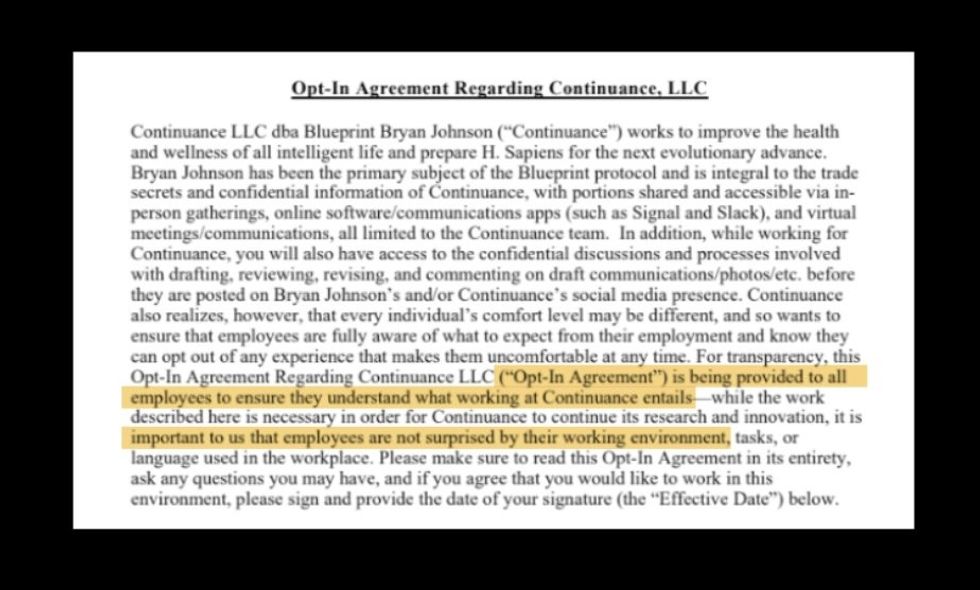 Blueprint’s transparency agreement X/ bryan_johnson
Johnson maintains that the agreements ensure clarity for employees and prevent misunderstandings about the unique work culture at Blueprint. “If someone doesn’t align with our culture, they are free to work elsewhere. No one is forced to sign anything,” he said.
He further emphasized that NDAs are common in business, particularly for high-profile figures like himself, and that they help to maintain trust and establish boundaries. “Confidentiality agreements try to create clear boundaries and expectations, so that trust isn’t left to chance,” Johnson explained, adding that his agreements are constantly evolving to ensure precision.
The New York Times report also delved into Johnson’s personal life, including details about his past experiences with drugs such as LSD, DMT, and Ibogaine, as well as his high-profile divorce and use of prostitutes. However, Johnson dismissed these revelations as irrelevant to the broader narrative, framing them as part of the Times’ unsuccessful attempt to tarnish his reputation.
In his post on X, Johnson claimed that the New York Times' article was intended as a takedown but ended up reading more like a profile piece. “What was supposed to be a takedown ended up reading more like a profile piece,” he wrote, thanking the newspaper sarcastically for the coverage.
Despite the mounting accusations, Johnson remains defiant, asserting that his lifestyle and business practices reflect his commitment to innovation and transparency. His dedication to longevity research, which reportedly costs him $2 million annually, remains a key focus of his public persona. Johnson insists that his workplace culture, while unconventional, is designed to foster honesty and openness, not to alienate employees.
As the allegations continue to unfold, Johnson’s reputation as a tech visionary is being tested. While his commitment to longevity and personal health remains unwavering, the scrutiny surrounding his behaviour and treatment of employees may have lasting implications for both his business and public image.