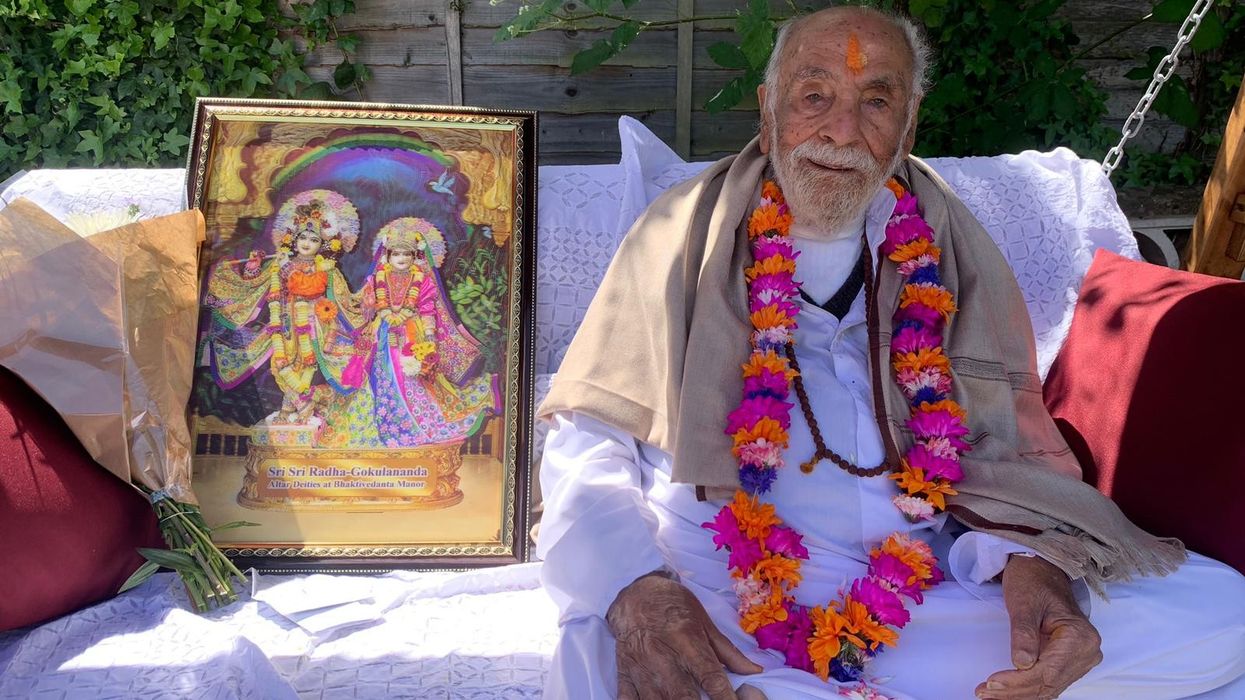

BRITAIN’S Asian community is mourning the loss of a respected community and spiritual leader, Pujya Rambapa, following his passing on Tuesday (31), aged 102.
Rambapa, as he was fondly known, dedicated his life to the spread of Hinduism, spirituality as well as charitable and philanthropic activities in the UK and India, where he was from.
He was the first to introduce spiritual leaders, such as Pujya Morari Bapu, to the UK’s Asian community, who attended their kathas or religious discourses.
Rambapa also helped in the establishment of 70 temples in the UK and abroad, through the donation of life-sized marble deities.
He was born as Maganlal Vallabhdas Bhimjiyani in Jira village in Gujarat’s Saurashtra to Vallabhdas Bhimjiani on May 28, 1920. As a young boy, he became a devotee of Hanuman and studied the ancient Hindu text, the Ramayana.
Aged 10, he moved to Uganda where he met his guru, Pujya Shree Hirjibapa, who he served for the next 40 years. He helped set up the Sanatan Hindu Temple in Kampala which today still holds weekly Hanuman Chalisa Yagnas.
In 1970, Rambapa moved to London with his family and founded the Shree Jignyasu Satsang Mandal to promote Hinduism.
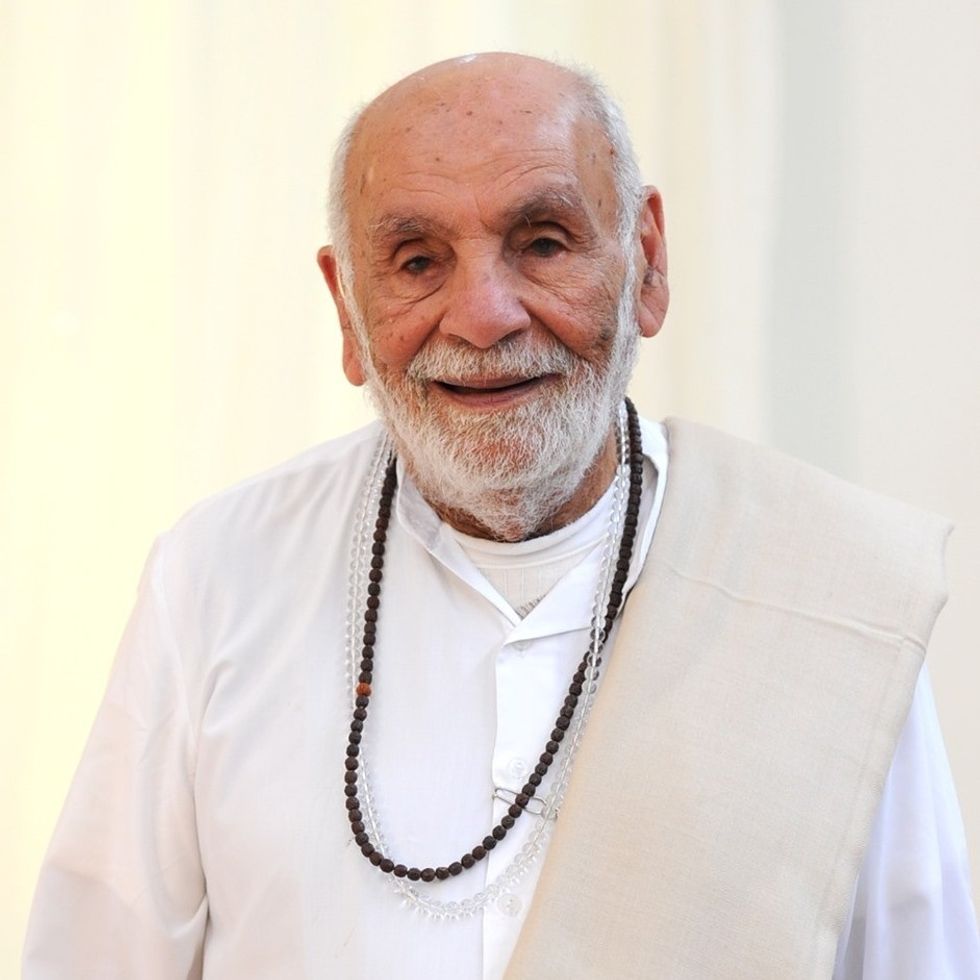 Pujya Rambapa
He travelled to India where he commissioned sculptors to create a true likeness of Hindu deities, which were later installed in temples, community centres, prisons and private homes in the UK and abroad.
Among the temples which received the life size sculptures are the Hare Krishna Mandir (Watford), the Sindhi Community Centre (Cricklewood), Sri Ram Mandir (Southhall), Krishna Mandir (Leamington Spa), Shree Sanatan Mandir (Preston), Bristol Hindu Mandir (Bristol), Shree Jalaram Mandir (Greenford), Sanatan Mandir (Crawley) and Krishna Mandir (Cheltenham).
Deities were also donated to establish temples in Germany, Spain, Italy, Portugal, North America, Guyana, Kenya, Barbados and Ghana and Uganda.
In 2007 Rambapa worked with HM Prisons Service, to help set up Hindu temples in prisons where inmates could offer prayers. The first of these was established in 2007 at Wormwood Scrubs prison, where Hindu inmates also received the copies of the Hanuman Chalisa and Bhagvad Gita in English from Rambapa
Many communities in the UK benefited from financial support from his efforts over the past five decades.
Pujya Rambapa, through the Shree Jignyasu Satsang Mandal, the Divya Seva Foundation (UK), and well-wishers provided a month's worth of foodgrains to 1,001 needy families displaced following a cyclone in Gujarat in 2021. A sum of £11,000 was also donated to India Prime Minister Narendra Modi's relief fund, and a further Rs 500,000 (£5,000) was donated to support those in need.
The Jignyasu Satsang Mandal also regularly organised recitations of the Ramayana, spiritual lectures, and the 108 Hanuman Chalisa, for 30 years and they remain popular all over the UK.
In an editorial of Garavi Gujarat newsweekly, the late founder and editor in chief of Eastern Eye’s sister title, Ramniklal Solanki, described Rambapa as the “Saint of the Thames”.
Despite his advanced years, Rambapa was an exemplary and tireless saint who spread the philosophy of spirituality, humanity, charity, and faith.
His birthday has been observed since 1970 as a day of prayer and selfless service, which his family and followers said they intend to continue.
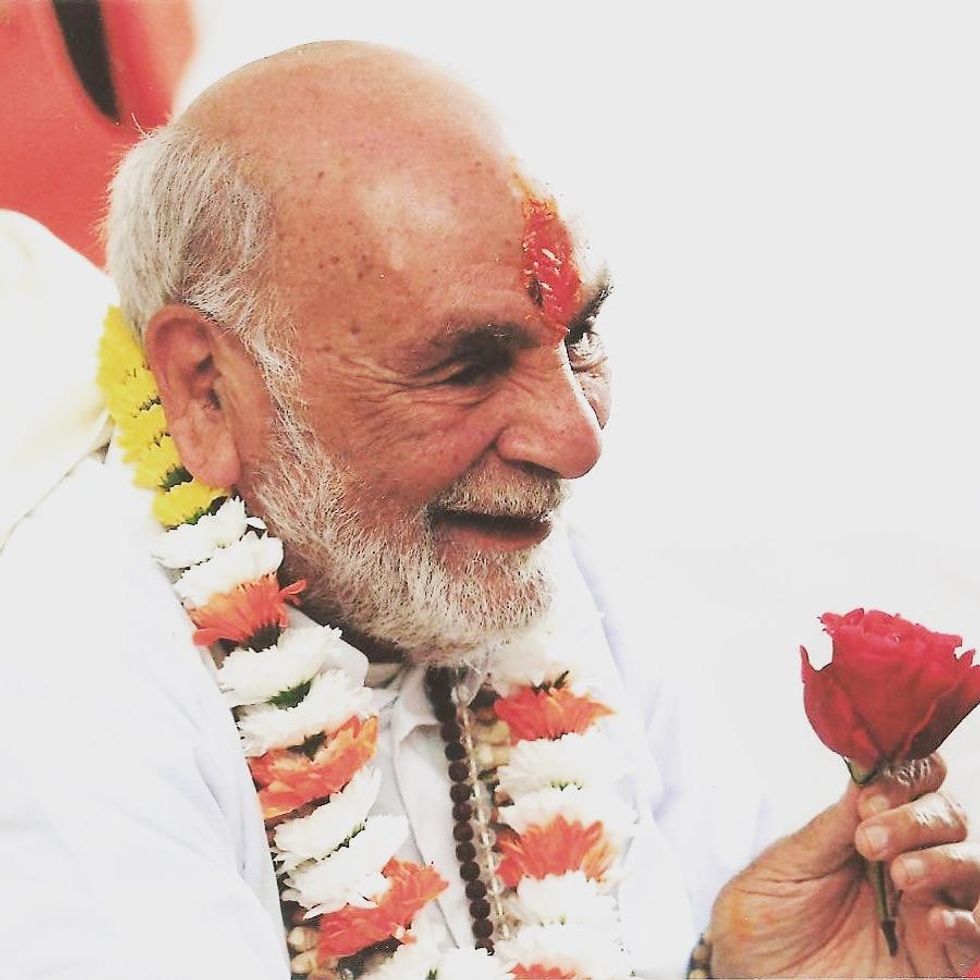 Rambapa
 also gave spiritual discourses at the House of Commons and in India his efforts included organising free food and medical camps at the Kumbh Mela. Here his Maruti Rambapa Seva Trust provided meals for thousands of underprivileged pilgrims and saints each day, for weeks at a time, with Rambapa serving them.
Two years ago, when he turned 100 in 2020, followers of Rambapa from all over the world, including the UK, the US, India, Australia and the UAE chanted prayers in his name.
During the Covid-19 pandemic, lockdown and social distancing restrictions meant Rambapa was unable to meet members of the community in person or give his blessings at satsang meetings.
In an interview with Garavi Gujarat, Rambapa said, “those who want to have darshan, even if they sit at home and close their eyes, they will have darshan of the lord and guru.”
At the recently held Asian Business Awards in November, hosted by Eastern Eye publishers, the Asian Media Group, Rambapa was awarded the Pearl of Uganda - Lifetime Achievement Award for his outstanding contribution to spirituality and the Asian community.
Well-wishers and devotees can leave personal messages and tributes at rambapa.muchloved.com.






 Curator Emma Slocombe with ikat robes and arabachi coats in the Peter the Great Room in Blickling Hall Amit Roy
 View of the entrance to Blickling Hall on a rainy autumn dayAmit Roy
 Kente cloth from Ghana in the Long Gallery in Blickling Hall
 Decoration in the Great Hall at Blickling Hall Amit Roy
 Palampore fragment made in coastal south-east India in the Brown Room in Blickling Hall Amit Roy
 Bed valance dating from early 1700s in the Italian Print Room at Blickling Hall Amit Roy
 Indian inspired fabric draped on sofas in the South Drawing Room in Blickling Hall Amit Roy
 Indian inspired fabric draped on sofas in the South Drawing Room with Indian carpet in Blickling Hall Amit Roy
 Karun Thakar has picked out the geometric patterns in the bookcase and the Kente cloth in the Long Gallery in Blickling Hall Amit Roy
 Large tapestry depicting Peter the Great defeating the Swedish army at the Battle of Poltava in 1709 Amit Roy
 ikat robes and arabachi coats in the Peter the Great Room in Blickling Hall Amit Roy
 Baghs and kanthas made by women provide contrast to the men only portraits in the Great Hall at Blickling Hall Amit Roy
 Baghs and kanthas in the entrance Great Hall at Blickling Hall Amit Roy
 Baghs and Kanthas in the Great Hall in harmony with stained glass window at Blickling Hall Amit Roy
 Kimonos reflect Japanese influence in Upper Ante Room in Blickling Hall Amit Roy
 Kimono in Upper Ante Room in Blickling Hall
 A view of the Palace and fort at Agra shows romantic side of India Amit Roy
 Blickling Hall Amit Roy
 Table carpet, European 1670-1680 Amit Roy
 Unfinished 17th century Italian embroidery in the Print Room at Blickling Hall Amit Roy
 Picture of Kashmir shows a romantic view of India Amit Roy
 A panel of Ashburnham bed hangings made in Gujarat for sale in Europe in the Brown Room in Blickling Hall Amit Roy
 Colcha made in the 1600s by women in Bengal for the Portuguese market in the Long Gallery at Blickling Hall Amit Roy




