

Highlights
- Matharu said immigrant families bring resilience, determination and a willingness to overcome challenges.
- Pavita Cooper highlighted barriers to diversity at the top of British companies and the need for men and women to work together.
- Dr Vijay Patel said entrepreneurs must adapt to challenges rather than give up, stressing humility, honesty and integrity in leadership.
RENOWNED Asian entrepreneur Tony Matharu said the experience of immigrants had shaped Britain's business community and called for greater recognition of the values, resilience and determination they brought to the country.
Speaking at a panel discussion at the Asian Business Awards last Friday (20), Matharu said labels such as immigrant, asylum seeker and refugee had acquired negative connotations, even though many British families had similar histories.
"My mother is all three. She fled the Partition and had to seek refuge and asylum. Then she found herself in Kenya, where she migrated to, and then she moved from Kenya to England, where I was born," he said.
Matharu, founder of Integrity International Group and Blue Orchid Hospitality, said he was born and brought up in London, but believed the experiences of earlier generations continued to influence families across Britain.
"Nearly all of us, if not all of us, can see that in ourselves one generation or two generations ago, or maybe even on the stage today," he said.
He added that the common values among immigrant families went beyond cultural identity.
"The resilience, the passion, the willingness to give to others and to overcome obstacles and challenges, is something we recognise in this room," he said.
The discussion, hosted by broadcaster Nikki Bedi, also featured Pavita Cooper, chair of the British Fashion Council, and Dr Vijay Patel OBE, co-chairman of Waymade Capital.
Asked about his decision to convert vacant office buildings into hotels in the 1980s, Matharu said he had recognised a gap in the hospitality market.
He said existing hotels were not always suited to the changing requirements of travellers and business delegates. Repurposing office buildings offered an opportunity to create accommodation that met those needs.
"I wasn't constrained by the inhibitions of the establishment of that time," he said.
Matharu's family business includes a substantial London hotel portfolio, and he continues to focus on property development and the restoration of existing buildings through Integrity International Group.
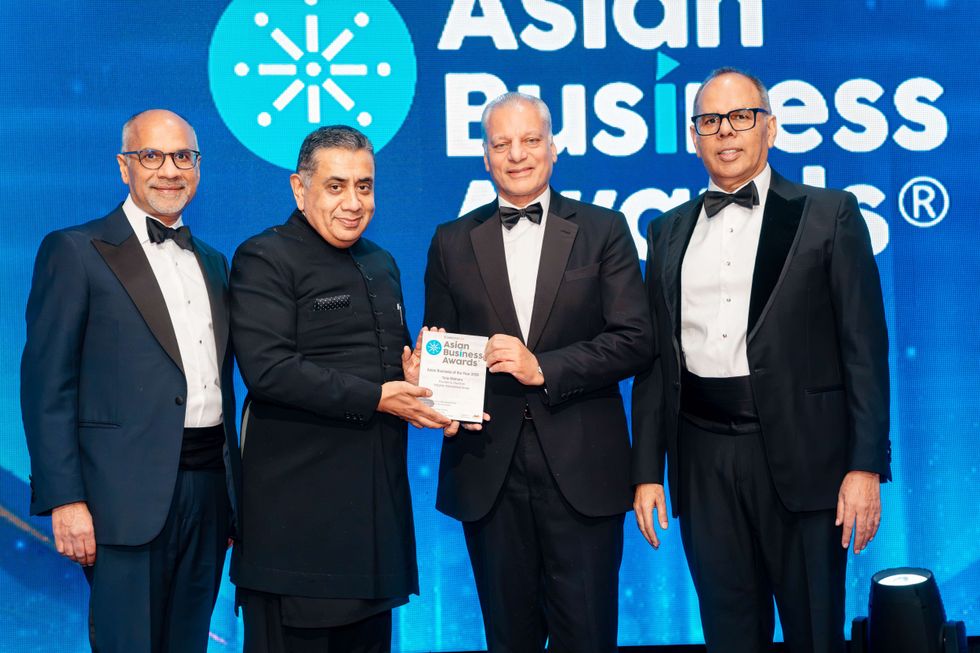 Tony Matharu, Founder and Chairman of Integrity International Group, receives the Asian Business of the Year, at the Asian Business Awards 2026. Pictured from left: Asian Media Group Executive Editor Shailesh Solanki, AMG non-executive director, Lord Tariq Ahmad, Tony Matharu and AMG Group Managing Editor Kalpesh Solanki. Eastern Eye
Cooper spoke about the importance of access and support in helping people progress in their careers. She recalled being awarded a scholarship to attend a private school, aged 11, and initially feeling out of place because she was the only pupil not wearing a uniform.
However, she said the opportunity had helped change her prospects.
Her corporate career included senior roles at Shell, Barclays and Lloyds Banking Group. Cooper said men played an important part in supporting her progress.
"Even though I'm a huge advocate for women, I strongly believe that change only happens when men and women work together," she said.
She highlighted the continuing lack of diversity at the highest levels of British business.
Describing the situation as a "snowy peak", Cooper said there were no black leaders among the top three positions of chair, chief executive or chief financial officer in FTSE 100 companies.
She referred to the Parker Review, which calls for FTSE 350 companies to have a leader of colour on their boards, but said progress had not been sufficient.
"It does not reflect the talent pool," she said, adding that women and leaders from ethnic minority backgrounds continued to face greater barriers in reaching senior positions.
Cooper said access to professional networks remained difficult and that traditional ideas of what a chief executive should look like could also limit opportunities.
Dr Patel, who built an international pharmaceutical business after opening his first pharmacy in Essex, said difficult periods were unavoidable in business.
He recalled the financial crisis of 2008-2009 and the changes businesses had to make following Brexit.
"But what entrepreneurs do is find a way. It's not to give up and walk away; you must find a way around it and continue with what you are doing, in a modified form," he said.
Patel began his business journey in 1975 with a £6,000 bank loan to open a pharmacy in Leigh-on-Sea. He later co-founded Waymade Healthcare and Amdipharm with his brother Bhikhu Patel, building a pharmaceutical business with an international presence.
Matharu said mistakes could provide valuable lessons, provided people were prepared to acknowledge them and make changes. He argued that businesses and public institutions should be willing to recognise failures rather than conceal them. "If you have values that don't change and principles that are not compromised, then that is your safety net," he said.
Cooper said she had sometimes remained too long in organisations where her approach to challenging established practices was not fully valued.
 Nikki Bedi Eastern Eye
Recalling advice from her father, she said: "Go where you're celebrated, not where you're tolerated."
She added that what she once regarded as a difficult aspect of her personality had become an advantage in her non-executive career, allowing her to campaign for change and influence organisations, government and the media.
Asked what qualities made a good leader, Patel said business owners should recognise the abilities of the people they employed and support their development.
He said leaders needed humility, honesty and integrity, and should create opportunities for the next generation of executives. Matharu agreed that building strong teams and setting an example were essential. He said recognising opportunities and making sacrifices to make the most of them were familiar experiences for many people from immigrant backgrounds.
Trust, he added, was fundamental to relationships, both personal and professional. Cooper concluded that effective leaders needed ambition as well as an understanding of the people they worked with.