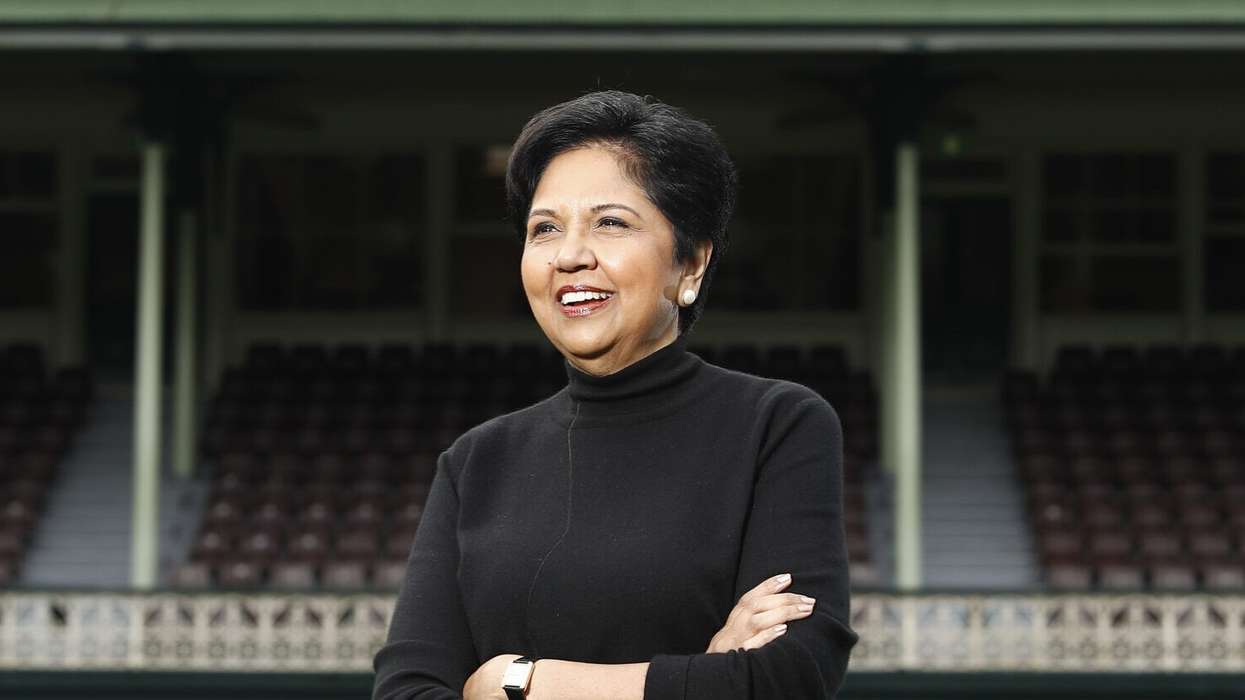

- Indra Nooyi said the US offered opportunities she believes she would not have found in India.
- Her comments comparing India's "chaos" with China's orderliness triggered mixed reactions online.
- The interview has reignited debate over meritocracy, democracy and leadership opportunities.
Former PepsiCo CEO Indra Nooyi has triggered a wide-ranging debate after comparing India, China and the US, saying America's merit-based system made it possible for her to become the head of one of the world's biggest companies.
Speaking during a conversation with former US Secretary of State Condoleezza Rice at the Hoover Institution, Nooyi reflected on leadership, innovation, governance and her own career journey. Her remarks quickly spread across social media, where they drew both support and criticism.
One of the most discussed moments came when Nooyi said she could never have become PepsiCo's chief executive anywhere other than the US, including in India.
"I could never have become CEO in any other country in the world, including in India... It's because the system here in America is a meritocratic system," she reportedly said. She added that her mentors focused on talent rather than gender or ethnicity and simply wanted "the best brains to rise to the top".
Nooyi also described herself as grateful to the US, saying the country had welcomed her and given her opportunities she believes would not have been available elsewhere.
India's 'chaos', China's order
The former PepsiCo chief also compared her experiences of India and China, describing each country through a different lens.
Speaking about India, Nooyi reportedly said its appeal lies in its unpredictability rather than order. "India is going to be impossible if you like clean, orderly living. The beauty of India is in its chaos," she said, adding that everyday scenes, such as cows walking through traffic, may seem unusual to visitors but are part of a rhythm that Indians instinctively understand.
By contrast, she described China as relatively homogeneous and easier for visitors to navigate. She also praised the country's centrally driven governance model for transforming it into a global economic power, while noting that India's democratic system naturally makes decision-making slower.
"India is still struggling to be a world power because democracy rules and progress is slow. But I am glad it is a democracy," she reportedly said.
At the same time, Nooyi stressed the importance of the India-US relationship, saying both countries need to better understand each other's perspectives. She also described India as a strategically important partner for the US amid growing geopolitical competition with China.
Praise, criticism and a wider conversation
The interview quickly sparked debate across social media.
Supporters argued that Nooyi had offered an honest assessment of India's infrastructure challenges and the opportunities available in the US. Some also agreed with her comments on meritocracy, saying strong work and innovation continue to be rewarded in the American business environment.
Others, however, felt her remarks painted too broad a picture. Some questioned whether her success could be attributed solely to meritocracy, while others argued India has produced many successful business leaders. Several users also criticised her description of India's "chaos", saying issues such as pollution, waste management and civic infrastructure should not be confused with cultural diversity.
Some commenters also pointed out that the US has its own social challenges, arguing that every country has strengths and weaknesses.
The discussion has since grown beyond Nooyi's personal experiences into a broader conversation about leadership, governance, democracy and whether career opportunities depend more on talent or the systems in which people work.