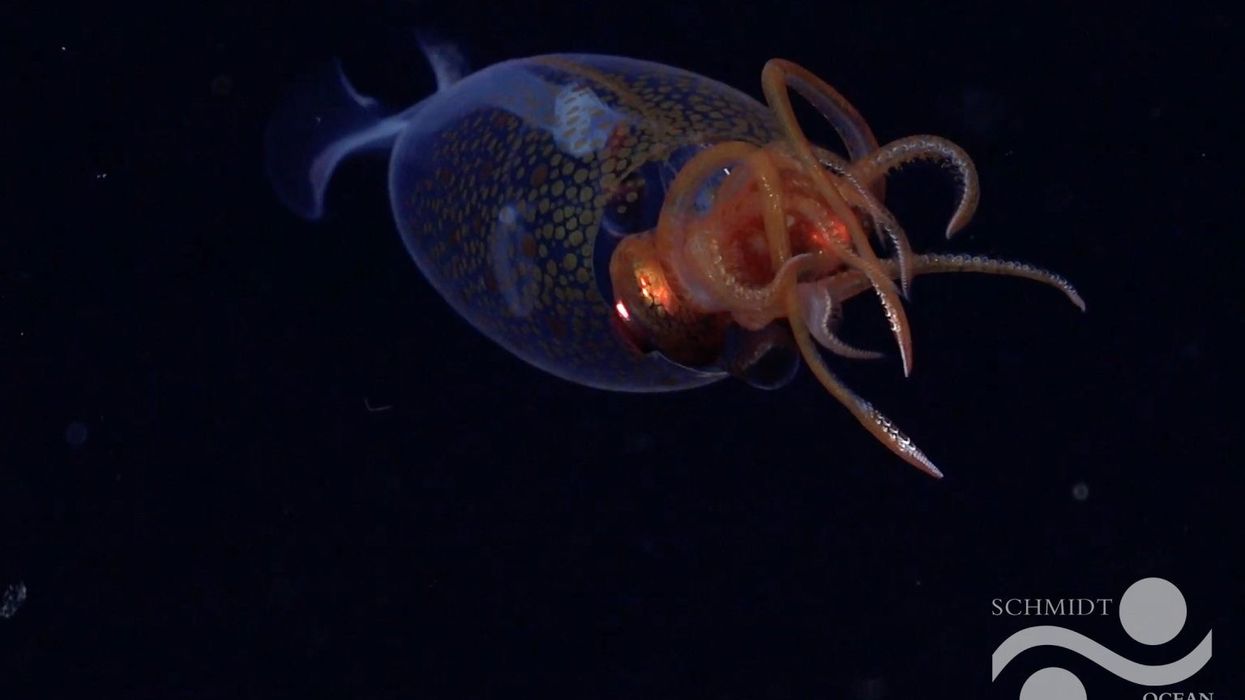

In a groundbreaking moment for marine biology, scientists have captured the first-ever footage of a colossal squid swimming in its natural deep-sea environment. The rare sighting marks a significant milestone in the study of one of the world’s most elusive sea creatures, nearly 100 years after it was first discovered.
The colossal squid (Mesonychoteuthis hamiltoni) is the largest invertebrate on Earth, capable of reaching lengths of up to 10 metres and weighing nearly half a metric tonne. It is also the largest known mollusc and possesses the biggest eyes of any known animal, measuring almost 30 centimetres in diameter.
Despite its impressive size and status, the colossal squid remains largely mysterious, as most scientific knowledge about the species has come from specimens found inside the stomachs of whales or caught accidentally in deep-sea fishing operations. Much of its life cycle and behaviour have remained unknown until now.
The Schmidt Ocean Institute has reported that a team of researchers on board its research vessel, Falkor, successfully recorded the squid during a recent month-long expedition near the South Sandwich Islands in the South Atlantic Ocean. On 9 March, at a depth of around 600 metres (1,968 feet), scientists deployed the remotely operated submersible SuBastian, which captured footage of a 30-centimetre-long juvenile colossal squid.
Dr Kat Bolstad, a marine biologist at Auckland University of Technology and an expert in squid and octopus species, verified the footage and described the moment as both exciting and humbling.
“It’s exciting to see the first in situ footage of a juvenile colossal and humbling to think that they have no idea that humans exist,” said Dr Bolstad.
She explained that for over a century, colossal squid have mostly been observed only as prey remains in the stomachs of whales and seabirds, or occasionally as predators of harvested toothfish.
- YouTubeSchmidt Ocean
The captured footage provides a rare opportunity to observe a living specimen in its natural habitat. One striking feature noted in juveniles is their transparent appearance, which gradually fades as they mature. This see-through quality had been previously observed in captured specimens, but never before seen in a living squid in the wild.
Another unique trait of the colossal squid is the presence of hooks located on the middle of their eight arms, which helps differentiate them from other deep-sea squid species such as Galiteuthis glacialis. This relative of the colossal squid was also recorded in deep-sea footage for the first time in January, near Antarctica, during a separate Schmidt Ocean Institute expedition.
Dr Jyotika Virmani, Executive Director of the Schmidt Ocean Institute, highlighted the significance of both discoveries.
“The first sighting of two different squids on back-to-back expeditions is remarkable and shows how little we have seen of the magnificent inhabitants of the Southern Ocean,” she said.
“These unforgettable moments continue to remind us that the Ocean is brimming with mysteries yet to be solved.”
The expedition near the South Sandwich Islands is part of ongoing efforts to map and explore remote regions of the deep ocean, particularly in the Southern Hemisphere, where vast areas remain unexplored and undocumented.
The footage of the colossal squid is expected to fuel further interest in deep-sea exploration and could provide critical insights into the ecology, behaviour, and development of the species. For scientists and ocean enthusiasts alike, the video is a powerful reminder of how much remains hidden beneath the waves and how far we still have to go in understanding the mysterious depths of our planet’s oceans.