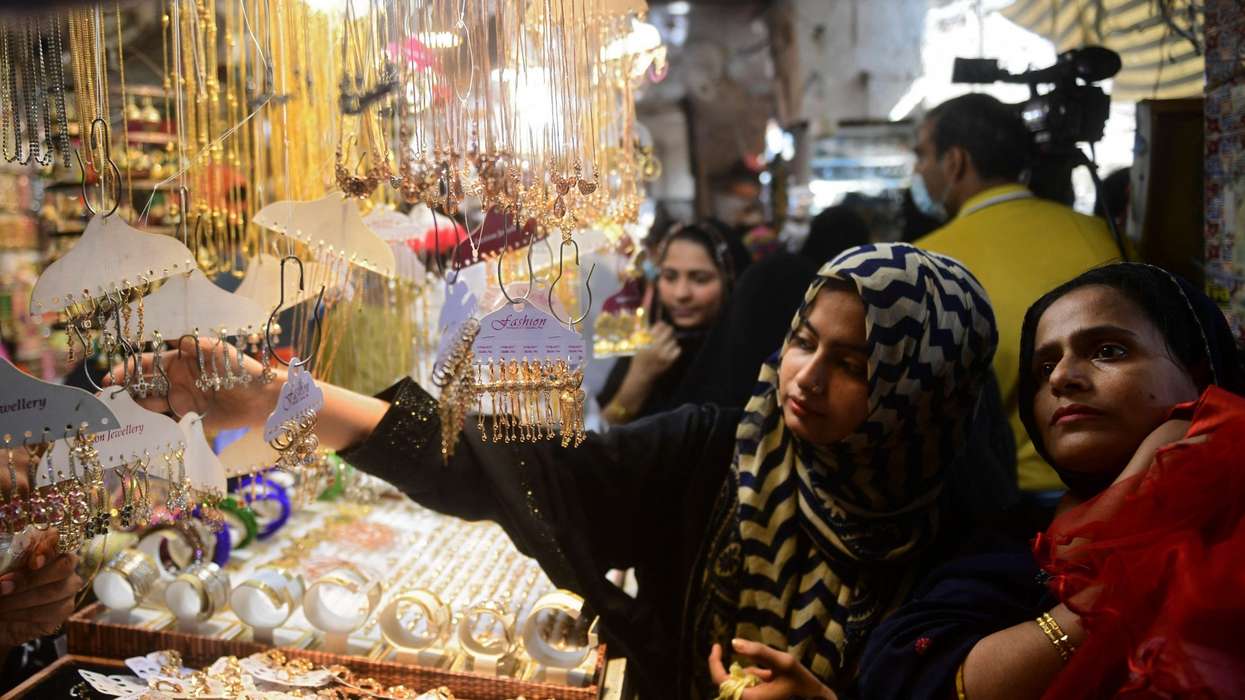

According to retailers, Pakistan's retail sales have experienced a significant decline in the lead-up to Eid al-Fitr compared to previous years, as shoppers struggle with the impact of historically high inflation.
Traditionally, the period leading up to Eid al-Fitr, which marks the end of the holy month of Ramadan and is expected to fall on Saturday (22) in Pakistan, is marked by the highest sales of the year. However, the country is currently grappling with a severe economic crisis.
Tariq Mehboob, chairman of the Chain Store Association Pakistan (CAP) and CEO of Royal Tag, a men's clothing brand, reported a 20% reduction in sales across all categories except for women's clothing.
The inflation rate reached 35% in March, triggered by a depreciating currency, a rollback in subsidies, and the imposition of higher tariffs to secure a bailout package of $1.1 billion from the International Monetary Fund.
In addition, food inflation has risen to more than 47%, forcing even the wealthier professional class to make lifestyle adjustments to cope with the escalating prices.
Asad Shafi, owner of Cross Stitch, a female clothing brand, said that Pakistanis have lost over 50% of their wealth in the last two years due to currency depreciation.
He added that as a result, fashion retailers' expectations are low, with even bare minimum sales deemed acceptable to stay afloat.
Asfandyar Farrukh, co-founder of the Chain Store Association Pakistan (CAP) and managing director of Hub, a leather goods store, noted that Eid shopping this year began earlier and peaked sooner, coinciding with salary pay days, as customers anticipated price increases.
Farrukh added that established brands are not seeing as significant a decline in revenue as local markets, as they cater more to upper-middle and upper-income customers.
Both Anarkali and Liberty Market, which typically cater to the middle and lower-middle class, have reported a decrease in customers this year ahead of Eid al-Fitr.
Ashraf Bhatti, president of the Anarkali Traders Association, stated that there has been a 50% reduction in Eid shopping this year, while Sohail Sarfaraz Mani, President of Liberty Market Traders Association, estimated the drop to be around 35%.
The decrease in sales contributes to the deceleration of Pakistan's $350 billion economy, which has struggled in recent months due to stringent stabilisation policies such as a historic high of 21% interest rates by the central bank.
Although Pakistan's economy is projected to grow by 2% this fiscal year, the World Bank reduced its growth projections for Pakistan from 2% to 0.4% in April.
With inputs from Reuters