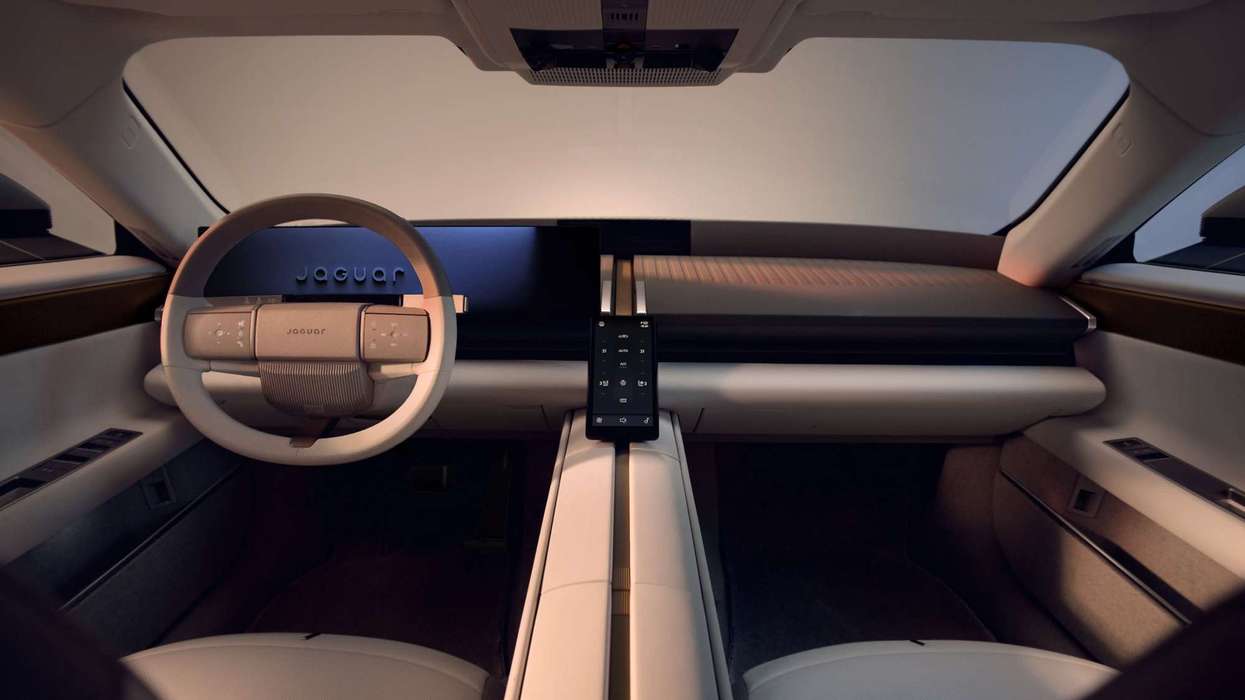

- Jaguar has revealed official interior images of the production Type 01, ahead of a full unveiling on 6 October in New York.
- The car has no rear window, no conventional rear-view mirror, and a full-length "central spine" running through the cabin.
- Type 01 is expected to start around $130,000, and it's the car Tata-owned Jaguar Land Rover is relying on to relaunch Jaguar as an all-electric luxury brand.
There's no rear window in the new Jaguar. No mirror bolted to the windscreen either. Look for a central touchscreen and you won't find one there. What Jaguar has built instead is a car that removes almost everything a driver expects to see, then dares you to call that a downgrade.
That car is the Type 01, and Jaguar has just shown its interior for the first time without camouflage, ahead of a full unveiling on 6 October in New York. It's a bigger moment than one car launch usually is. Type 01 is what Jaguar's Indian owner, Tata Motors, is depending on to justify one of the most drastic calls in the company's history: pausing Jaguar's entire legacy lineup, sales included, to relaunch the brand from nothing as an electric-only, ultra-premium marque.
Get this car wrong, and there's no fallback range sitting behind it to fall back on.
A cabin built to match a divisive exterior
The interior traces straight back to the Type 00 concept Jaguar unveiled in "Miami Pink" at Miami Art Week in 2024, a car that split opinion so sharply online that "Copy Nothing", Jaguar's own rebrand tagline, briefly became a punchline aimed right back at the brand. The production cabin hasn't backed away from any of it. A dramatic full-length central spine, which Jaguar calls a "signature art piece," runs the length of the car. Four individual seats replace a traditional bench. Most functions stay hidden until needed, under what the brand calls "technology on demand."
Jaguar boss Rawdon Glover isn't shying away from the reaction either. "Unmistakable from every angle," he said of the car, adding: "the interior is no different." That's as close to owning the controversy as a car company gets.
So what replaces all the things Jaguar took out? Not much, on purpose. There's a curved digital instrument cluster ahead of a two-spoke steering wheel, and a small vertical touchscreen lower on the dash for climate and audio. No passenger screen. No sprawling central display. Where most premium EVs are piling on screens, Jaguar has gone the other way entirely.
The missing mirror is the detail people keep coming back to. In its place sits a "ClearSight Rear View Display," a screen built into the base of the windscreen, positioned deliberately level with the door mirrors so a driver's eyes don't have to travel far to use it. Jaguar's reasoning is that it keeps attention forward. Whether owners agree once they're actually driving one is a different question, and one nobody outside Jaguar has answered yet.
Underneath the design statement, there's real firepower. Reports point to around 1,000 horsepower on the range-topping version, with 0-62mph arriving in roughly 3.3 seconds. Pricing is expected to start near $130,000, a figure that puts Type 01 somewhere Jaguar has rarely gone before, outside a handful of limited editions.
The bet sitting underneath the design
Jaguar Land Rover has belonged to India's Tata Motors since 2008, and Type 01 sits right at the centre of the biggest UK bet Tata has made in years. Most car makers ease an electric model in alongside the range that's already selling. JLR chose the opposite: wind down Jaguar's existing lineup first, then rebuild the brand around cars like this one. UK dealers have spent the best part of a year with little beyond leftover stock to sell while they wait for Type 01 to actually arrive in showrooms.
That's the part of this story that doesn't show up in a photo of a dashboard. Two more electric Jaguars are reportedly lined up to follow Type 01 fairly quickly. Which means how this exact car lands in October, loved, mocked, or somewhere uncomfortably in between, isn't just a verdict on one dashboard with no mirror. It's the first real read on whether Tata's biggest bet on British luxury actually pays off.