
- Imperial College London and IISc Bengaluru to develop magnet-guided nanorobots
- Tiny motors inside synthetic cells could deliver drugs to precise locations
- Approach could mean lower doses and fewer side effects
- Project funded by Imperial's India Connect Fund
Scientists in Britain and India are developing tiny robots that can be steered through the body using magnets, in a project that could lead to more precise ways of delivering medicines.
The collaboration between Imperial College London and the Indian Institute of Science (IISc) in Bengaluru, announced this week, combines synthetic biology with nanorobotics to create microscopic systems that can move, carry materials and release them at specific locations.
How it would work
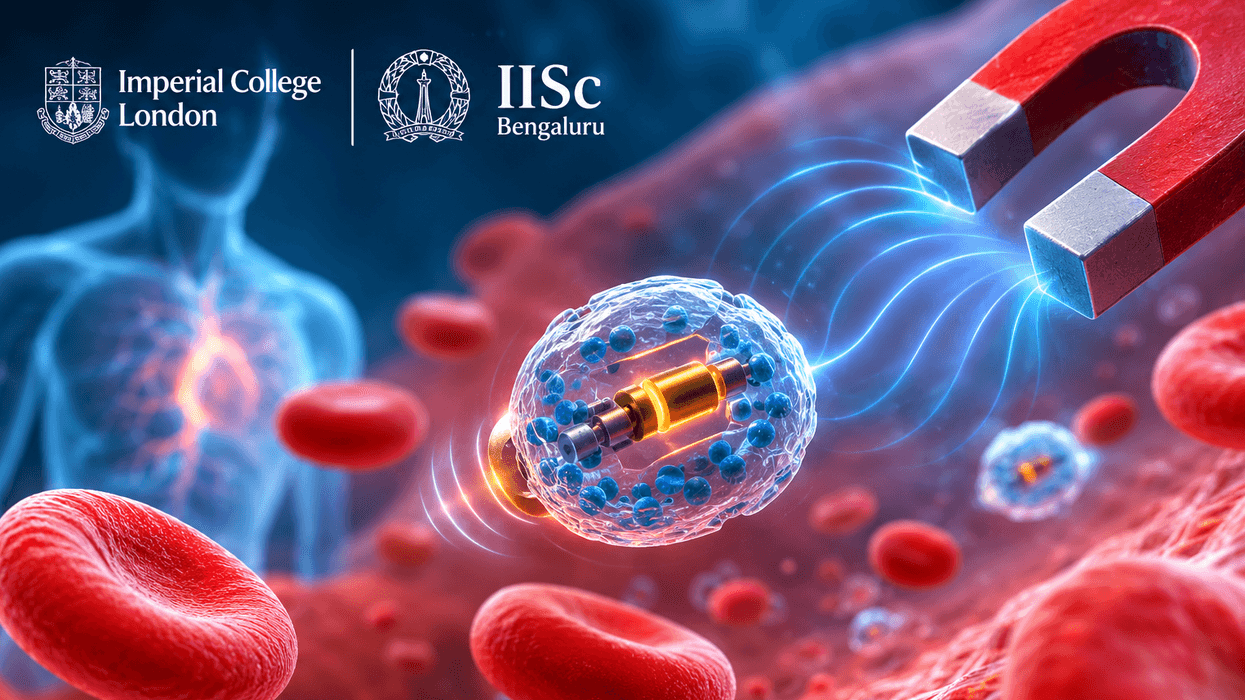
The team plans to place magnetic nanomotors inside synthetic cells, engineered structures that mimic some functions of living cells. The motors would act like tiny engines, allowing the cell-like compartments to be guided by external magnetic fields.
Most synthetic cells cannot move on their own. The researchers hope that adding magnetic motors will allow them to travel to a chosen target and carry out tasks there.
Fewer side effects
When drugs enter the bloodstream, they can spread throughout the body and cause unwanted side effects. Guiding medicines precisely to where they are needed could mean lower doses and fewer side effects, the researchers said.
The technology could also be used for biosensing and environmental monitoring.
'A platform that can be guided to a target'
Professor Ambarish Ghosh, an expert in magnetic nanorobotics at IISc, said his team had learnt how to steer nanorobots through blood, tissue and even inside living cells, but that they were inorganic.
"Dr Contini's synthetic cells can carry and release cargo in ways an inorganic robot cannot. Together they give us a platform that can be guided to a target and made to act there," he said.
Dr Claudia Contini, from Imperial's Department of Life Sciences, said: "Adding magnetic nanomotors could give these systems a new ability to move and respond to their surroundings."
She described Ghosh and his team as "internationally recognised" for developing magnetic nanorobots that work in complex biological environments.
The project is supported by Imperial's India Connect Fund, with the two institutions sharing expertise, training and facilities. It aims to build a long-term research partnership between the UK and India.
(With inputs from PTI)