
Highlights:
- Amrita Khanna and Gursi Singh make their LFW debut
- Bata chappals become sculptural heels
- “Adarsh Balak” inspires eveningwear
- Childhood schoolbook drawings become fashion
- The designers revisit pre-digital India
Fifteen minutes after their London Fashion Week debut, Amrita Khanna and Gursi Singh were backstage at Lindley Hall in Victoria, still trying to process what had just happened.
The Delhi-based designers and real-life partners had presented their Spring/Summer 2027 collection, India: IYKYK, to a room filled with international press, buyers, models and friends of the label.
Singh was dressed in a black knit turtleneck and jeans. Khanna wore a voluminous shirt with her signature silver chain-link jewelry. Around them, models were changing and the backstage crew was dismantling the show equipment. While talking to Nodmag, Singh joked "I think I need a drink.”
“Yes, me too,” Khanna replied. “I don’t think it has hit me yet. This all just feels too surreal and overwhelming.”
The collection they had just presented was deeply personal. Instead of looking at India through the familiar lens of elaborate occasionwear, the designers went back to the everyday visual memories of the 1960s, 1970s and 1980s.
Looking back at an India before the internet
For Khanna and Singh, the starting point was a world where images were made by hand.
Before digital printing became commonplace, shop signs, billboards, and photo studio backdrops were often painted manually. Those details became the foundation for their London collection.
“There is so much talk about the handmade and craft,” Singh said. “With this collection, we wanted to explore the world that existed before digital printing: when signs, billboards, and photo studio backdrops were all painted by hand.”
Khanna found another connection to childhood.
“We all have that one memory of being forced to do it as kids,” she said.
That memory also gave the designers a way to connect India's handmade traditions with a much more contemporary conversation around technology and artificial intelligence.
As creative industries increasingly debate what happens when machines can generate images and ideas in seconds, Khanna and Singh looked back at a time when making something by hand was simply part of everyday life.
The Bata chappal becomes a fashion statement
One of their most recognizable references came from something far less glamorous: the Bata chappal.
The designers transformed the ubiquitous Indian footwear into kitten heels, giving an everyday object a completely different silhouette.
A black band around the ankle added another familiar Indian detail, referencing the practice of using black to ward off the evil eye.
The idea captures how Khanna and Singh approached the entire collection. They were not searching for exotic references or grand symbols of India. They were looking at things people had grown up seeing.
The result was fashion that could carry a private memory into an international setting.
From schoolbooks to the runway
The designers also reached into childhood classrooms.
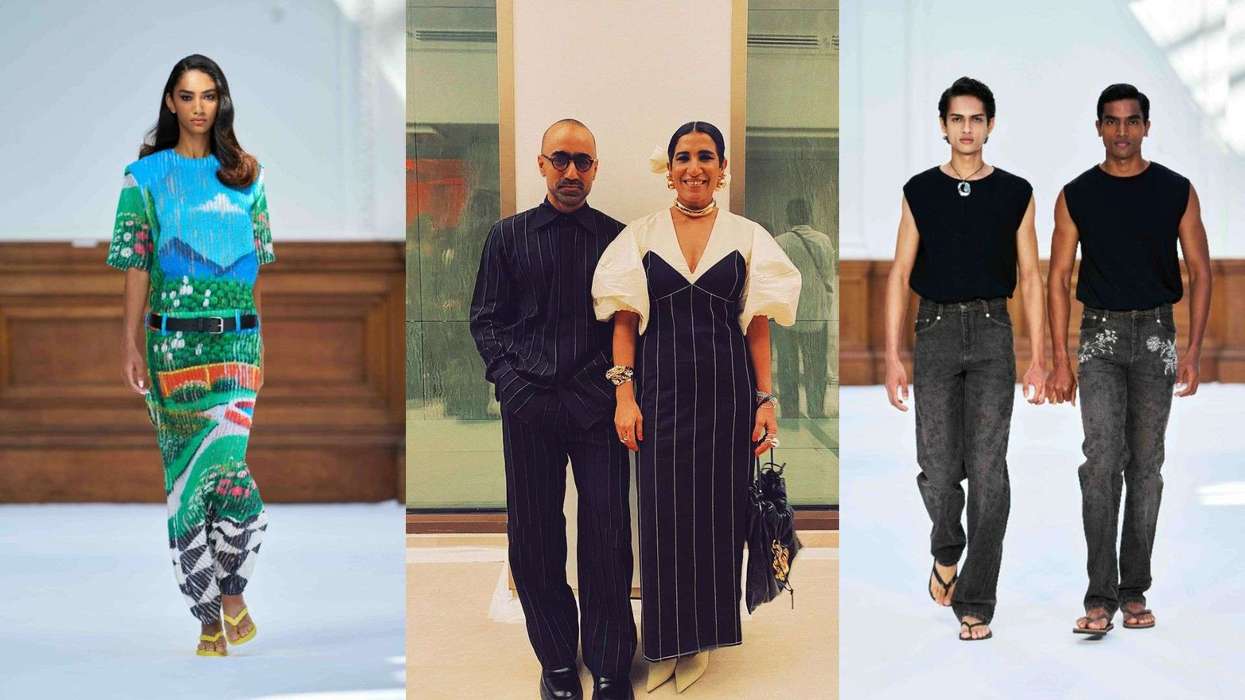
An illustration of a human ear, taken from a primary school textbook, became a major motif on a blouse. A graphic of lips appeared on a skirt.
Then came the Adarsh Balak imagery.
The Seventies-era posters and comic charts depicting the expectations of an “ideal boy” from a middle-class Indian household became graphics for deconstructed eveningwear, styled with an obi belt.
The references were specific enough to feel instantly familiar to an Indian audience while appearing unexpected to viewers encountering them for the first time.
A memory of their mothers
One of the collection's opening looks carried an even more intimate reference.
A model walked out in a silk bra and sheer petticoat decorated with floral embroidery, her hair styled into a voluminous 1960s bouffant.
Singh described it as one of his favorite looks because it reminded him of seeing their mothers in the moment before they put on their saris.
That memory turned the look into something more than a retro reference. It captured a private domestic moment and placed it on an international runway.
Their India was also playful
Khanna and Singh's approach was not limited to nostalgia.
Menswear included sleeveless vests with embroidered pants, white jackets with block-print panels, and chintz shorts. Denim became a canvas for embroidery and graphic treatments.
One of the most unexpected moments featured two male models in matching black muscle tees and embroidered gray denim, walking with their pinkies locked.
The show notes imagined them as two men crossing a market while discussing the price of onions.
It was ordinary, slightly funny, and unmistakably grounded in everyday Indian life.
Taking Indian visual culture beyond occasionwear
Khanna and Singh's London debut arrives during a period when Indian designers are increasingly presenting work internationally without relying solely on traditional occasion wear.
Their collection instead asked what happens when Indian fashion draws from the things people see every day: footwear, textbooks, painted advertisements, family photographs, and memories of childhood.
That is what made India: IYKYK feel personal.
For Khanna and Singh, the London runway was not simply a place to introduce a new collection. It became a way to take pieces of the India they remember, sometimes glamorous, sometimes ordinary, and often deeply specific, and let an international audience see them differently.