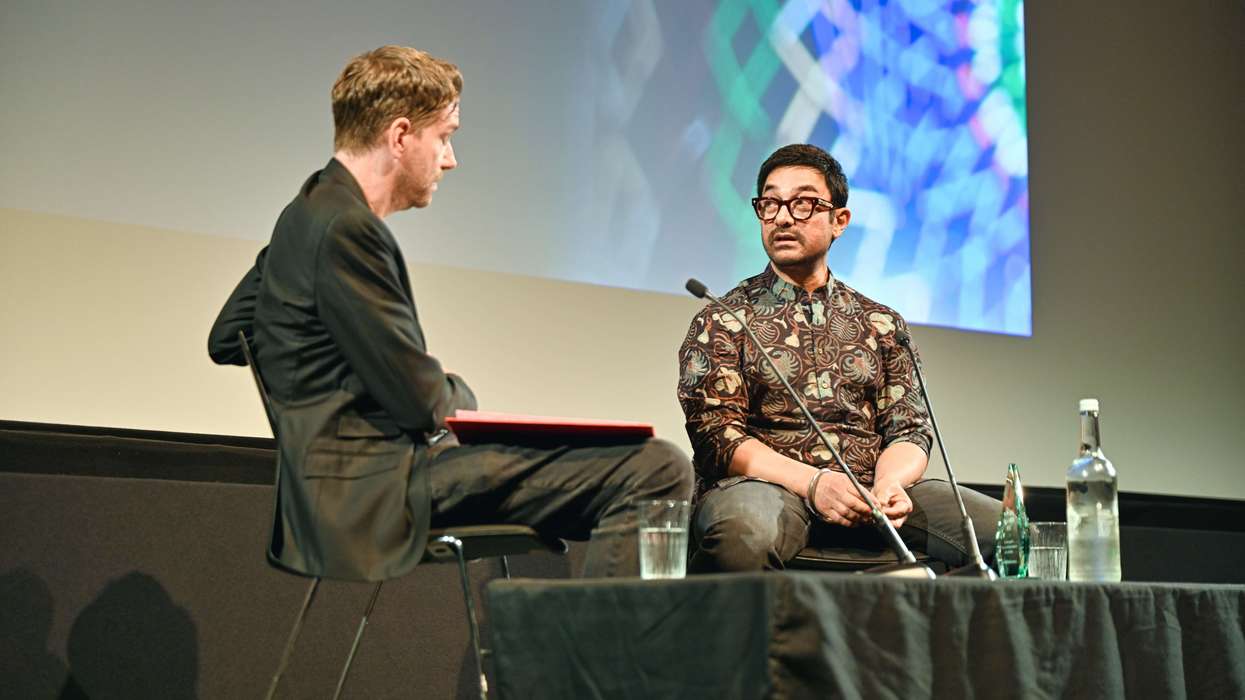
BOLLYWOOD superstar Aamir Khan traced his journey from a nervous Gujarati stage debutant to one of Indian cinema’s most bankable names, in a rare on-stage conversation at BFI Southbank last Thursday (16).
Khan was in the city to mark 25 years since the release of his Oscar-nominated film LagaanLagaan, at the 17th London Indian Film Festival. The star was presented the festival’s “Outstanding Achievement Icon award at the closing gala last week.
In an interview with film and television critic, Mike McCahill, Khan recalled his earliest brush with acting came not through film, but theatre.
While a student at Narsee Monjee College in Mumbai, he worked backstage for a Gujarati theatre group, “buying costumes, giving tea,” before an unexpected vacancy pushed him into a role. “The actor couldn’t do the show at the last minute. I got my first break as an actor because until then you’re just backstage,” he said.
Khan identified an earlier, quieter moment as his true turning point.
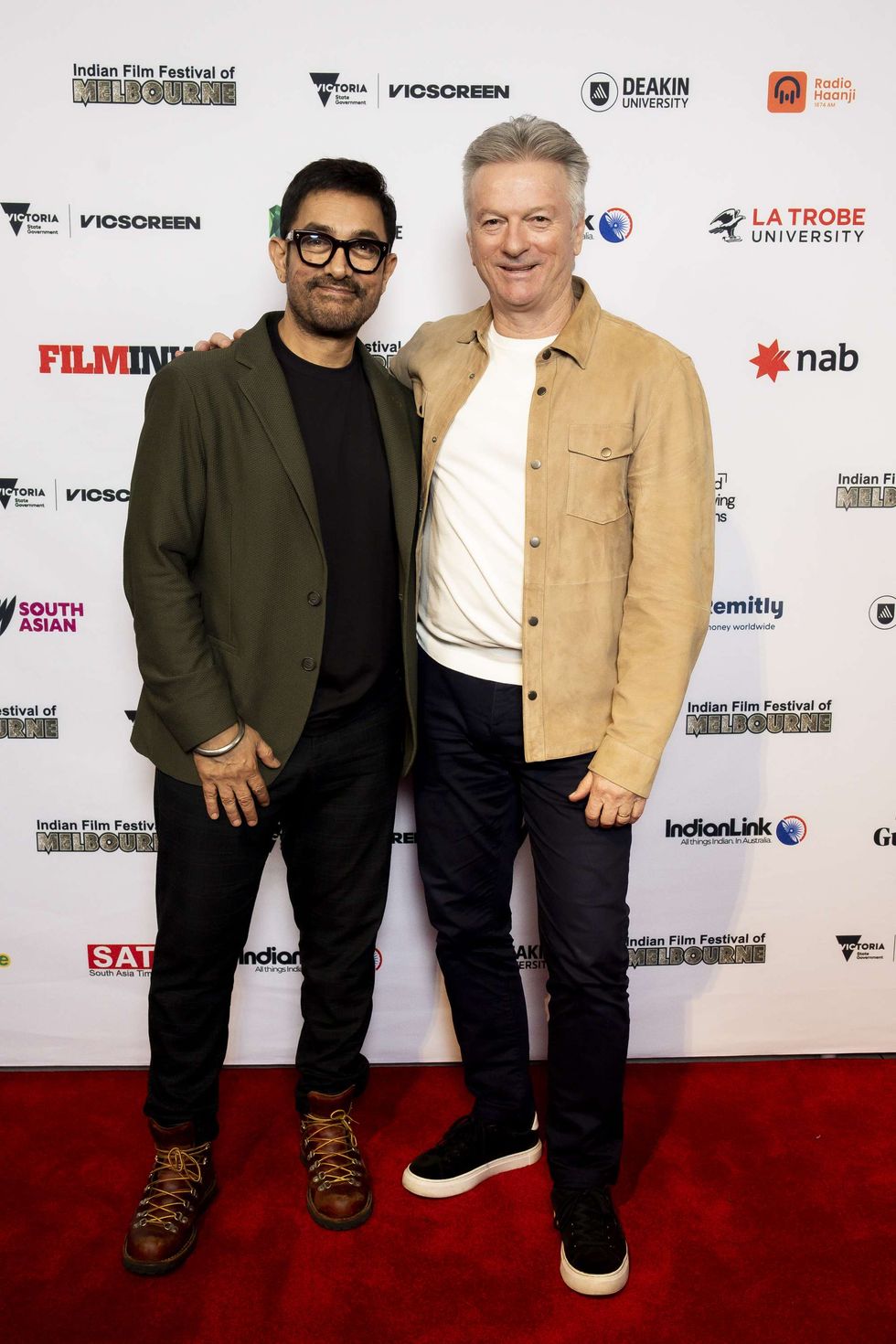 With Steve Waugh at a special 25th anniversary screening of Lagaan in Melbourne on July 9Sam Tabone/Getty Images
Aged around 15, he helped a friend, Aditya Bhattacharya, shoot a short film called Paranoia during the school holidays. “That one month of trying to grapple with telling a story is what really got me interested in films,” Khan said. “That’s when I knew this is the world I want to live in.”
His father and uncle were both film makers, and Khan grew up watching writers and directors debate scripts in his father’s living room, though he “never imagined” going into films himself. His parents actively discouraged him, wary of “a very volatile profession” in which “you can be successful one day and the next day you’re nobody,” he said.
Khan’s first film credit as an adult was in Ketan Mehta’s 1984 film Holi, which he joined chiefly out of curiosity about a Steadicam, then a novelty in Indian film making, that never arrived on set. “That film I did as an actor, but more as an assistant, to be honest,” he said.
Pushed on whether the Hindi film industry of the 1980s and 1990s deserved its popular reputation as a golden age, Khan disagreed, saying, “For me, the golden era of Indian cinema is the 1950s and 1960s”, while praising the writers, composers and actors of that period.
He was candid about the decade when he began working: “As an audience, the 1980s was the lowest point. The writing had gone to pieces.”
However, contemporaries such as Aditya Chopra, Sooraj Barjatya and Rajkumar Santoshi “turned the wheel back into better films” from the late 1980s, the actor said.
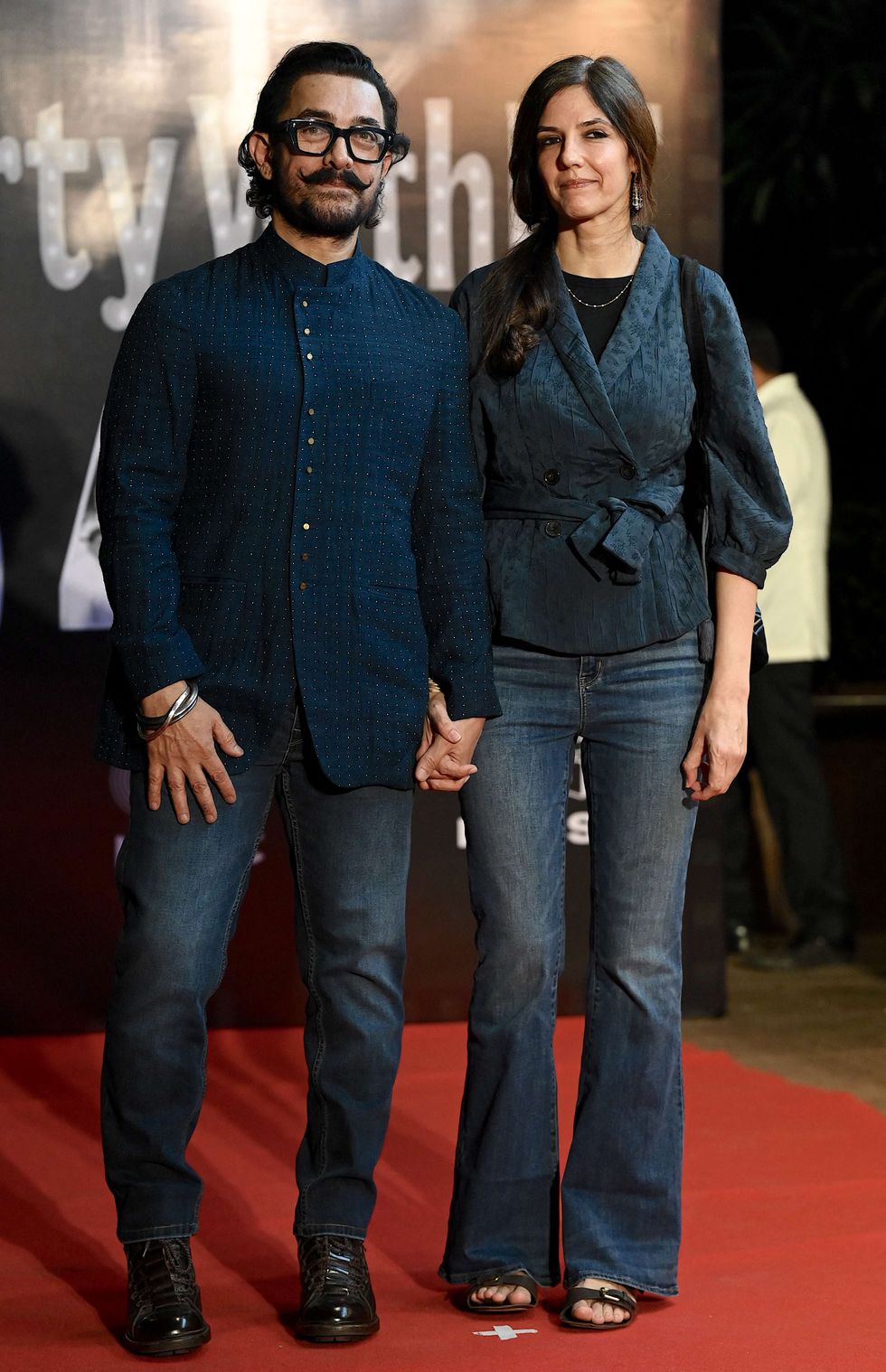 With Gauri Spratt Sujit Jaiswal/AFP via Getty Images
Khan’s breakout role was in the hit, Qayamat Se Qayamat Tak (1988), but, overlooked by directors he most admired, he signed roughly eight to ten films with directors he barely knew. “I really shouldn’t have been doing these films,” he said, recalling how budget constraints meant a script’s imagined Kashmir backdrop could end up filmed against “two small hills” at a Mumbai studio. Those films were released one after another and largely failed. “I suddenly got labelled a one-film wonder,” Khan said, “and with each film coming out, I’m kind of sinking further.”
At that low point, director Mahesh Bhatt, riding high after the success of films such as Arth, Saaransh and Naam, offered him a script. Badly needing the lift a Bhatt film would bring, Khan, who didn’t like the script asked for a night to think it over.
“I couldn’t sleep all night,” he recalled, and turned the film down the following evening, bracing for Bhatt never to work with him again.
“Had I compromised that day, I think my entire career would have been a series of compromises,” Khan said. “When I could stick to what I believed in at my worst, it gave me a lot of strength.”
That episode, he said, crystallised the three things he now weighs before signing any project: a strong script, a director whose sensibility matches his own, and a producer willing to resource and release the film properly. “Filmmaking is a director’s medium,” he said. “Unless you have complete faith in the director... you’re going to end up imagining you’re going in one direction” while the film goes elsewhere.”
Much of the evening centred on Lagaan, which marked its 25th anniversary this year and was screened at BFI IMAX on July 12 as part of the festival.
Khan, who produced the film, called it “a huge risk” and “a very tough shoot,” recalling a near-daily crisis on set and a running conversation with director Ashu tosh Gowariker about a scene, ultimately cut, in which his character confesses his doubts to his mother on the eve of the climactic match. Khan said the script’s depiction of “the undying human spirit” drew him to a project he never expected to be discussing 25 years later.
Lagaan received an Oscar nomination in 2002 in the best foreign language film category, but lost to No Man’s Land.
Khan credited the film’s refusal to second-guess its audience for its lasting ap peal, adding, “I like to go with what ex cites me.”
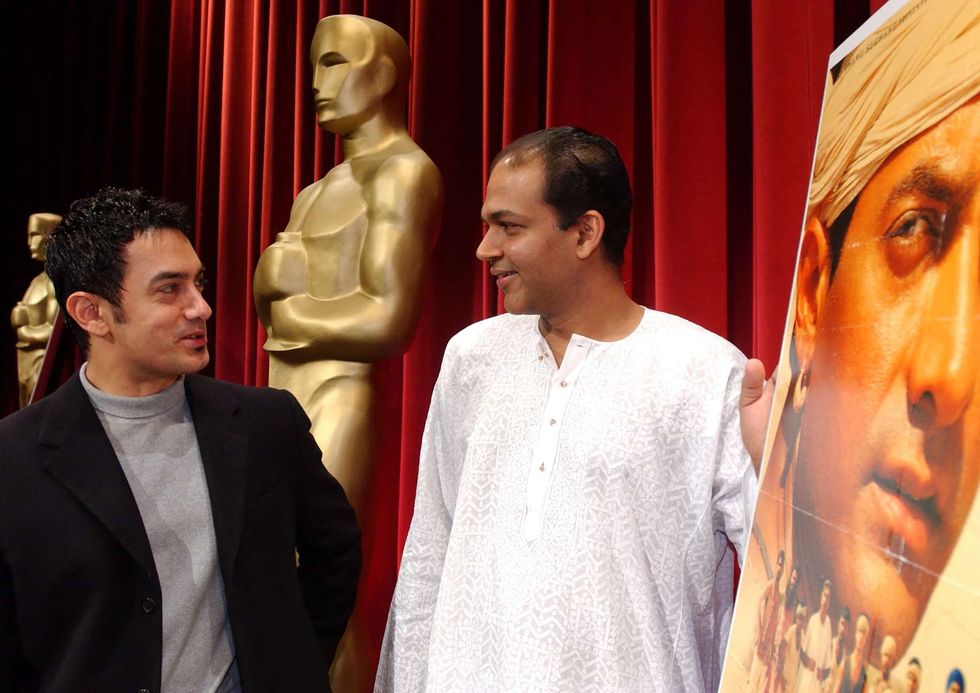 With Ashutosh Gowariker in 2002 Lucy Nichilson/AFP via Getty Images
The years immediately after Lagaan were harder than the film’s success suggested. “I was actually going through a personal crisis myself,” Khan said, of his divorce from his first wife, Reena Dutta, which unfolded as the film’s global reputation grew. “I wasn’t in a state of mind emotionally to work,” he said, adding that it took him several years to return fully to acting, with Mangal Pandey: The Rising in 2005.
Khan also looked back on subsequent hits, including Ghajini, 3 Idiots, Dhoom 3, PK and Dangal, each the highest-grossing Indian film of its year.
“I was really fortunate to have some great stories coming my way,” he said, though the pressure never fully lifted. “None of these films was ever meant to be a big success,” Khan said.
Asked if he craved the lighter work load of a character actor, he was unequivocal: “I enjoy a challenge. I get bored repeating myself.”
Khan also revealed he was never “much of a film watcher”.
“Some people play football, some people watch football. I just like to make films,” he said.
On directing child actors in Taare Zameen Par, a film he took over mid-pro duction, he said the young cast needed almost no guidance: “I didn’t have to tell them anything. The adults, I had to work a little bit on.”
Later, fielding questions from the audience, Khan was asked by British Asian actor and comedian, Sanjeev Bhaskar, what had sparked the social conscience running through so much of his work, from Lagaan to Taare Zameen Par to Satyamev Jayate.
Khan paid tribute to his mother, recalling how she gently made him see, after a childhood tennis win, that his defeated opponent would be facing the very same question from his own mother at home. “I never thought of that. Maybe I shouldn’t have won,” he recalled telling himself at the time. That habit of “thinking of the other,” he said, “kind of seeped into me, and over time it came out through my work.”
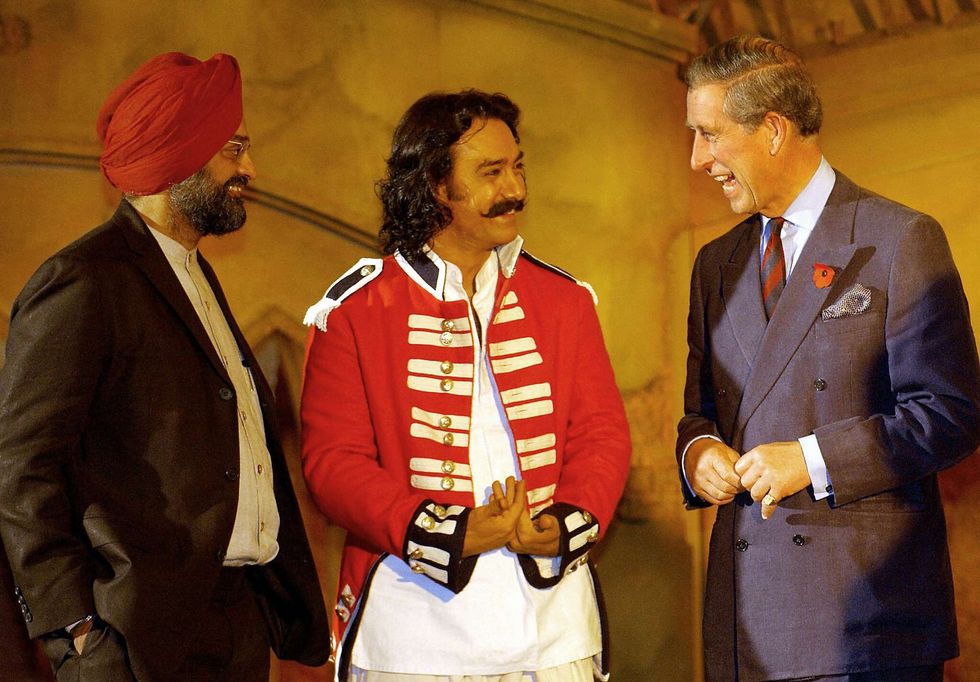 With producer Bobby Bedi and the then Prince Charles on the set of The Rising in Mumbai in 2003Rob Elliot/AFP via Getty Images
Khan also put to rest one of 3 Idiots’ enduring mysteries: whether his character, the eccentric inventor Phunsukh Wangdu, was based on educator and climate activist Sonam Wangchuk, who was until last week on a protest fast in India.
Khan called the long-held claim “a misconception”.
“I didn’t know about Mr Sonam at that time when we were doing this film 3 Idiots,” he said. “Neither Raju nor Abhijat, the writers of the film, nor I. We didn’t know about Mr Sonam.”
The question resurfaced after co-star Omi Vaidya, who played Chatur, shared a video backing Wangchuk’s recent hunger strike and linking the character to Wangchuk.
Khan disagreed: “I know that I saw the video of Chatur, just recently... he is wrong.”
He added that the claim took nothing away from Wangchuk’s work: “What Mr Sonam is doing is good work, in any case. He doesn’t have to be based on the char acter of 3 Idiots for us to respect him.”
On his own upcoming work, he confirmed only that a new film begins shooting in November, with preparation from August and an announcement “very soon”.
He gave no further detail, though the project is widely reported in the Indian press to be a Partition-era cricket drama reuniting him with Lagaan director Ashutosh Gowariker.
The London appearance came days after Khan’s wedding earlier this month to long-time partner Gauri Spratt in Mumbai.