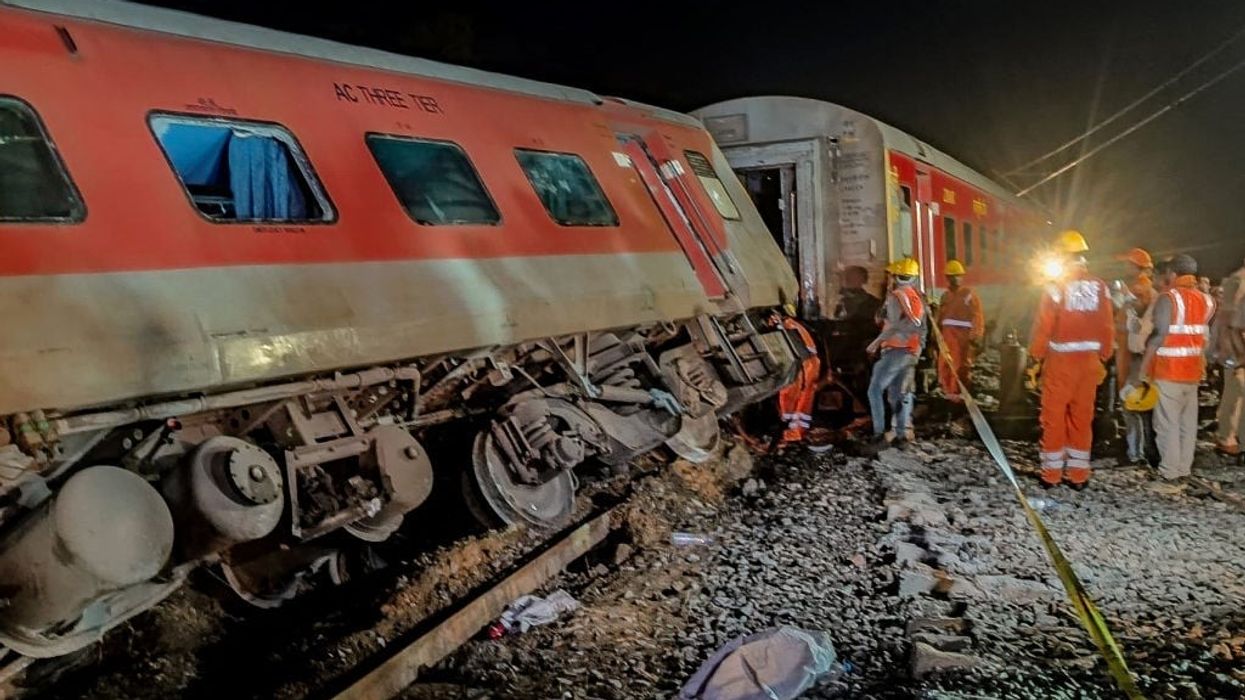

AN Indian passenger train derailed and overturned several of its cars on Thursday (18), killing at least two people and injuring 24 others with rescue and relief efforts ongoing.
India's railway network is the main form of travel in the vast country, but it is poorly funded and deadly accidents often occur.
The Chandigarh-Dibrugarh Express, a 22-car passenger service that runs for 2,640 kilometres (1,640 miles), derailed near the northern Hindu holy city of Ayodhya, at around 2:30 pm (0900 GMT).
"Two people have died," Indian Railways spokesman Pankaj Kumar Singh told AFP.
Uttar Pradesh state relief commissioner Naveen Kumar said that another 35 were injured, three of them seriously.
He added that rescue operations were finished and no one was trapped inside the train.
At least four carriages had overturned at the site of the accident in Gonda district, broadcaster NDTV reported.
Footage aired by the network showed passengers standing on top of a derailed compartment that had crashed onto its side while others milled about the wreckage.
"The train accident in Gonda district is extremely sad," Uttar Pradesh chief minister Yogi Adityanath posted on social media platform X.
"District administration officials have been directed to carry out relief and rescue operations on a war footing and to take the injured to the hospital," he added.
"I pray to Lord Ram for the speedy recovery of the injured."
Anil Kumar Tiwari, chief medical superintendent of Gonda District Hospital, told AFP that a team of medics had been rushed to the accident site.
India has launched a $30 billion railway infrastructure modernisation in a bid to boost the economy and connectivity.
But analysts say that while accidents have reduced over time, India's antiquated rail system still has a long way to go.
An average of 20,000 people died each year between 2017 and 2021 in rail accidents -- collisions, derailments and other causes -- according to official records.
Defective tracks, poor maintenance and old signalling kit combined with human error were the main cause of derailments, a report by India's top audit authority said.
Last year nearly 300 people were killed when a passenger train and a stationary goods train collided, with the derailed compartments then striking another fast-moving passenger service.
India's worst-ever rail accident occurred in 1981, when a cyclone blew a train off its tracks and into a river in the state of Bihar, leaving 800 dead and more than 100 injured.
Indian Railways, the world's fourth-largest rail network, runs some 14,000 trains daily with 8,000 locomotives over a vast system of tracks some 64,000 kilometres (40,000 miles) long.
The trains carry more than 21 million people each day.
(AFP)