Skip to content
Search

Latest Stories

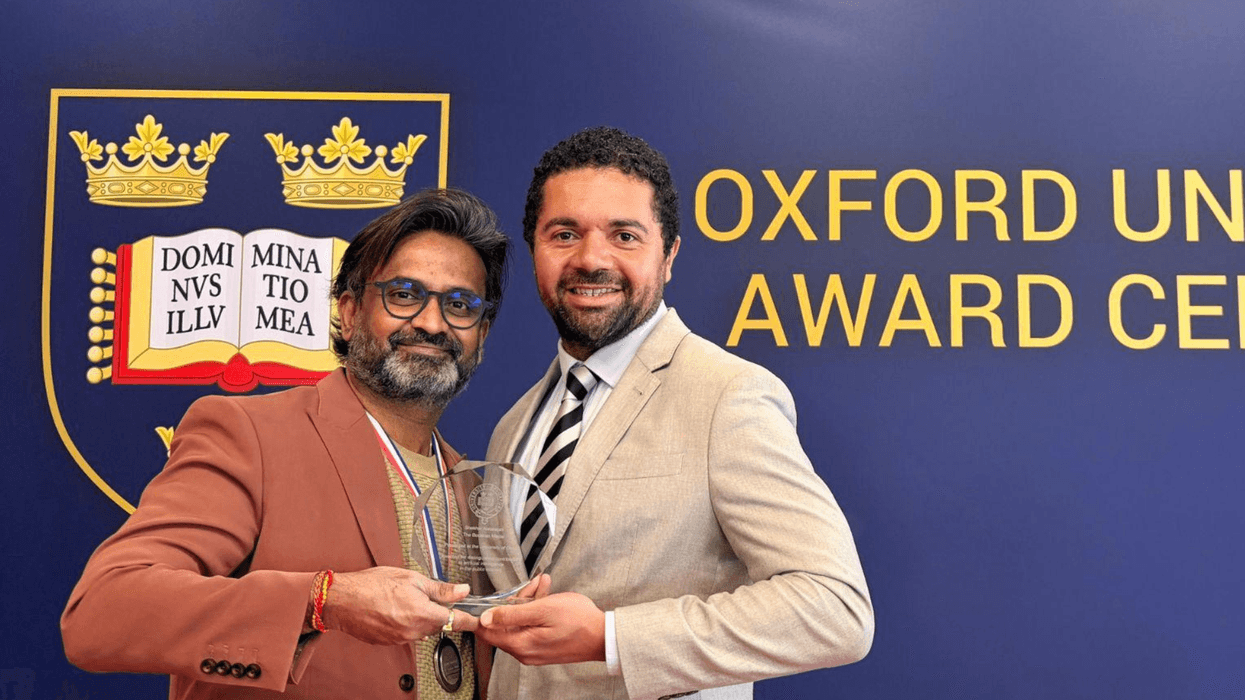
Oxford recognises Orchestro.AI founder Shekhar Natarajan with Bodleian Medal for ethical AI work

Orchestro.AI founder honoured for ethical AI contributions

Shekhar Natarajan Oxford

Natarajan said his work focuses on thinking, knowledge, and human responsibility in an AI-driven world

Orchestro.AI

Highlights

  • Holds over 207 patents in technology.
  • Pioneered Angelic Intelligence concept.
  • Worked with Walmart, Disney, Coca-Cola, PepsiCo.
Oxford University has given the Bodleian Medal to Shekhar Natarajan, founder and CEO of Orchestro.AI, for his work in artificial intelligence that serves the public interest.
The award recognises the Indian-origin entrepreneur who has spent over 25 years working in technology at some of the world's biggest companies.

Natarajan's journey to this honour started in India, where his mother sold her wedding ring to pay for his education. He later moved to the United States with just $34 in his pocket.

At times he lived in his car while dealing with rejection and hard times. Today, he holds more than 207 patents and has helped grow businesses from millions to billions at Walmart, Coca-Cola, Disney and PepsiCo.


Angelic intelligence vision

Through Orchestro.AI, Natarajan has created what he calls Angelic Intelligence. This is a patented approach where good values form the basic foundation of the technology, not something added on later.

This represents a new way of thinking about artificial intelligence , one that aims to improve human judgement rather than replace it.

"To stand in Oxford, in a city that has been a beacon of human knowledge for nearly a thousand years and receive the Bodleian Medal is a moment I could not have dared to imagine," Natarajan said during the ceremony.

He spoke about the importance of the Bodleian Library, which has survived plagues, wars and revolutions while keeping humanity's greatest discoveries and knowledge safe.

"At this remarkable moment in history, artificial intelligence is becoming part of that story," he added.

Technology meets humanity

Natarajan said his work deals with basic questions about thinking, knowledge and human responsibility in a world changed by artificial intelligence.

"We are not simply building faster tools. We are teaching machines to reason, to learn, to assist," he explained.

The Oxford award comes at a time when questions about AI ethics, fairness, bias and human control are becoming more important globally.

Natarajan's work offers answers by changing the purpose of innovation rather than slowing it down.

"I accept this medal with deep gratitude to Oxford, to those who championed this work, and to every person who dared to believe that technology and humanity are not in opposition, but in partnership," he said.


More For You

Starmer calls lack of disclosure over Mandelson vetting ‘frankly staggering’

Starmer said on three occasions that “full due process” was followed in Mandelson’s appointment

Getty Images

Starmer calls lack of disclosure over Mandelson vetting ‘frankly staggering’

Highlights

  • Starmer accepts he unknowingly misled MPs over Mandelson's failed security checks.
  • Foreign Office overruled vetting recommendation and kept Starmer in the dark.
  • Top civil servant Sir Olly Robbins sacked and set to face MPs on Tuesday.
Keir Starmer has said it is “frankly staggering” that ministers were not informed about the failed security vetting of Peter Mandelson, insisting he does not accept that senior figures could have been kept in the dark at multiple stages of the process.
He said he should have been told before Mandelson took up the Washington post, that the cabinet secretary should have been informed during a 2025 review, and that the foreign secretary should have known when addressing a select committee.
Downing Street has insisted the prime minister would never knowingly mislead parliament and that he was himself misled by the Foreign Office.
His official spokesperson said the information about Mandelson's failed vetting should have been provided to parliament, to Starmer and to other government ministers, but was not.

Starmer had told the Commons on three separate occasions that "full due process" was followed when Mandelson was appointed US ambassador.

That position has now unravelled following revelations that United Kingdom Security Vetting recommended against Mandelson's security clearance before he took up the Washington post.

Keep ReadingShow less