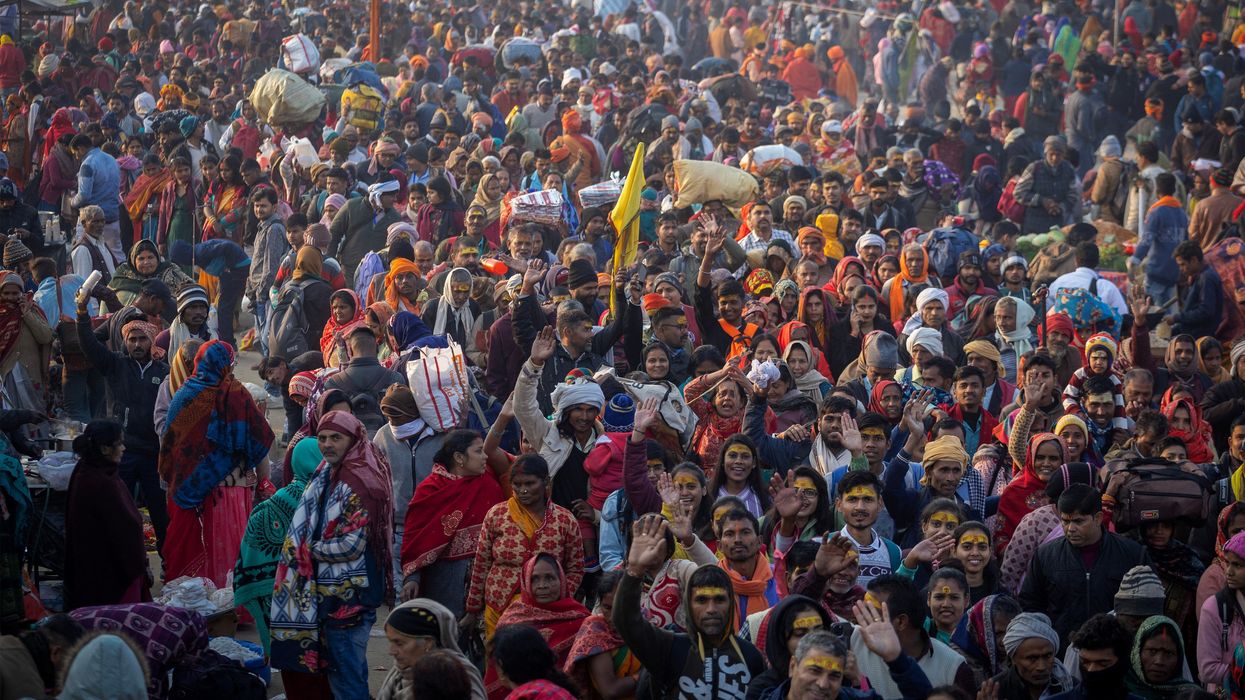

INDIA’s government announced on Friday that more than 420 million pilgrims have taken part in ritual bathing at the Maha Kumbh, a Hindu religious festival.
Organisers say the estimate is based on artificial intelligence and surveillance cameras used to track attendance.
The figure, which exceeds the combined populations of the United States and Canada, cannot be independently verified.
The Press Information Bureau of India said, “More than 420 million devotees took a dip in the holy Triveni Sangam,” referring to the confluence of the Ganges, Yamuna, and mythical Saraswati rivers.
The Kumbh Mela, a six-week Hindu festival held every 12 years in Prayagraj, Uttar Pradesh, will continue until 26 February.
Religion and politics are closely linked in India, and critics argue that the event is being promoted to strengthen the image of prime minister Narendra Modi.
Modi took a ritual dip on Wednesday. Uttar Pradesh state chief minister Yogi Adityanath, a BJP leader and monk, is overseeing the festival’s management.
Organisers say artificial intelligence, surveillance cameras, and overhead drones are being used to monitor crowds and estimate the number of attendees.
Despite these measures, a stampede on 29 January led to the deaths of at least 30 people and left 90 others injured.
Officials initially stated that there were no serious injuries, despite television footage from the scene showing otherwise.
The festival is based on Hindu mythology, which describes a battle between deities and demons for a pitcher containing the nectar of immortality.
Pilgrims believe that bathing at the confluence of the rivers leads to salvation.
(With inputs from AFP)





English questioning rose from 20 per cent to 31 per cent, and racist jokes from 36 per cent to 41 per cent
Workplace violence against Black and ethnic minority employees rises to 26 per cent
Highlights
The Trades Union Congress surveyed 1,044 Black, Asian and ethnic minority employees. The results show clear increases in racist behaviour between 2020 and 2026.
Workers having their English questioned rose from 20 per cent to 31 per cent. Those hearing racist jokes went up from 36 per cent to 41 per cent.
Racist comments made to workers or around them increased from 31 per cent to 36 per cent.
Violence and threats
The most worrying finding involves physical threats and violence, which jumped from 19 per cent to 26 per cent.
Racist posts shared on workplace social media grew from 22 per cent to 28 per cent. Racist materials being passed around increased from 19 per cent to 25 per cent.
Beyond direct racism, many workers face unfair treatment. Nearly half (45 per cent) said they get harder or less popular jobs.
Over two in five (43 per cent) receive unfair criticism. The same number (41 per cent) stay stuck on temporary contracts.
Work conditions got worse too. Those not getting enough hours rose from 30 per cent to 40 per cent.
Workers denied overtime went from 30 per cent to 37 per cent. Being kept on short-term contracts increased from 33 per cent to 41 per cent.
Direct managers cause most unfair treatment (35 per cent), followed by other managers (19 per cent).
Bullying mainly comes from direct managers (30 per cent) and colleagues (28 per cent). Racist behaviour mostly comes from colleagues (33 per cent) and customers or clients (22 per cent).
Paul Nowak, TUC general secretary, said: "Black and ethnic minority workers are facing appalling and growing levels of racism and unfair treatment in Britain. This racism is plaguing the labour market – and it's getting worse."
The TUC is calling for urgent government action to tackle the problem. The union wants ring-fenced funding for the Equality and Human Rights Commission to enforce workplace protections.
It is pushing for mandatory ethnicity pay gap reporting for companies with over 50 employees.
The TUC says the Employment Rights Act, which makes employers responsible for protecting workers from harassment by customers and clients, will be an important step forward.
The union also wants employers to treat racial harassment as a health and safety issue and monitor ethnicity data across recruitment, pay and promotions.