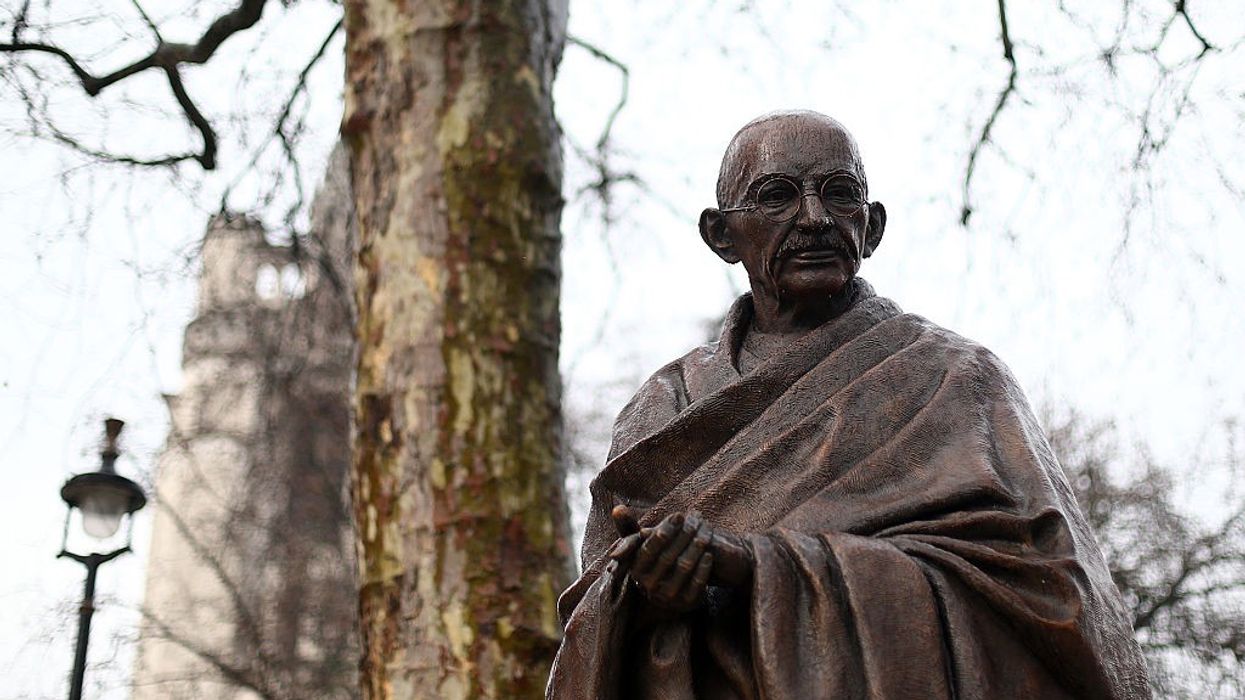

LONDON on Saturday (2) witnessed events being organised in different parts to commemorate the 152nd birth anniversary of Mahatma Gandhi. While Indian High Commissioner to the UK HE Gaitri Issar Kumar paid floral tributes to the statue of the iconic leader in Parliament Square, bhajans and talks were organised on the enduring legacy of the life and teachings of the 'Father of the Nation'.
At the Gandhi statue in Tavistock Square Gardens in London, Deputy High Commissioner of India Sujit Ghosh welcomed Councillor Sabrina Francis, the mayor of Camden, for a special ceremony attended by the heads of the defence wings of the Indian high commission and community leaders.
Wreaths were placed to pay homage to the Gandhi Memorial by the deputy high commissioner, heads of the defence wings, community leaders, councillors and the members of parliament. The Bharatiya Vidya Bhavan and the Sargam Cultural Institute collaborated to play some of Gandhi’s favourite bhajans.
The Gita Foundation and the National Association of Patidar Samaj also organised a peace march on the day.
HE Kumar inaugurated an illuminating exhibition on the life of Gandhi illustrated in photographs and curated by Mr Pandey from India’s Benaras. She also announced at the event the curation of a special volume of essays by noted Gandhian scholars.
At the Nehru Centre, the high commission’s cultural wing, a virtual interaction was hosted by the centre’s director Amish Tripathi and film-maker Rajkumar Hirani on the concept of ‘Gandhigiri’, as popularised in his ‘Munnabhai' films.
The high commission also launched with the support of Bharatiya Vidya Bhavan virtual Sanskrit Speaking Classes lessons for 10 weeks starting October 2.






 Curator Emma Slocombe with ikat robes and arabachi coats in the Peter the Great Room in Blickling Hall Amit Roy
 View of the entrance to Blickling Hall on a rainy autumn dayAmit Roy
 Kente cloth from Ghana in the Long Gallery in Blickling Hall
 Decoration in the Great Hall at Blickling Hall Amit Roy
 Palampore fragment made in coastal south-east India in the Brown Room in Blickling Hall Amit Roy
 Bed valance dating from early 1700s in the Italian Print Room at Blickling Hall Amit Roy
 Indian inspired fabric draped on sofas in the South Drawing Room in Blickling Hall Amit Roy
 Indian inspired fabric draped on sofas in the South Drawing Room with Indian carpet in Blickling Hall Amit Roy
 Karun Thakar has picked out the geometric patterns in the bookcase and the Kente cloth in the Long Gallery in Blickling Hall Amit Roy
 Large tapestry depicting Peter the Great defeating the Swedish army at the Battle of Poltava in 1709 Amit Roy
 ikat robes and arabachi coats in the Peter the Great Room in Blickling Hall Amit Roy
 Baghs and kanthas made by women provide contrast to the men only portraits in the Great Hall at Blickling Hall Amit Roy
 Baghs and kanthas in the entrance Great Hall at Blickling Hall Amit Roy
 Baghs and Kanthas in the Great Hall in harmony with stained glass window at Blickling Hall Amit Roy
 Kimonos reflect Japanese influence in Upper Ante Room in Blickling Hall Amit Roy
 Kimono in Upper Ante Room in Blickling Hall
 A view of the Palace and fort at Agra shows romantic side of India Amit Roy
 Blickling Hall Amit Roy
 Table carpet, European 1670-1680 Amit Roy
 Unfinished 17th century Italian embroidery in the Print Room at Blickling Hall Amit Roy
 Picture of Kashmir shows a romantic view of India Amit Roy
 A panel of Ashburnham bed hangings made in Gujarat for sale in Europe in the Brown Room in Blickling Hall Amit Roy
 Colcha made in the 1600s by women in Bengal for the Portuguese market in the Long Gallery at Blickling Hall Amit Roy




