
- AI services contributed more than 8 per cent of Infosys’ revenue in the previous quarter.
- The company could see AI account for 20 to 30 per cent of its work within a few quarters.
- Infosys plans to recruit another 20,000 graduates this financial year, with training focused on AI.
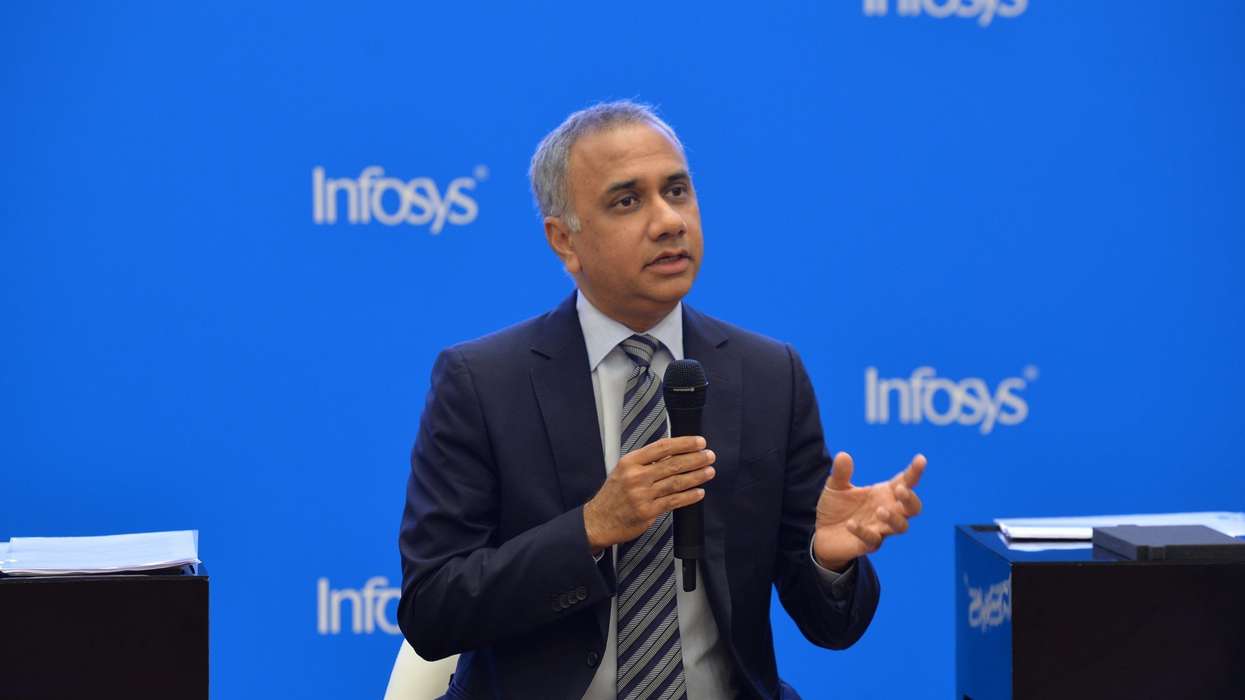
Infosys chief executive and managing director Salil Parekh expects artificial intelligence (AI) services to account for almost half of the Indian IT giant’s work within two to three years, as demand for AI-led projects accelerates.
Speaking at the Bloomberg New Economy Forum 2026 on Tuesday (October 13), Parekh said AI services contributed more than 8 per cent of the company’s revenue in the previous quarter and were growing at a double-digit rate sequentially.
The business includes developing AI agents, using coding tools and modernising legacy technology for clients. Although it remains relatively small compared with Infosys’ overall operations, Parekh said its current growth rate could push its share of the company’s work to 20 to 30 per cent within a few quarters.
“It (AI services) is growing at a fantastic pace. If you sort of extrapolate that by a few quarters, you already start to see that's 20-30 per cent of our work in a few quarters, and maybe in two or three years, almost half of our work,” he said.
He described the outlook as evidence of “a huge demand” for AI services and argued that the technology could benefit India’s IT services industry rather than undermine it.
“My own sense is it is good news for Infosys, and by sort of that same view, good news for the tech services in India,” Parekh said.
How is Infosys preparing for the AI shift?
Infosys is investing in training its workforce to help clients adopt and deploy AI. Parekh said the company hired 20,000 college graduates last year and plans to recruit another 20,000 during the current financial year.
The new employees are trained in AI before working with clients on implementation and change management. Of Infosys’ workforce of around 300,000, approximately 80,000 employees are already working with coding tools on client projects and some internal initiatives, he said.
Enterprise customers are increasingly using AI services, but cost is becoming an important consideration as adoption expands. Parekh said clients were examining whether cheaper tokens and open-weight models could deliver the same results as the latest, more expensive models.
That shift could influence how businesses choose AI systems and how much they spend on running them. For IT services companies, the opportunity may lie not only in building AI applications but also in helping customers select, integrate and manage models at an acceptable cost.
Data centre investment brings new risks
Parekh cautioned that the infrastructure supporting AI growth could face challenges even as demand remains strong. Data has become central to the AI ecosystem, while stricter requirements around data sovereignty and cloud infrastructure are limiting some capacity expansion, he said.
He also questioned how long the large investments being made in data centres would remain useful. Chips are “massively expensive” and face intense competition, while advances in foundation models could substantially reduce the cost of running AI systems.
New models using different approaches from the two major closed-model providers could make inference several times cheaper, potentially changing the amount of computing capacity businesses need.
“Today the demand is fantastic, but these are some of the risks that could play out,” Parekh said, adding that the effects could become visible in five to ten years.
He also warned of a possible backlash against AI infrastructure expansion, particularly in Western markets. The social response to the technology, he suggested, needed to be balanced against the economic forces driving investment, which “may be out of sync right now”.
His comments point to a central question for the industry: whether demand for AI services can continue growing quickly enough to justify the investment in computing infrastructure, even as cheaper models and changing public attitudes reshape the market.