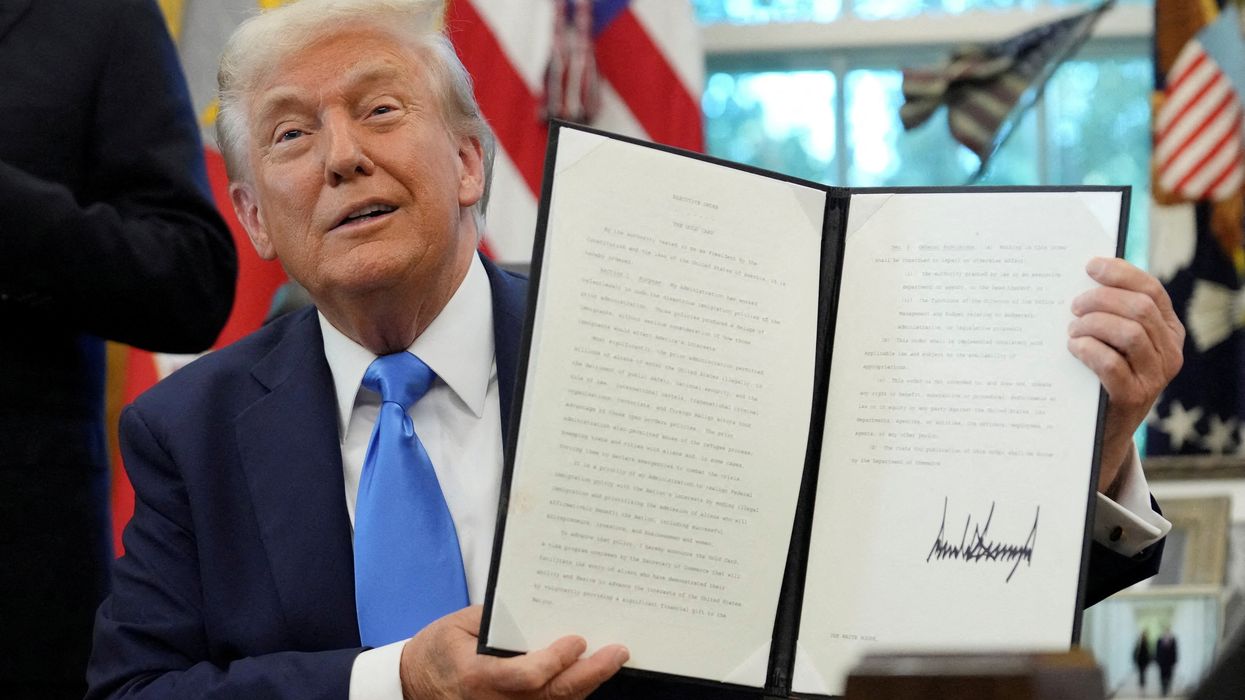

US PRESIDENT Donald Trump has signed a proclamation raising the annual fee for H-1B visas to $100,000 (more than £74,000), a move widely criticised by lawmakers and community leaders as “reckless” and “unfortunate.”
The proclamation, titled Restriction on entry of certain non-immigrant workers, will come into effect from 12.01 am on September 21. Immigration lawyers have advised H-1B holders or their dependants currently abroad to return to the US immediately or risk being stranded.
Congressman Raja Krishnamoorthi called the fee hike a “reckless attempt to cut America off from high-skilled workers who have long strengthened our workforce, fuelled innovation, and built industries that employ millions.”
Ajay Bhutoria, a former adviser to president Joe Biden, warned that the decision could undermine the US technology sector. “This massive jump from the current $2,000–5,000 fee will crush small businesses and start-ups reliant on diverse talent,” he said.
Currently, H-1B visas cost between $2,000 and $5,000 depending on employer size and are valid for three years, extendable for another three. The new fee will particularly affect Indian tech workers, who make up a large share of visa holders.
According to US Citizenship and Immigration Services (USCIS), Amazon had the highest number of H-1B approvals in 2025 with 10,044, followed by Tata Consultancy Services (5,505), Microsoft (5,189), Meta (5,123), Apple (4,202), Google (4,181), Deloitte (2,353), Infosys (2,004), Wipro (1,523) and Tech Mahindra Americas (951).
In his proclamation, Trump argued that the visa programme was being exploited to replace American workers with cheaper labour. “The abuse of the H-1B programme is a national security threat,” he said, citing investigations into fraud and money laundering by outsourcing companies.
The new order requires the Secretary of Homeland Security to reject petitions not accompanied by the $100,000 fee for H-1B speciality occupation workers outside the US, for at least 12 months. Limited exemptions will apply if hiring is deemed in the national interest.
Commerce secretary Howard Lutnick said the policy aims to “bring in only extraordinary people” while raising more than $100 billion (£74bn) for the US Treasury. He added that companies must now decide whether a foreign worker is “valuable enough” to justify the new cost.
The move comes as Indians on H-1B visas already face long waits for Green Cards, raising concerns that many may be forced to leave the US if employers refuse to pay.
Critics warn the decision will drive away skilled professionals who power Silicon Valley and contribute billions to the US economy. Krishnamoorthi noted that many H-1B holders eventually become citizens and entrepreneurs who create American jobs.
The Foundation for India and Indian Diaspora Studies called the policy “very unfortunate,” warning of severe consequences for the technology industry.
New York immigration attorney Cyrus Mehta said H-1B visa holders outside the US may already be stranded, as most cannot reach America before the deadline. Internal emails from Microsoft advised employees on H-1B visas not to travel abroad.
Trump also announced a new Gold Card scheme, offering a fast-track visa and Green Card pathway to individuals who contribute $1 million (£738,222) to the US Treasury, or $2m (£1.48m) if sponsored by a company.
(Agencies)