
Highlights
- Surya Kant says India-UK FTA is a historic agreement with the potential to raise bilateral trade by $34 billion annually by 2040
- Calls for a stronger arbitration and mediation framework to support growing commercial ties
- Indian high commission condemns disruption during the chief justice's lecture at a London university
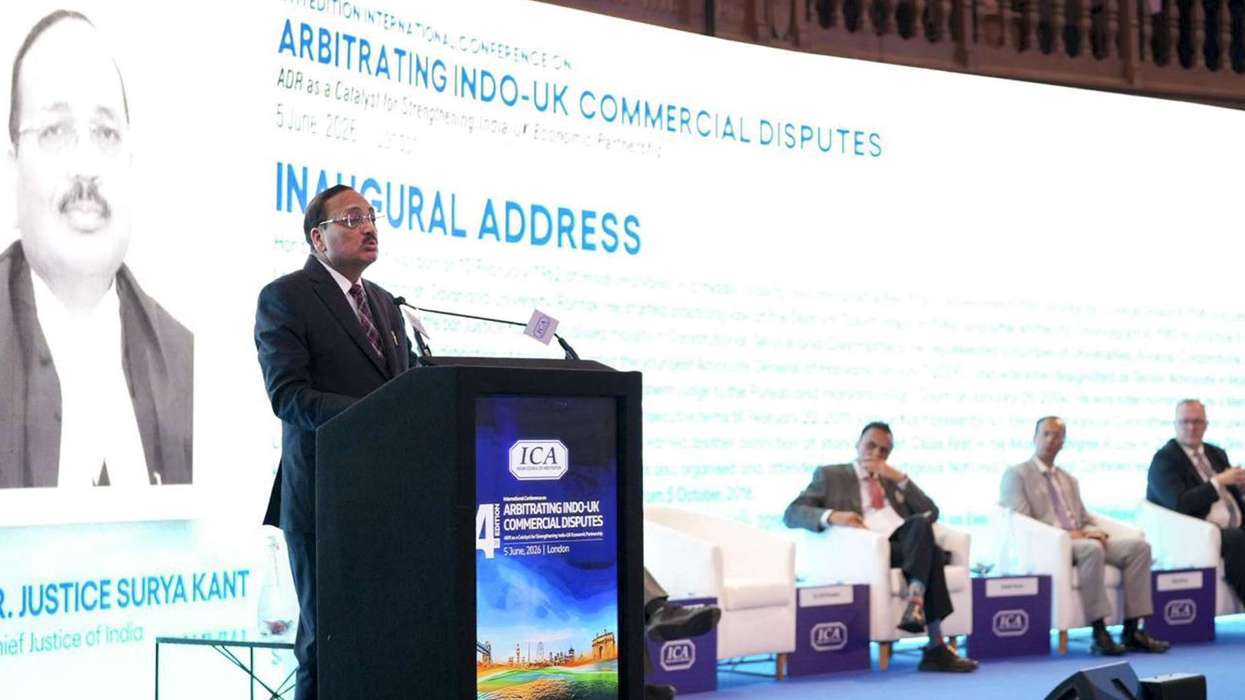
INDIA's chief justice Surya Kant on Friday (5) said the India-UK free trade agreement (FTA) was a historic step for both countries but warned that its success would depend on having a strong dispute resolution system to support growing commercial activity.
Addressing the Indian Council of Arbitration's international conference on 'Arbitrating Indo-UK Commercial Disputes' in London, Justice Kant said trade agreements alone could not deliver economic ambitions unless businesses had confidence that disputes would be resolved fairly, quickly and at a reasonable cost.
Calling the recently concluded FTA an "unquestionably historic moment", he said the agreement was expected to increase bilateral trade by around $34 billion (£25.3bn) a year by 2040.
"Ambitions are realised in contracts, not communiques," he said, adding that the economic partnership between India and the UK would require an alternative dispute resolution (ADR) system that translates commercial confidence into everyday practice.
Justice Kant said parties entering international arbitration place significant trust in the process when they choose private tribunals over national courts and therefore expect proceedings to be fair, proportionate and timely.
He warned that arbitration must not become too expensive, slow or inaccessible. If it did, institutions would need to examine their own practices, he said.
'Arbitration is difficult for new entrants'
The chief justice also pointed to concerns about a concentration of appointments among a small group of arbitrators, lawyers and experts. While expertise often develops through experience, he said such patterns could create a perception that arbitration is difficult for new entrants to access.
He said the FTA was likely to generate disputes in areas such as supply chains, technology licensing and fintech partnerships. To address these efficiently, he called for capped fees, greater use of documentary procedures, online hearings where appropriate, a short mediation stage and fixed timelines for decisions.
Referring to India's Mediation Act 2023 and the UK's growing use of mediation, he said both countries had a strong foundation for developing integrated dispute resolution mechanisms.
"What is needed now is not comparison but co-creation," he said, calling for an India-UK ADR corridor that combines the strengths of both legal systems.
Meanwhile, the high commission of India in London condemned the disruption of a separate event addressed by the chief justice at Birkbeck, University of London on Thursday (4).
Justice Kant had delivered a lecture on "Artificial Intelligence and International Law" before a question-and-answer session. According to the high commission, an individual attempted to disrupt the event after the discussion.
The mission said differences of opinion were natural in a democracy but should be expressed in a civil and respectful manner. It described the behaviour as unacceptable and inconsistent with respectful public discourse.
During the lecture, Justice Kant said technology was neither inherently beneficial nor harmful and that its impact depended on the legal, political and ethical frameworks governing its use.
(with inputs from PTI)