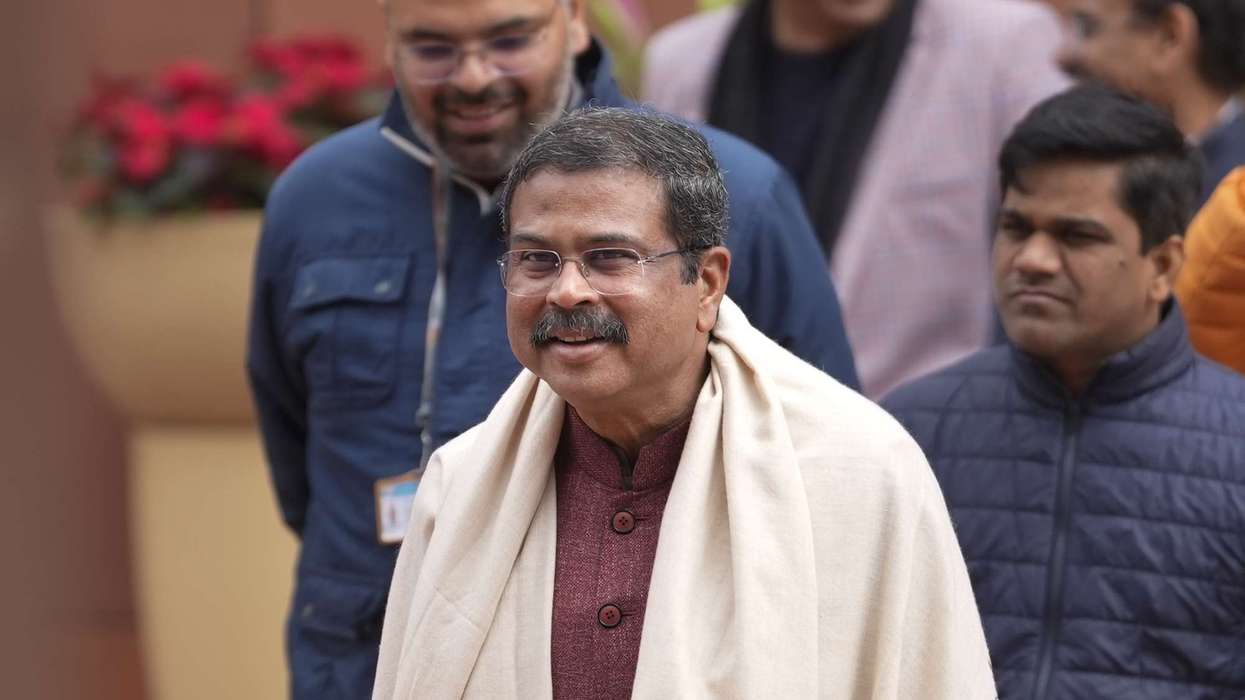

INDIA's education minister Dharmandra Pradhan said on Saturday (25) he had resigned from his position, handing a major victory to youth protesters nationwide who demanded that he quit to take responsibility over examination paper leaks.
The minister announced his resignation on X just as police fired tear gas to scatter young protesters in the Indian capital, hours before their leaders were set to hold another round of talks with ministers to push for the move.
He bowed to mounting pressure over the NEET-UG 2026 paper leak after days of nationwide protests led by students and youth groups demanding accountability for examination irregularities. NEET-UG is India's national entrance exam for students who want to study medicine after school. Every year, millions of students sit the exam, making it one of the world's largest entrance tests.
The minister said he had submitted his resignation to prime minister Narendra Modi.
In his statement, Pradhan said the developments of the past 10 days had deeply disturbed him and that the issue was "not a matter of individual prestige". He said he had accepted responsibility for the NEET paper leak "from day one" and had decided to step down in the interest of restoring confidence in the examination system.
He also appealed for peace, saying that "anti-national forces" should not be allowed to exploit the situation. The resignation marks a major victory for protesters, whose central demand had been Pradhan's removal.
"We have done it," said Abhijeet Dipke, founder of the Cockroach Janta Party that led the protests, to loud cheers at the Jantar Mantar protest site in New Delhi.
India's biggest street protests of recent years have become a political flashpoint, posing one of the biggest challenges to Prime Minister Narendra Modi as politicians joined youngsters' calls to demand action.
The demonstrations, led by the CJP alongside student groups, have focused on alleged irregularities in the NEET-UG examination, concerns over the CBSE's on-screen marking process and broader reforms to public examinations.
Until Friday (24), government sources had maintained that Pradhan's resignation was "not on the cards", while insisting that systemic reforms, rather than ministerial accountability, were the priority.
The Centre had already dismissed dozens of National Testing Agency (NTA) officials, ordered a wider overhaul of the examination body and backed tougher legislation against paper leaks.
Youngsters at the Jantar Mantar site shouted "Jai Hind", a patriotic slogan meaning "Victory to India". Thousands of supporters of India's youth-led "cockroach" movement had been protesting since June, but anger boiled over since police on Monday (20) injured dozens of students, launching baton charges and firing tear gas to deter crowds of protesters marching on parliament.
The protests, led largely by young people and triggered by discontent over leaks of question papers for high-stakes entrance exams, reflect anger over job scarcity, corruption and government accountability.
Federal authorities even on Saturday restricted access to the internet and to 18 metro stations to try to limit the protest in the capital, the latest day of such restrictions.The controversy erupted after allegations that question papers had been leaked before the examination. The government subsequently cancelled the original test, handed the investigation to the Central Bureau of Investigation (CBI) and conducted a nationwide re-examination under tighter security arrangements.
Authorities have also announced that future NEET examinations will move to a computer-based format to improve security and reduce the risk of leaks.
Opposition parties repeatedly demanded Pradhan's resignation and accused the government of failing to protect the integrity of India's competitive examination system. The government had offered a parliamentary debate on the matter but resisted calls for the minister to step down until Saturday's announcement.
(with inputs from agencies)