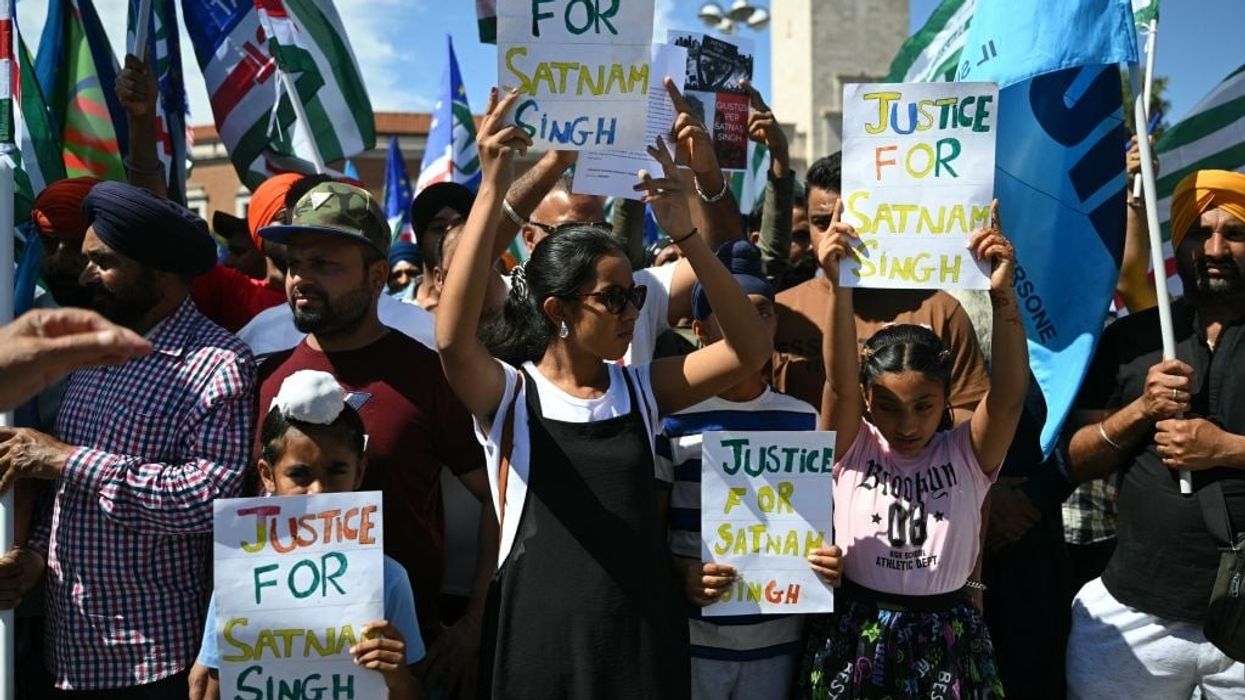

THOUSANDS of Indian farm labourers urged an end to "slavery" in Italy on Tuesday (25) after the gruesome death of a worker shone a light on the brutal exploitation of undocumented migrants.
Satnam Singh, 31, who had been working without legal papers, died last week after his arm was sliced off by a machine. The farmer he was working for dumped him by the road, along with his severed limb.
"He was thrown out like a dog. There is exploitation every day, we suffer it every day, it must end now," said Gurmukh Singh, head of the Indian community in the Lazio region of central Italy.
"We come here to work, not to die," he said.
Children held up colourful signs reading "Justice for Satnam Singh" as the procession snaked through Latina, a city in a rural area south of Rome that is home to tens of thousands of Indian migrant workers.
Indians have worked in the Agro Pontino -- the Pontine Marshes -- since the mid-1980s, harvesting pumpkins, leeks, beans and tomatoes, and working on flower farms or in buffalo mozzarella production.
Singh's death is being investigated, but it has sparked a wider debate in Italy over how to tackle systemic abuses in the agriculture sector, where use of undocumented workers and their abuse by farmers or gangmasters is rife.
"Satnam died in one day, I die every day. Because I too am a labour victim," said Parambar Singh, whose eye was seriously hurt in a work accident.
"My boss said he couldn't take me to hospital because I didn't have a contract," said the 33-year-old, who has struggled to work since.
"I have been waiting 10 months for justice," he said.
The workers get paid an average of $21 (£16.6) a day for up to 14 hours labour, according to the Osservatorio Placido Rizzotto, which analyses working conditions in the agriculture industry.
Far-right prime minister Giorgia Meloni has sought to reduce the number of undocumented migrants to Italy, while increasing pathways for legal migration for non-EU workers to tackle labour shortages.
But according to the Confagricoltura agribusiness association, only around 30 per cent of workers given a visa actually travel to Italy, meaning there are never enough labourers to meet farmers' needs.
This month, Meloni said Italy's visa system was being exploited by organised crime groups to smuggle in illegal migrants.
She condemned the circumstances of Singh's death, saying they were "inhumane acts that do not belong to the Italian people".
"I hope that this barbarism will be harshly punished," she told her cabinet ministers last week.
Italy's financial police identified nearly 60,000 undocumented workers from January 2023 to June 2024.
But Italy's largest trade union CGIL estimates that as many as 230,000 people -- over a quarter of the country's seasonal agricultural workers -- do not have a contract.
While some are Italian, most are undocumented foreigners.
Female workers fare particularly badly, earning even less than their male counterparts and in some cases suffering sexual exploitation, it says.
"We all need regular job contracts, not to be trapped in this slavery," said Kaur Akveer, a 37-year-old who was part of a group of women in colourful saris marching behind the community leaders.
"Satnam was like my brother. He must be the last Indian to die," she said.
(AFP)