
Skip to content
Search

Latest Stories

Submit Guest Post

England draw first Test against New Zealand at Lord's

England draw first Test against New Zealand at Lord's

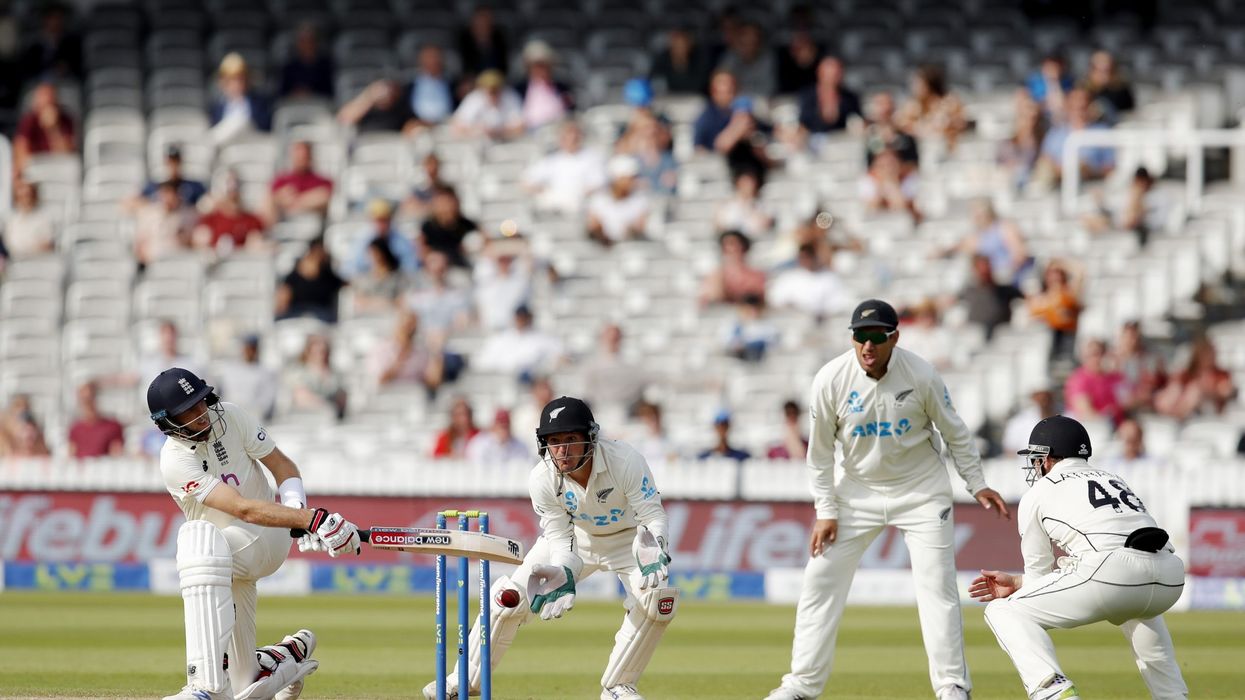
ENGLAND offered stiff resistance in the final session to secure a hard-fought draw against New Zealand on day five of the first Test at Lord's on Sunday (6).

Having lost day three's play due to rain, New Zealand skipper Kane Williamson made a bold declaration at 169 for 6 at lunch to set England a target of 273.


But England openers Rory Burns and Dom Sibley saw off the new-ball well in a bid to save the Test match.

Sibley spent over five hours in the middle for his unbeaten 60 off 207 balls, while Ollie Pope was unbeaten on 20.

The hosts finished with 170 for 3 in 70 overs before both sides shook hands on a draw late in the evening.

England captain Joe Root, who showed incredible patience for his 40 in the final session, said they adopted a cautious approach given the quality of the visiting bowling attack on a deteriorating surface.

"It was slow and hard to time the ball and get any sort of rhythm," Root told the BBC. "You look at the target and amount of overs you have, it wasn't quite as straightforward as that.

"Of course it will disappoint a few people but from our point of view, we're very much in this series.

"We leave here level and give ourselves a great chance to win the series at Edgbaston."

Conway shines

New Zealand may have missed an opportunity to grab the advantage over England ahead of the second Test at Edgbaston, but captain Williamson can take plenty of positives from Lord's.

Devon Conway produced a masterful double hundred on debut, while Tim Southee and Kyle Jamieson proved difficult to contain with the new ball and combined for 10 wickets in the match.

"Special performance from Conway, a special player," Williamson said. "He showed his class on his debut Test at the home of cricket.

"Special performance from Tim as well, he led the attack beautifully, and (the other) guys complemented him well. We had to be patient on this pitch, and we got rewards for that."

Meanwhile, the England & Wales Cricket Board has suspended Ollie Robinson from "all international cricket" after a series of historical racist and sexist tweets were revealed as the pace bowler was making his debut on Wednesday.

Robinson, who picked up seven wickets in the match, has since apologised for his "thoughtless and irresponsible" social media posts.

Root said: "Ollie's learned a hard lesson. It's unacceptable what he's done," Root said. "He's fronted up to the dressing room and the world.

"We've started doing a lot of good work as a team and we'll continue to do that. We want to make the game as inclusive and diverse as we possibly can and we'll continue to keep looking at finding ways to make that possible."

Add EasternEye As Your Trusted Source
preferred source on google news

More For You

Tackling hostility against Muslims matters for everyone

Anti immigration protesters attend the 'Glasgow Reclaims The Streets From Far-right Hatred And Violence' anti-racism protest on June 13, 2026 in Glasgow, Scotland.

Getty Images

Tackling hostility against Muslims matters for everyone

Sunder Katwala

Born in the mid-1970s I felt part of a lucky generation, which gained from pushing back the overt racism of that era. When we talk about stronger “social norms”, what we mean is that few people thought that monkey chants at the football or racist jokes on the telly were normal anymore – while more had Asian and black colleagues, neighbours and friends.

That past progress is put to the test today. A terrible crime in Belfast saw organised efforts at indiscriminate racist attacks on migrants and ethnic minorities, whose only connection to the crime was the colour of their skin. Those seeking to make racism fashionable again have the online megaphone of the world’s richest man, Elon Musk, on their side.

Past progress could be experienced unevenly, too. Being of mixed Indian and Irish Catholic parentage, I saw both identities rise in status once the BBC comedy Goodness Gracious Me inverted who could tell the jokes, and peace broke out in Northern Ireland. Yet, British Muslims of my generation felt under more intense scrutiny after the 9/11 terrorist attacks.

Efforts to tackle anti-Muslim hatred risked being stalled by arguments over what to call it and how to define it. The government’s new definition of anti-Muslim hostility seeks to transcend the confusion that the term “Islamophobia” could generate. But the challenge is not just to define the prejudice – but to find effective ways to shrink it.

There are sobering findings on the starting points in new research from British Future and the British Muslim Trust. More than half of British Muslims report experiencing prejudice based on their religion last year – a quarter in person and over a third online. A third of the public hold mostly negative views. One in six endorse sweeping and often indiscriminate hostility. Anti-Muslim hostility can have about twice the social reach as prejudice against other faith or ethnic minorities.

Tackling this hostility cannot be the responsibility of Muslims alone. It will take a whole-of-society effort. After all, this is foundationally about the attitudes towards a six per cent minority group, held among the 94 per cent of us who are not Muslim.

Keep ReadingShow less