
For some British Asian couples, the decision to travel to India for IVF involves more than the cost of treatment. Access to care, waiting times, donor availability, family connections, and cultural comfort can all shape where they seek treatment, says Dr Rohit Gutgutia, a fertility and IVF specialist.
Speaking to Eastern Eye, Gutgutia discusses why some British Asian couples are looking beyond the UK for fertility treatment, from NHS waiting times and private costs to donor availability, family connections, and cultural attitudes towards IVF.
NHS waiting times and eligibility
Access to NHS-funded IVF can vary, while waiting times can add another layer of uncertainty for couples who are already concerned about their age and chances of conceiving.
Dr Rohit Gutgutia, a Kolkata-based fertility and IVF specialist with more than two decades of experience in reproductive medicine, says the limits of NHS provision are one reason British Asian couples are looking further afield. Gutgutia, who holds an MBBS and a DGO in Gynaecology and Obstetrics and trained in advanced IVF in Israel in 2005, has written about transparency in how IVF success rates are reported and the risks of overtreatment.
“NHS covers only about 30 per cent of cycles that happen in the UK. There are two main reasons for this. One is the wait time that is there. So if it's an IVF, it essentially means couples require a child, and they need an IVF. So nobody's going to wait that long for a pregnancy.”
Gutgutia also points to age as an important consideration, saying access to NHS-funded treatment can become more difficult for women over 39 or 40. For couples who turn to private treatment, the financial commitment can then become another consideration.
“The cost in an IVF in the UK turns out to be prohibitively expensive. It's almost equivalent to three months' salary for an average Asian couple.”
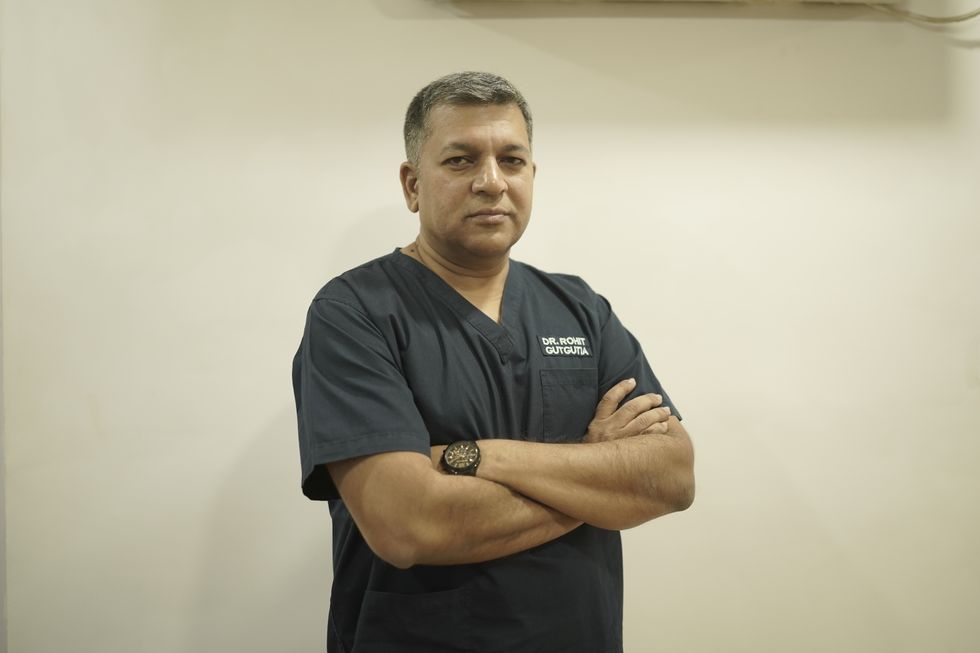 Dr Rohit Gutgutia is a fertility and IVF specialist with more than two decades of experience in reproductive medicine. He holds an MBBS and DGO in Gynaecology and Obstetrics and trained in advanced IVF in Israel in 2005. www.easterneye.biz
Family ties make India familiar
For British Asians, travelling to India for treatment can also be easier because the country may already be part of their family life. Relatives, regular visits and existing connections can make a lengthy medical journey feel more manageable.
“They have family in our country in India. They have easy access to IVF centres in India. They usually do travel back once a year for family connections, as it is.”
This can mean travelling to India is not necessarily a rejection of NHS care. Some couples may first seek diagnosis or treatment in the UK before considering India for their IVF cycle.
Donor availability and ethnicity
Donor treatment can introduce another consideration for British Asian couples. Gutgutia says some patients want a donor who shares their ethnic background, while the availability of South Asian donors in the UK can be limited.
“So if you are a British Asian couple, you would want donor matching your own racial background and ethnicity. So then because there is a short supply of, let's say, Indian donors or south Asian donors in the UK, they would prefer to come to India.”
He says the trend is not limited to donor treatment. According to Gutgutia, couples have increasingly travelled to India for IVF using their own eggs and sperm as well.
India’s changing fertility sector
India's IVF sector has expanded considerably, with larger companies entering the market and greater standardisation across parts of the industry.
“It's become a lot more standardised. There are large corporates who have entered the IVF scene, so there is transparency, there is ethical service, and quality is maintained at a fraction of the cost that would basically be the cost of a cycle in the UK.”
At the same time, Gutgutia cautions couples about additional treatments, or IVF add-ons, that may be offered alongside standard treatment.
“Most of these add-ons are actually not beneficial.”
That caution reflects his broader view that fertility care should involve honest counselling, careful preparation and realistic expectations.
The cultural side of fertility
For British Asian couples, fertility can also be a private family matter. Gutgutia says attitudes can differ between generations and between the cultures that shape British Asian families.
“The British Asian couples still, that is also to do with the way the English are. They don't talk about their health openly. They kind of kind of tight-lipped about a lot of matters. And there's a mixture of both the cultures that's happened.”
That can affect how couples involve parents and relatives in their fertility journey. Some may tell family members that they are undergoing IVF without discussing the underlying reasons or details of treatment, making confidentiality an important consideration.
A different reason to travel
For some British Asian couples, travelling to India for IVF therefore brings together several practical and personal factors: access to treatment, family support, familiarity with the country and, for some, donor availability.
Navigating that journey from abroad is the gap Gutgutia set out to address with Ikivana, which he co-founded with UK-based entrepreneur Megha Agarwal, the company’s CEO. Agarwal, an MBA who has built businesses across hospitality, food technology, health and wellness, co-founded the platform after seeing people travel overseas for fertility treatment without consistent guidance or continuity of care. Ikivana coordinates treatment alongside transparent pricing, visas, accommodation, emotional support and wellness services.
Gutgutia believes trust will be crucial if India is to attract more patients from the UK, pointing to countries such as Spain and Greece that have established themselves as destinations for fertility treatment.
For British Asians with longstanding family connections to India, however, the relationship with the country may already be there. IVF may simply be giving that connection a new purpose.