
Highlights
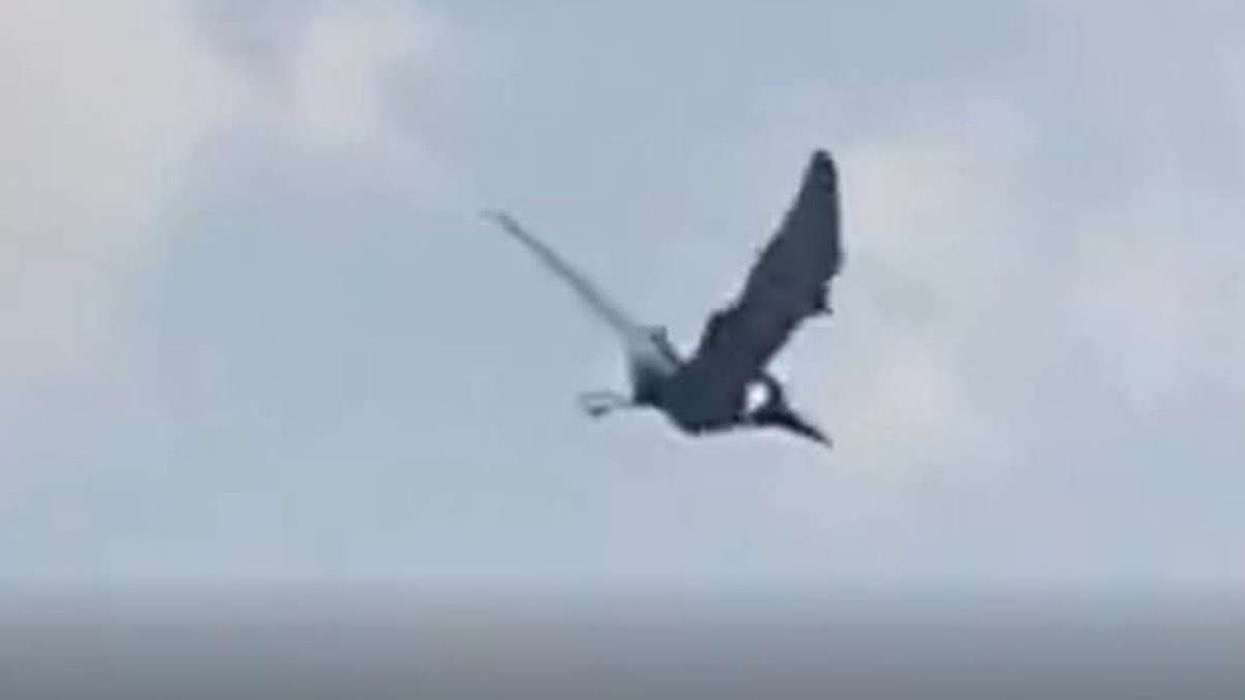
- A viral video showing a mysterious flying creature over Ciudad Juárez, Mexico, sparked speculation that a prehistoric pterodactyl had returned.
- Specialists identified the mysterious silhouette as a great blue heron, a bird with a wingspan of up to 6.6 feet.
- Mexican ufologist Jaime Maussan shared the footage and suggested the creature could be a Pteranodon.
- An AI-enhanced version of the alleged creature added another twist to the online controversy, raising questions about the authenticity of viral footage.
A mysterious flying creature spotted over Ciudad Juárez in Mexico has sparked an online frenzy, with social media users debating whether the footage shows a prehistoric flying reptile.
The video, which circulated widely on social media, appears to show a large winged silhouette moving across the sky. Some viewers speculated that it could be a pterodactyl, a prehistoric flying reptile that became extinct millions of years ago.
However, the mystery has taken an unexpected turn after specialists suggested the creature was actually a great blue heron. The controversy also attracted attention after Mexican ufologist Jaime Maussan shared an enhanced version of the footage that reportedly involved artificial intelligence (AI).
What did the viral Mexico flying monster video show?
The first reported footage dates back to October 29, 2026, when a home security camera in the Anapra neighbourhood of Ciudad Juárez captured a brief image of a large flying silhouette.
According to Maussan, the camera had been moved by cats, allowing it to record the mysterious object. The short clip subsequently circulated online, attracting millions of views and fuelling speculation about the creature's identity.
Maussan, a prominent UFO researcher and television personality, shared the footage through his social media accounts and programmes, including Interestelar.
He suggested that the creature could be a Pteranodon, a genus of prehistoric flying reptile. He also raised the possibility of a dimensional portal in the Juárez Valley, adding to the unusual claims surrounding the sighting.
However, the footage did not provide clear evidence of an unidentified prehistoric animal.
Why experts believe the flying creature was a great blue heron
Rather than an extinct flying reptile, specialists identified the silhouette as a great blue heron (Ardea herodias).
The large bird is known for its impressive wingspan, which can reach approximately 6.6 feet (2 metres). Its broad wings and distinctive flight pattern can make it appear unusually large, particularly when captured in unclear or low-quality footage.
Great blue herons are real birds found across North America. Their size and appearance can make them look unusual when viewed from a distance or in poor lighting.
The proposed identification offers a more ordinary explanation for the mysterious silhouette than the claims circulating online.
How AI became part of the pterodactyl controversy
The controversy grew after Maussan presented an enhanced version of the alleged creature, reportedly using AI to add visual details and make its appearance clearer.
The development raised questions about how much of the viral imagery represented the original recording and how much had been digitally altered.
Reports have also highlighted that online compilations surrounding the alleged sighting included imagery enhanced or generated using AI.
However, it is important to distinguish between the original security-camera footage and the enhanced versions shared online. The reported use of AI does not establish that the original recording itself was entirely generated by artificial intelligence.
The incident has once again highlighted how digitally altered images and videos can influence online discussions, particularly when the original footage is unclear.
What did Mexican authorities say about the alleged flying monster?
Authorities in Ciudad Juárez have also dismissed claims that the footage proves the existence of a prehistoric creature.
Sergio Rodríguez, director of Civil Protection in the city, described the circulating videos as digital entertainment without a factual basis.
He said that if a genuine prehistoric animal were discovered, scientific institutions such as Mexico's National Institute of Anthropology and History (INAH) and international research organisations would be expected to investigate.
His comments challenged the extraordinary claims being made about the footage and highlighted the need for scientific evidence before accepting such sightings as genuine.
Pterosaurs were flying reptiles that lived during the Mesozoic Era and became extinct approximately 66 million years ago. Pteranodon was one of several genera, while pterodactyl is commonly used as a general term for these prehistoric creatures.
There is currently no scientific evidence that pterosaurs survived extinction or continue to exist today.
What began as a brief security-camera recording has therefore developed into a viral mystery involving UFO speculation, a possible bird identification and AI-enhanced imagery. Despite the online excitement, the available evidence does not support claims that a prehistoric flying reptile was spotted over Mexico.