
INDIA, the US, Japan and Australia agreed to jointly build a port in Fiji and announced agreements on critical minerals and energy security as the Quad grouping pushed ahead with new initiatives.
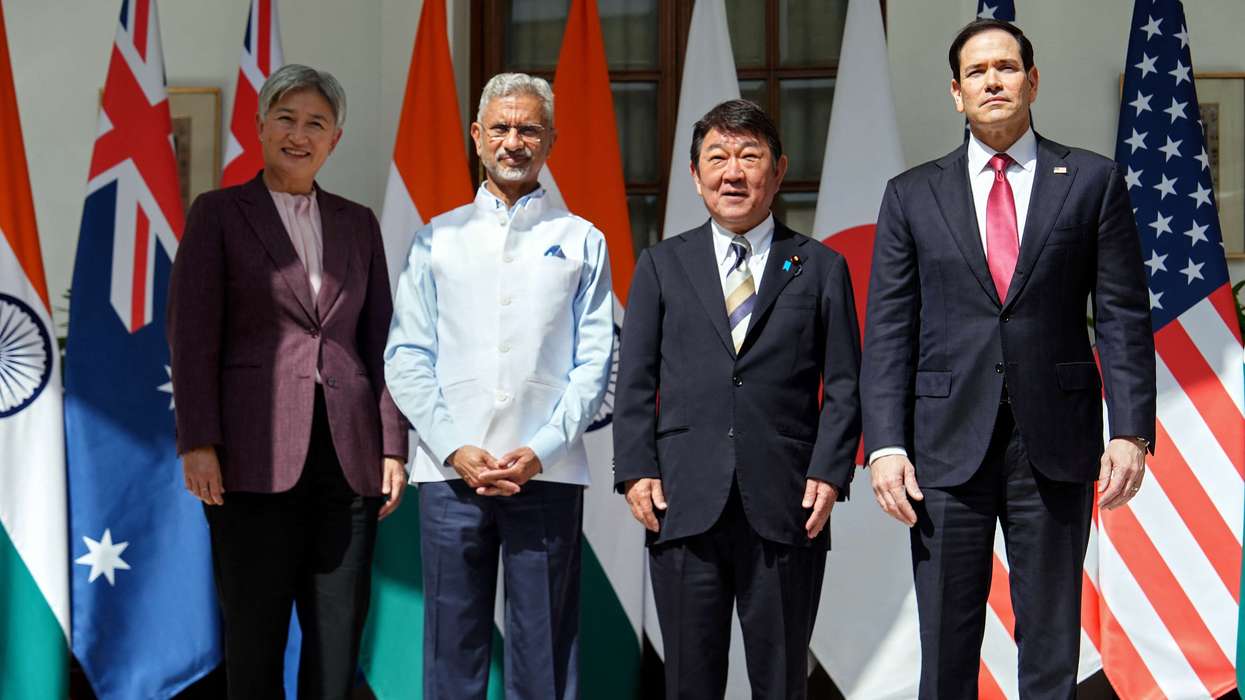
The meeting between Australian foreign minister Penny Wong, Indian external affairs minister S Jaishankar, Japanese foreign minister Toshimitsu Motegi and US Secretary of State Marco Rubio was the third Quad foreign ministers’ meeting since September 2024.
The Quad countries announced their first joint infrastructure project, a port in Fiji.
“We are going to be partnering on issues of port infrastructure, in particular in response to insufficient port capacity in the Pacific Islands, we are announcing plans to work with Fiji,” Rubio said.
The four-country grouping had lost momentum last year after it failed to hold a leaders’ summit amid tensions between US president Donald Trump and Indian prime minister Narendra Modi over Washington’s tariffs and other issues.
“We are beginning to show real achievements and real accomplishments,” Rubio said. “We are deeply committed to this partnership. It is a linchpin and a cornerstone of our global strategy as a nation in the United States.”
Rubio said the group had agreed to launch an Indo-Pacific Energy Security initiative and a framework on critical minerals.
The minerals framework will guide coordination on economic policy tools and investments to strengthen critical minerals supply chains, including mining, processing and recycling, Rubio said.
The initiative could be important for Japan after China stopped shipments of some minerals used in aerospace, defence and semiconductor industries following a diplomatic dispute.
New Delhi has pushed for a Trump visit to India, which could be linked to a Quad summit. Analysts have questioned whether the lack of leader-level engagement had reduced the importance of the grouping.
The foreign ministers did not comment on the possibility of a summit this year, but Rubio said over the weekend that diplomats would work towards a meeting later this year.
“The absence of a leaders’ summit has raised some doubts, but that does not necessarily indicate declining importance,” said Premesha Saha, a senior policy fellow at the Asia Society Australia in Melbourne.
“If the Quad can keep delivering at the ministerial and working levels, it can remain relevant even without regular leaders-level signalling.”
The Quad countries share concerns over China’s growing influence and Rubio has repeatedly stressed the need to maintain a “free and open Indo-Pacific”.
A joint statement issued by the four countries said they remained “seriously concerned about the situation in the East China Sea and the South China Sea” and the “militarisation of disputed features” in the South China Sea.
The countries also condemned attacks on commercial shipping vessels in the Middle East and said they opposed the imposition of tolls, stressing safety and uninterrupted global commerce through the Strait of Hormuz and the Red Sea.
China claims most of the South China Sea and has built military facilities on disputed features. Several Southeast Asian countries also claim parts of the sea. China and Japan also have a separate territorial dispute in the East China Sea.
Beijing has criticised the Quad as a Cold War-style grouping aimed at containing China.
On Tuesday, China said cooperation between countries should support regional peace, stability and prosperity and should not target any third party.
“We also do not support the formation of exclusive cliques or bloc confrontation. No cooperation should undermine mutual trust and cooperation among regional countries,” Chinese foreign ministry spokesperson Mao Ning told a daily press conference.
India also has territorial disputes with China, although Modi has signalled willingness to improve ties with Beijing amid tensions with Trump.