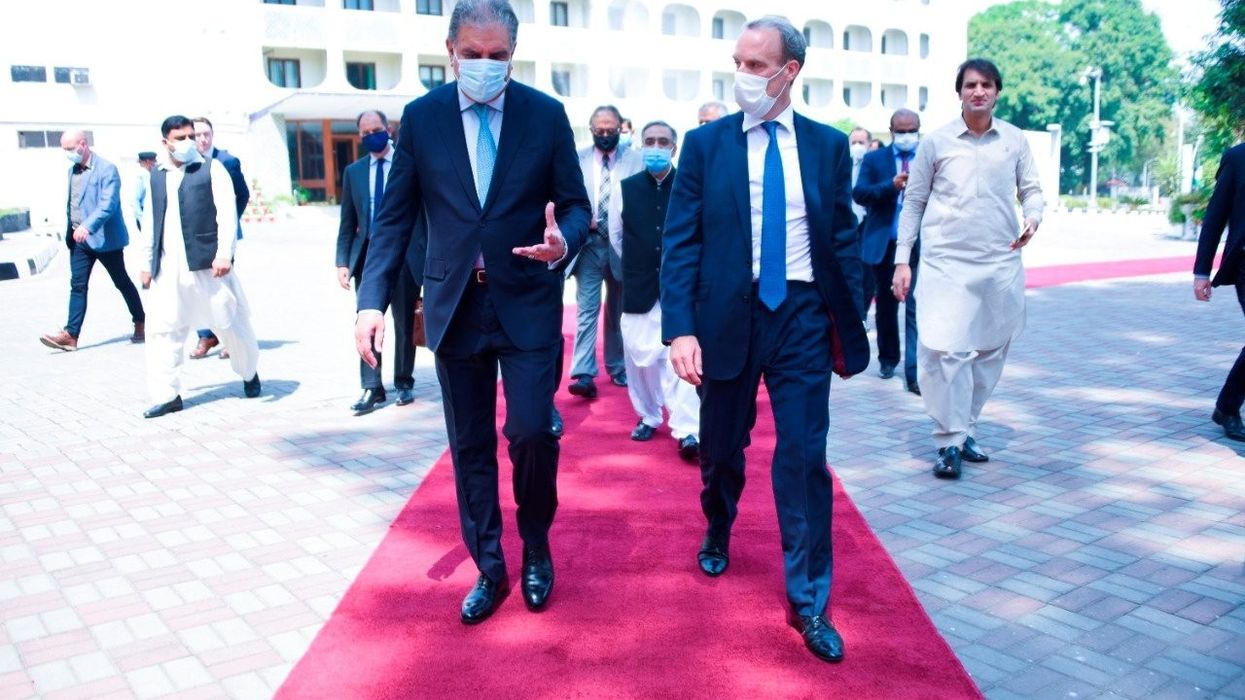

PUBLIC health officials of Pakistan and the UK are scheduled to meet on Monday (6) to discuss the possibilities of taking Islamabad off London’s travel red list.
British foreign secretary Dominic Raab who visited Pakistan on Friday (4) said it was a “sensitive and difficult” issue on which both sides have to work together to “find a way through”.
He hoped Pakistan would come out of the UKs’ travel restrictions, but did not make any commitment, saying the decision “is taken at a technical level”.
"We want to find a way through. No one wants Pakistan off the red list more than I do, but we take these decisions at a technical level. I think the smart thing for us to do is work together to enable that to happen as soon, as safely and as responsibly as it can be done," Raab said at a press conference.
Pakistan has a "pretty strong case" to be removed from the red list, The Telegraph said citing a source close to Raab. But the issue is not linked to Islamabad’s cooperation with the UK on the Afghanistan matter, it said.
Britain retained Pakistan on its red list when the review of travel status of various countries came up for review late last month. This meant that travellers from the South Asian country should go through stringent Covid-19 protocols on arriving in the UK.
Raab also said Britain agreed to listen to Pakistan’s concerns over being on the grey list of the Financial Action Task Force, an intergovernmental organisation that monitors money laundering and terror financing.
Pakistan foreign minister Makhdoom Shah Mahmood Qureshi, who asserted that Islamabad has been taking steps at legislative and administrative levels to come out of the grey list, sought the UK’s support on the matter.
"I urged the Foreign Secretary to be supportive of Pakistan on the steps that we have taken on that score."






 Curator Emma Slocombe with ikat robes and arabachi coats in the Peter the Great Room in Blickling Hall Amit Roy
 View of the entrance to Blickling Hall on a rainy autumn dayAmit Roy
 Kente cloth from Ghana in the Long Gallery in Blickling Hall
 Decoration in the Great Hall at Blickling Hall Amit Roy
 Palampore fragment made in coastal south-east India in the Brown Room in Blickling Hall Amit Roy
 Bed valance dating from early 1700s in the Italian Print Room at Blickling Hall Amit Roy
 Indian inspired fabric draped on sofas in the South Drawing Room in Blickling Hall Amit Roy
 Indian inspired fabric draped on sofas in the South Drawing Room with Indian carpet in Blickling Hall Amit Roy
 Karun Thakar has picked out the geometric patterns in the bookcase and the Kente cloth in the Long Gallery in Blickling Hall Amit Roy
 Large tapestry depicting Peter the Great defeating the Swedish army at the Battle of Poltava in 1709 Amit Roy
 ikat robes and arabachi coats in the Peter the Great Room in Blickling Hall Amit Roy
 Baghs and kanthas made by women provide contrast to the men only portraits in the Great Hall at Blickling Hall Amit Roy
 Baghs and kanthas in the entrance Great Hall at Blickling Hall Amit Roy
 Baghs and Kanthas in the Great Hall in harmony with stained glass window at Blickling Hall Amit Roy
 Kimonos reflect Japanese influence in Upper Ante Room in Blickling Hall Amit Roy
 Kimono in Upper Ante Room in Blickling Hall
 A view of the Palace and fort at Agra shows romantic side of India Amit Roy
 Blickling Hall Amit Roy
 Table carpet, European 1670-1680 Amit Roy
 Unfinished 17th century Italian embroidery in the Print Room at Blickling Hall Amit Roy
 Picture of Kashmir shows a romantic view of India Amit Roy
 A panel of Ashburnham bed hangings made in Gujarat for sale in Europe in the Brown Room in Blickling Hall Amit Roy
 Colcha made in the 1600s by women in Bengal for the Portuguese market in the Long Gallery at Blickling Hall Amit Roy




