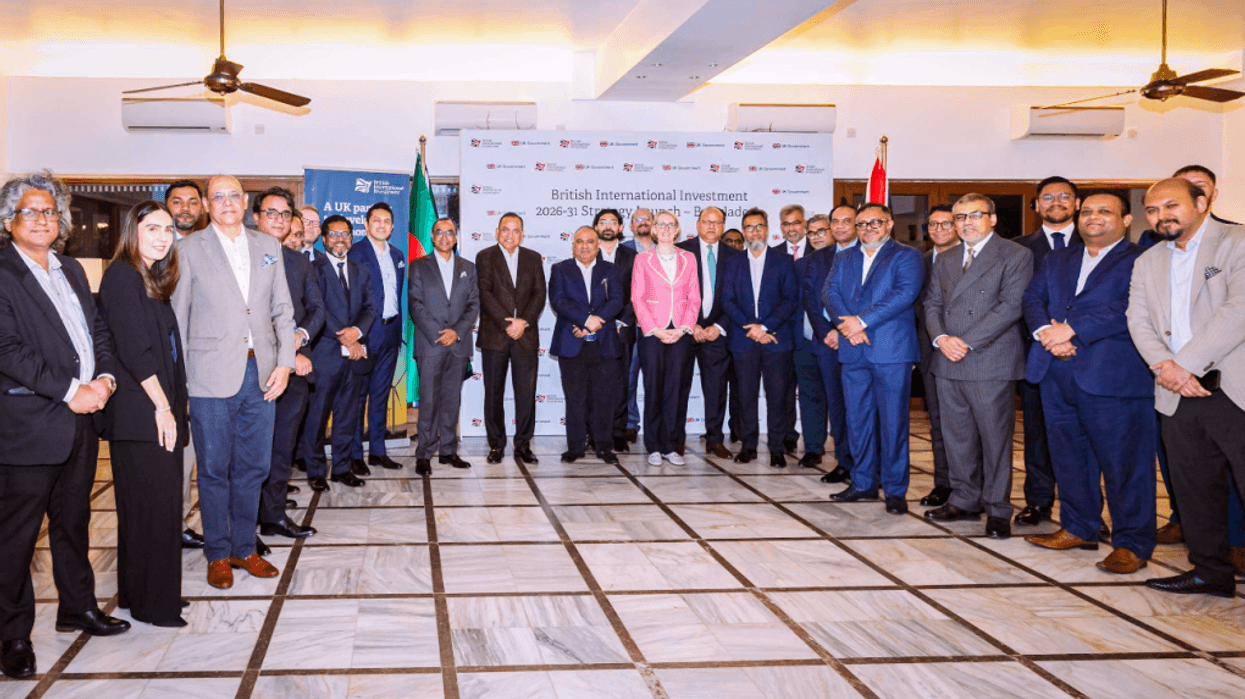

THE UK’s development finance institution has launched a five-year strategy in Bangladesh aimed at supporting job creation, private sector growth and the country’s transition towards a greener economy.
British International Investment's (BII) 2026-2031 strategy builds on more than four decades of investment in Bangladesh, where it currently manages a portfolio worth more than £202 million, a statement said.
BII said it will continue investing in sectors central to Bangladesh’s economic development, including financial services, manufacturing, micro, small and medium-sized enterprises (MSMEs), digital infrastructure and renewable energy.
The institution also plans to increase efforts to mobilise private capital into sectors with growth potential.
Srini Nagarajan, managing director and head of Asia at BII, said Bangladesh had achieved significant economic progress in recent decades, supported by its private sector and entrepreneurs.
“Bangladesh has made remarkable economic progress over recent decades, underpinned by a dynamic private sector and entrepreneurial talent,” he said.
“Through our new strategy, BII is reaffirming its strong commitment to Bangladesh’s long-term development and will build on more than 40 years of partnership in the country by backing businesses that expand opportunity, strengthen resilience and support the green transition.”
He added: “Our ambition is not only to invest, but to help mobilise greater pools of private capital into the sectors that will shape Bangladesh’s future growth.”
Key areas of focus under BII’s Bangladesh strategy
1. Creating jobs and supporting businesses
BII said its future investments will focus on creating employment opportunities and helping businesses expand.
Its previous investments include financing for Jinnat Textile Mills, which helped create more than 900 direct jobs. More than 44 per cent of the new roles were filled by women, while the investment also supported improvements in working conditions and more sustainable manufacturing practices.
2. Expanding finance for MSMEs and women entrepreneurs
BII highlighted its partnership with BRAC Bank, where its lending support has helped around 3,500 entrepreneurs, with a focus on MSMEs and women-owned businesses.
The institution said improving access to finance for smaller businesses would remain a priority under the new strategy.
3. Supporting renewable energy and digital infrastructure
The strategy identifies renewable energy and digital infrastructure as important sectors for Bangladesh’s future growth.
BII said investments in these areas would support economic resilience and help the country move towards a lower-carbon economy.
4. Attracting more private investment
Alongside direct investment, BII said it aims to bring more private capital into Bangladesh’s high-growth sectors.
The institution said it would work with businesses and investors to increase funding available for economic development.
5. Greater focus on frontier markets
BII said it would strengthen its commitment to frontier markets, including countries classified by the United Nations as Least Developed Countries.
At least 25 per cent of the value of its new investments during the strategy period will go towards these markets, including Bangladesh.
British high commissioner to Bangladesh Sarah Cooke said the strategy reflected the UK’s confidence in Bangladesh’s economic future.
“The UK believes in Bangladesh’s economic future,” she said. “British International Investment’s new strategy will help create jobs, crowd-in private sector investment and support economic transformation.”
She added: “As a reliable, long-term economic partner, it demonstrates our commitment to a modern UK-Bangladesh partnership built on trade, investment, knowledge partnerships and shared prosperity.”