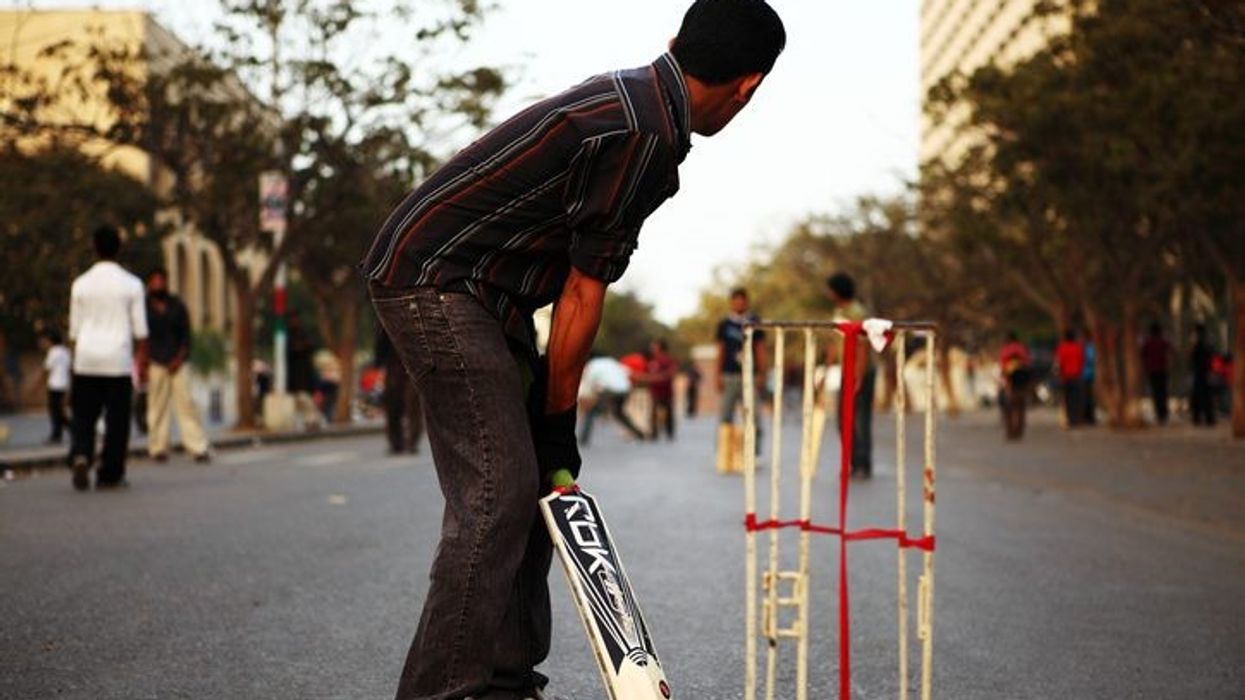

As midnight falls during Ramadan, a basketball court in central Karachi is illuminated by makeshift floodlights, turning it into an urban cricket stadium where young Pakistani men chase taped-up tennis balls flying through the night sky.
Donkeys and goats look on from the outfield and nearby piles of garbage, sometimes even interrupting the game. "After Taraweeh, (special Ramadan prayers) people crave entertainment, which is why many play cricket," explains batsman Waqas Danish.
"They play all night because some people can't wake up for breakfast if they sleep."
Tape-ball cricket is a common sight on Karachi's streets throughout the year, but during Ramadan, night tournaments spring up in almost every neighbourhood.
The chaos of multiple overlapping games in a confined space may bewilder outsiders, but for Karachi's street cricketers, there is a method to the madness.
The frantic games, consisting of four to six overs per innings, are completed before sehri, the meal consumed before daytime fasting.
These games range from pickup matches on makeshift concrete pitches to professional competitions on dusty ovals.
"The kids and youths can't afford kits and all the accessories for playing hard-ball cricket, but they can easily afford the tape ball," competition organiser Taqdeer Afridi told AFP in Karachi.
While gambling is illegal in Pakistan, money is often involved, and big-hitting mercenaries are occasionally enticed from surrounding neighbourhoods to play under the makeshift lights powered by overhead electric lines.
The tennis balls used are tightly bound with electrical tape to give them extra weight and mimic the swing of a cricket ball, while reducing the risk of damage to spectators or property.
Cricket matches held in the poorest neighbourhoods can attract hundreds of spectators, who admit that watching the sport all night helps them endure the day's fast.
"All day they are sleeping. Maybe they go to their jobs for four or five hours," says 19-year-old spectator Rahman Khan.
After the Partition in 1947, cricket was considered a sport for the upper class, played at Karachi's posh clubs and elite schools. However, with the population boom of the 1960s, cricket adapted to the sprawling metropolis and tennis balls emerged as a substitute for hard balls.
The use of tennis balls wrapped with electrical tape emerged as a cheaper alternative to traditional cricket equipment, making the sport accessible to everyday Pakistanis. This form of cricket took on different experimental forms over the following decades, eventually becoming a staple in Karachi's streets.
While the exact origins of the tape ball game are unknown, historians and fans agree that it originated in Karachi.
Veteran Nasir Ali, 64, recalls the 1980s as the formative years for the game and attributes its success to the added speed that the tape provided.
Ali even hosts an annual competition in his apartment block's courtyard.
Street cricket in Pakistan has produced some of the country's best players, including Wasim Akram and Shaheen Shah Afridi, who credit the game with shaping their techniques.
According to Pakistan's national youth coach Mohammad Masroor, the rules of street cricket, whether played with a tennis ball, taped ball, or hard ball, are adapted to the urban environment, which helps hone a batsman's skills.
Masroor believes that if a batsman can hit any ball, they can play cricket, making street cricket an important breeding ground for talent in Pakistan.
(With inputs from AFP)