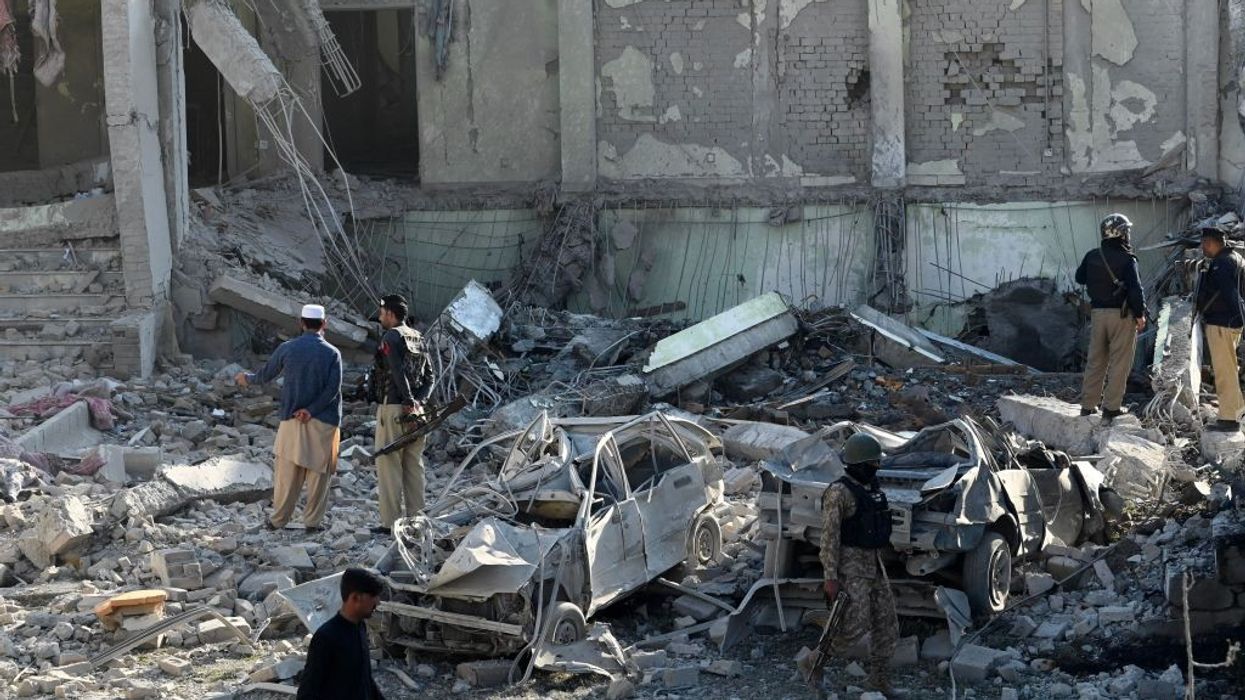
At least 12 people, mostly policemen, were killed by multiple explosions caused by a fire in a munitions cache in a Pakistan police station on Monday (24), officials said.
The explosions levelled the specialist counter-terrorism station in Kabal town of Swat Valley, in the northwestern region of Khyber Pakhtunkhwa which neighbours Afghanistan.
The incident came amid a string of high-toll militant assaults on police in Pakistan, many linked to the domestic Taliban branch, and initially sparked fears of a fresh attack.
But the head of Swat police said a short-circuit in a basement storing "grenades and other explosives" was the cause of the blasts.
"There is no suggestion that it was caused by an outside attack or by suicide bombers," Shafi Ullah Gandapur told reporters.
Khalid Sohail, a senior officer in the local counter-terrorism department, said the shock waves caused "the complete collapse of the building".
"A series of two to three bomb explosions occurred," Akhtar Hayat Gandapur, the inspector general of Khyber Pakhtunkhwa police, said, adding the "majority of the victims" were policemen.
Footage from the site showed a body being stretchered from the rubble as a smattering of small fires blazed in the darkness.
Bilal Faizi, spokesman for Khyber Pakhtunkhwa's rescue service, said 12 people were killed and 50 injured.
Akhtar Hayat Gandapur gave the same death toll and injury count.
Police on edge
Since the start of the year, two attacks on large police bases have been linked to the Pakistani Taliban, known as Tehreek-e-Taliban Pakistan (TTP).
On Twitter, Prime Minister Shehbaz Sharif intially described Monday's blasts as a "suicide attack".
"Our police has been the first line of defence against terrorism," he tweeted.
Late at night he tweeted an update saying, "The nature of the blast is being investigated".
In January, a suicide bomber detonated his vest in a mosque inside a police compound in the northwestern city of Peshawar, killing more than 80 officers as the building collapsed and rained down rubble on worshippers.
The following month, five were killed when a TTP suicide squad stormed a police compound in the southern port city of Karachi, prompting an hours-long shootout.
The TTP have long targeted law enforcement officials, who they accuse of conducting extrajudicial executions.
Pakistan has witnessed a dramatic uptick in attacks since the Taliban seized control of Kabul, focussed in its border regions with Afghanistan, and Islamabad says offensives are being launched from Afghan soil.
The TTP was founded in 2007, when Pakistani militants fighting alongside the Taliban in Afghanistan splintered off to focus attacks on Islamabad as payback for supporting the US invasion after the 9/11 attacks.
(AFP)
Pakistan: 12 die in munitions blasts at police station in Khyber Pakhtunkhwa
The incident came amid a string of high-toll militant assaults on police in Pakistan, many linked to Tehreek-e-Taliban Pakistan, and initially sparked fears of a fresh attack