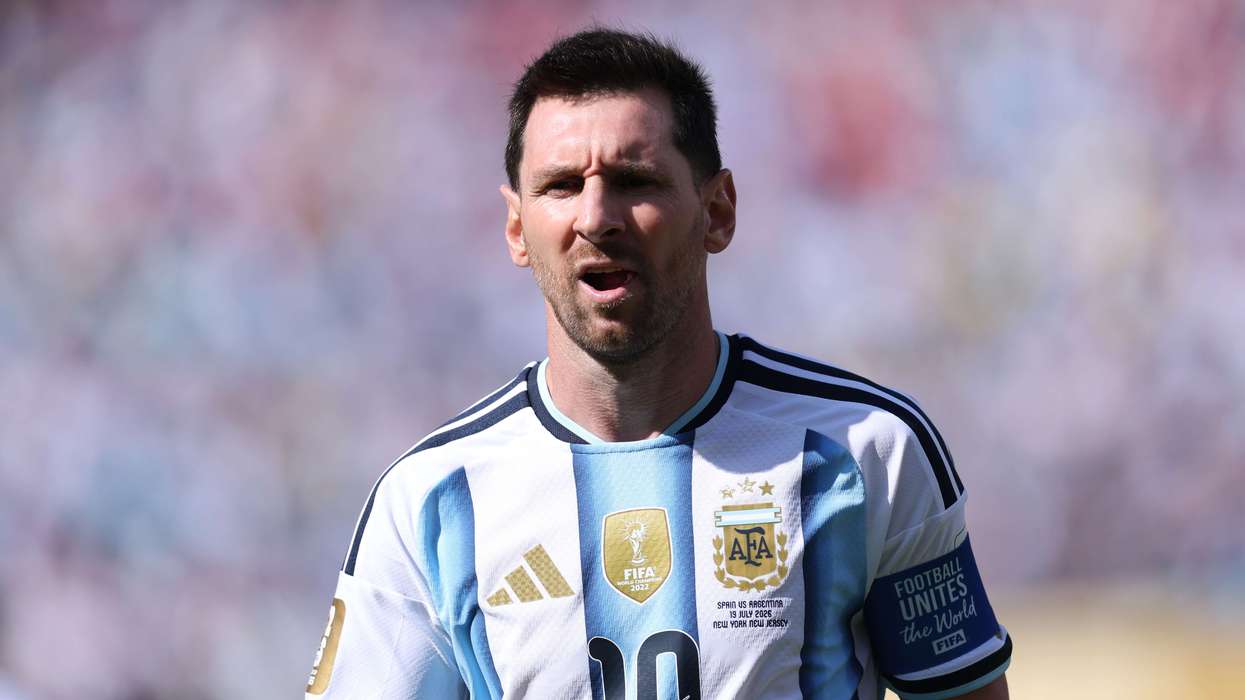

THERE is a version of this story that could have been written in Spanish rather than Argentine Spanish. After moving to Catalonia at 13 to join Barcelona, Lionel Messi could have represented Spain. He chose Argentina instead. On Monday, more than two decades later, he thanked the country for taking him in, and the country thanked him back.
"It's going to be difficult but I'm super grateful for all the joy he gave us, as a country," said Francisca Mieth, an 18-year-old university student, standing in Buenos Aires' leafy Belgrano neighbourhood. Nearby, dog walker Jose Aramburu, 36, offered his own summary of what the 39-year-old had meant to Argentina: "The most important thing that Messi gave us was the fact that he insisted, persisted and pursued a dream, a goal, an objective, without caring about what other people said."
Messi's own words, posted on Instagram, were harder won. "It was a decision that hurt and still hurts deep in my soul but I understand that it is the right time," he wrote. "I swear I always gave everything, not just in the last few years when we won everything but before that too, and I always fought and gave my all for this shirt."
Messi makes World Cup history
It is a strange thing to say about a player who finishes as Argentina's all-time leading scorer, but Messi's international career did not begin as a triumph. In 2005, an 18-year-old Messi came on as a substitute in a friendly against Hungary in Budapest — and was sent off ninety seconds later for what the referee saw as an elbow. Redemption came the following June, at his first World Cup, in the 6-0 win over Serbia and Montenegro that opened Argentina's 2006 tournament in Germany. He scored the final goal, in Gelsenkirchen. It was the beginning of a relationship with the World Cup that would come to define him.
For years, though, that relationship brought more heartbreak than glory. There were quarter-final exits to Germany in both 2006 and 2010 — the latter under Diego Maradona as coach — a Copa America final loss to Brazil in 2007, and a miserable showing on home soil at the 2011 Copa America. In 2014, as captain of Alejandro Sabella's Argentina, Messi scored in every group game and carried his country to their first World Cup final since Maradona's era, only to lose to Germany at the Maracana.
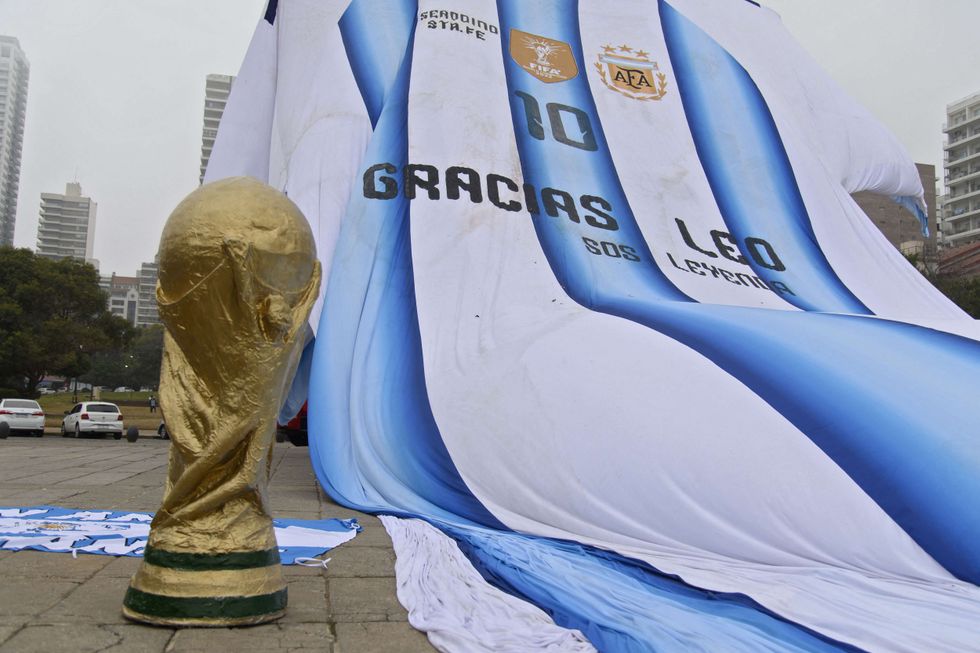 A replica of the FIFA World Cup trophy is seen next to a giant Argentina jersey bearing Lionel Messi's number 10 in front of the National Flag Memorial in Rosario, Santa Fe province, Argentina, on July 18, 2026, ahead of the 2026 FIFA World Cup final.Getty
Worse followed. A penalty-shootout defeat to Chile in the 2015 Copa America final. Then, in 2016, another final against Chile at the Copa America Centenario in the United States — and another shootout defeat, this time with Messi missing his own kick. He was, by then, a player with over 100 caps and no major international title to his name. "For me the national team is over," he said afterwards. "I've done all I can, I've been in four finals and it hurts not to be a champion." Six weeks later, he came back.
Spain claim second World Cup with extra-time win over Argentina
The turning point arrived in 2018, with the appointment of Lionel Scaloni as coach. In 2021, in the middle of the Covid pandemic, Messi and Argentina beat host nation Brazil 1-0 in the Copa America final, courtesy of an Angel Di Maria goal — Argentina's first major title in 28 years. Then came Qatar. In 2022, at 35 and playing his club football for PSG, Messi found another gear entirely: seven goals, three assists, a brace in an extraordinary final against France, and the winning penalty in the shoot-out that finally delivered the World Cup. "Obviously I wanted to finish my career with this. I can't ask for any more," he said at the time.
He did not stop there. Messi led Argentina to another Copa America title in 2024, and then, this year, to a record-equalling sixth World Cup at the age of 39. Any doubts about his age were answered emphatically — eight goals in the first five games, and a starring role in a dramatic late comeback against England in the semi-finals. His image was everywhere that summer: on billboards across downtown Buenos Aires, and towering 85 feet tall over a Patagonian town, where locals watched Argentina play England on a screen erected beside the statue's giant knees. When he turned 39 in June, Argentines took to the streets to sing him "Happy Birthday".
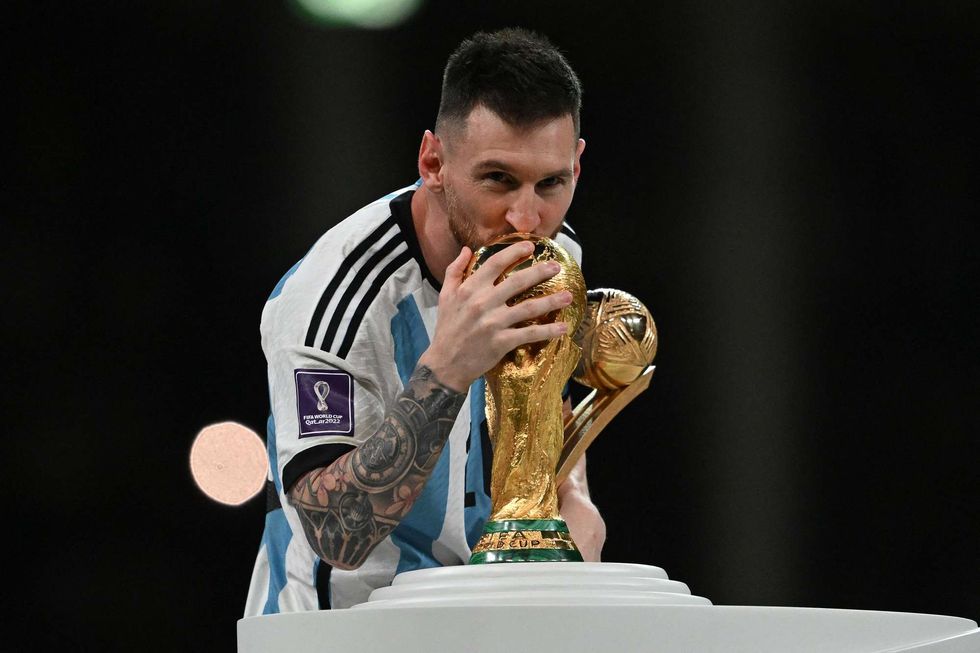 Messi kisses the FIFA World Cup Trophy during the trophy ceremony after Argentina won the Qatar 2022 World Cup final agaijst France on December 18, 2022.Getty
But the final proved one match too far. Argentina lost in extra time to Spain in East Rutherford, New Jersey, and Messi was photographed in tears as he collected his loser's medal. "Immense," he said afterwards, describing the pain, adding that it would "take a long time for this wound to heal." He finishes his World Cup career with more appearances than any other player in history — 34 — and 21 goals, one of only two men to play in three different finals.
There was a heavier loss still to come. In August, Messi's father, Jorge, died after a long illness. Messi has said the loss cemented his decision to step away from international football. In its immediate aftermath, he admitted to doubts about carrying on with the game at all. "I don't know what I'll do without you, I don't know how to go on. I just played football, and now I have serious doubts about continuing to do so for much longer," he said at the time.
In his retirement statement, the eight-time Ballon d'Or winner framed the decision as making way for what comes next. "I love, I loved, and I will always love being on the national team," he wrote. "I gave everything I had, I have nothing more to give, and besides, there are some very talented young players coming up behind me who deserve to be there."
Argentina fight back to end England's World Cup dream
He leaves with 125 goals in 207 appearances, first earned as an 18-year-old called up by Jose Nestor Pekerman in 2005, and two Copa Americas alongside the World Cup. Angel Di Maria, his long-time team-mate and a fellow 2022 world champion, thanked him on Monday not just for the trophies but for the choice he made as a boy in Catalonia: "We will be forever grateful to you for being Argentinian and for having taken Argentina to the top of the world. For having chosen to be Argentinian when you could have chosen something else. Thank you for everything." In a separate message, Di Maria wrote: "It's so hard to read that we won't see you in the sky blue and white anymore. I only know that I was born in the right century to be able to see you, enjoy you, and on top of that, to share all these years with you on the national team."
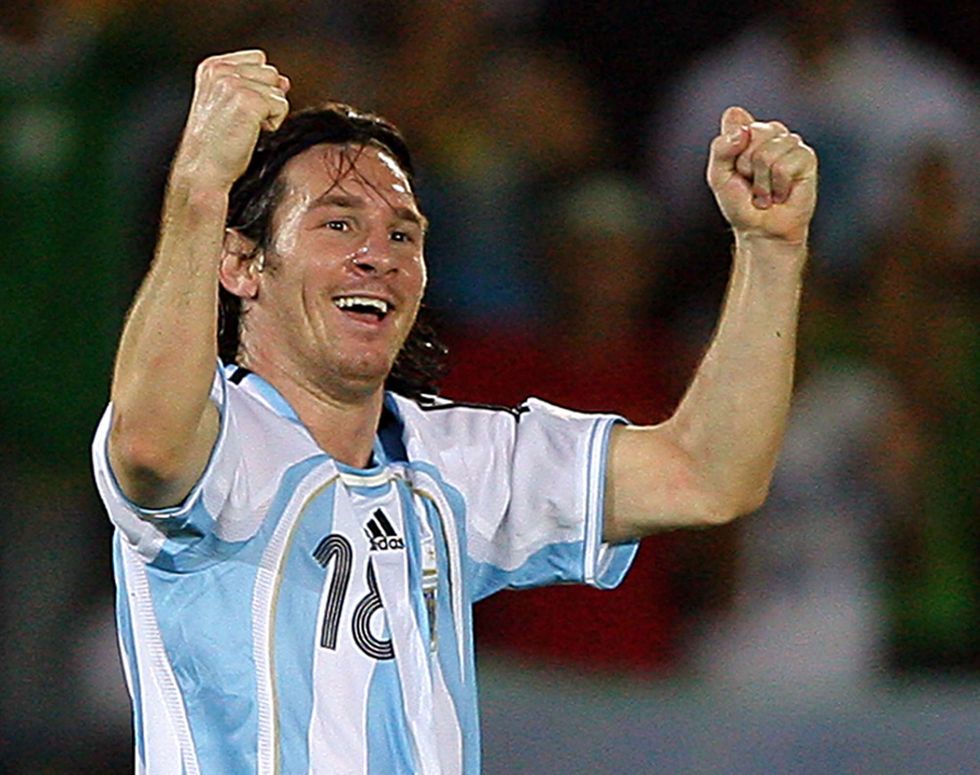 Messi celebrates after scoring the second goal of his team against Mexico during their Copa America 2007 Semifinal match 11 July 2007 in Puerto Ordaz, Venezuela. Getty
Other team-mates followed. Rodrigo De Paul, who also plays alongside Messi at Inter Miami, wrote: "Just thank you, the greatest of all time, thank you for making us so, so happy, you can't imagine how many smiles you brought!! You are eternal." Cristian Romero added: "I love you, I admire you, and I will always be grateful for everything you gave for me and for our country. Eternal thanks, captain." The Argentine national team's own statement was simple: "Eternal thanks, Leo. We will love you until the end of our days."
Tributes reached beyond football. President Javier Milei wrote: "Thank you so much, incredible man." FIFA president Gianni Infantino called Messi "one of the greatest players our sport has ever seen," crediting him with "an extraordinary international career which has inspired millions and redefined the beautiful game." Messi's wife, Antonela Roccuzzo, wrote: "What a privilege to have been by your side on this journey and to see you fulfill all your dreams. You deserved this story and so much more. We love you infinitely."
"The end of an era," read the headline on Argentine newspaper La Nacion's website. On television channel TN, a psychologist warned against the instinct to search for a successor: "no one should be burdened with the weight of being his replacement."
For Ernesto Godoy, a 38-year-old teacher in Buenos Aires, the retirement closes "an incredible career, a sportsman of a calibre rarely seen." He told AFP: "There was Maradona, then a void, then Messi, and now we're going to experience that void (again), life without Messi, just as Argentina did without Maradona."
Messi is not done playing football altogether — his contract with Inter Miami runs to the end of the 2028 season. But the sky-blue-and-white shirt, the one he said he always gave everything for, now belongs to someone else.
(With inputs from agencies)