
Highlights:
Kriti Sanon’s Raksha Bandhan advertisement for jewellery brand GIVA may have been pulled from circulation, but the controversy surrounding it has taken on a life of its own. What began as criticism of the actor’s outfit has evolved into a wider debate about women defending women, changing ideas of tradition and whether clothing should determine how someone’s relationship with culture is judged.
The advertisement showed Kriti in an ivory outfit featuring a bralette-style blouse, cape and draped skirt while celebrating Raksha Bandhan. A section of social media users objected to the styling, while actor and politician Kangana Ranaut also criticised the campaign.
But Kriti’s response changed the direction of the conversation. Rather than simply defending an advertisement, she challenged the broader idea that women’s clothing should be used as a measure of their respect for tradition.
 Instagram/@kritisanon
“Imagine being this bothered by what another woman chooses to wear”
Kriti’s most direct response was aimed at the idea that another woman’s clothing should become a matter for public policing.
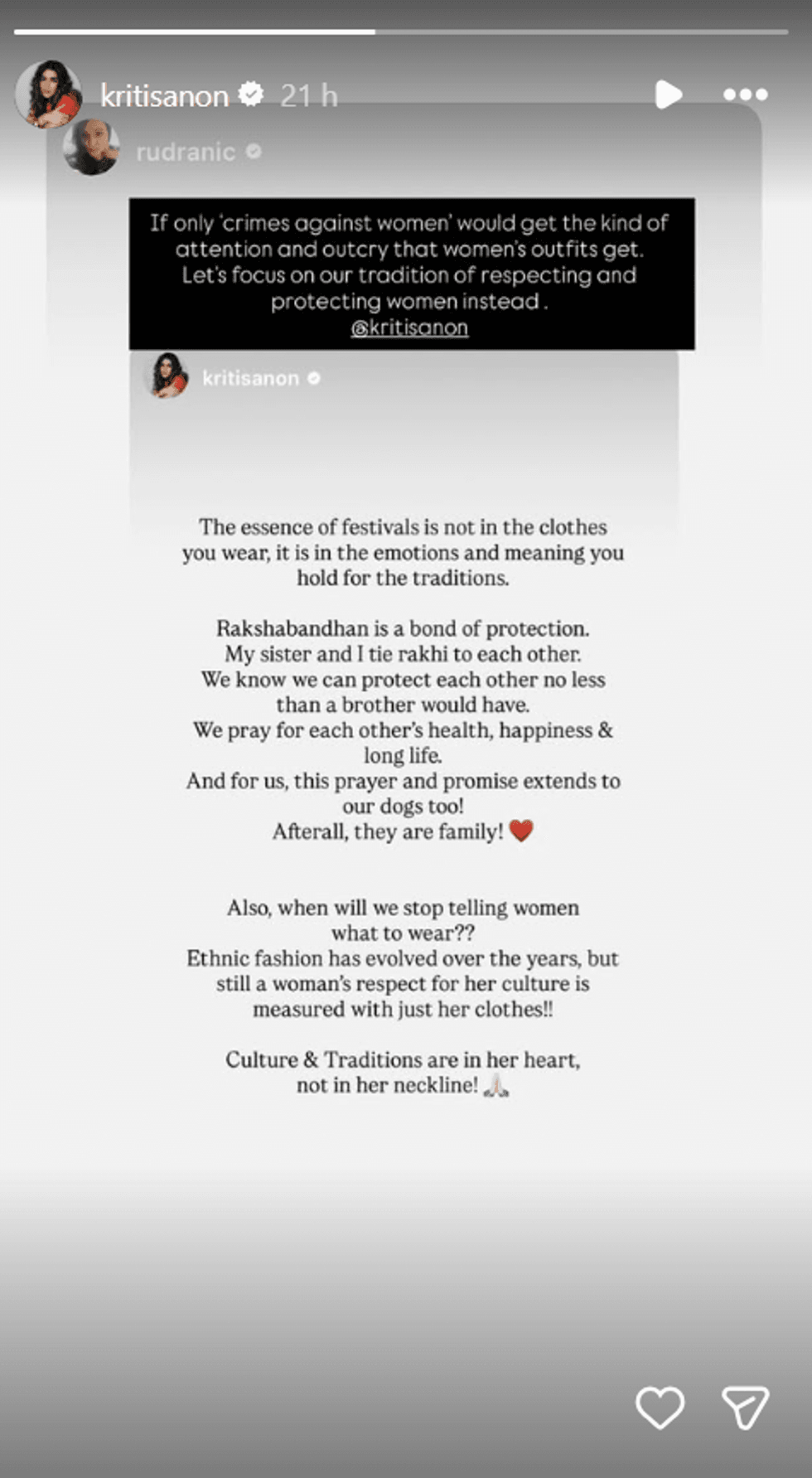
She wrote, “Imagine being this bothered by what another woman chooses to wear. Respectfully, evolve. PS: I'm the one she tied the rakhi to, and if I don't have a problem with it, why do you?”
That line has become central to the debate because it reframes the controversy. Instead of asking whether Kriti’s outfit was appropriate for Raksha Bandhan, her response asks why women’s clothing so often becomes the focus when discussing their morality, culture or respectability.
Her sister Nupur Sanon subsequently supported her and also asked Kangana to “respectfully evolve.”
“The essence of festivals is not in the clothes you wear”
Kriti’s argument went beyond fashion. She connected Raksha Bandhan to the emotional meaning of the festival rather than its visual presentation.
She wrote, “The essence of festivals is not in the clothes you wear; it is in the emotions and meaning you attach to the traditions.”
She explained that she and her sister tie rakhi to one another and view protection as a mutual bond rather than something exclusively defined by the traditional brother-sister dynamic.
Kriti added, “Raksha Bandhan is a bond of protection. My sister and I tie rakhi to each other. We know we can protect each other just as much as a brother would.”
That perspective adds another layer to the dispute: traditions can remain meaningful even as the way people observe them changes.
“Also, when will we stop telling women what to wear?”
This is where the controversy becomes less about GIVA and more about a familiar cultural argument.
Kriti asked, “Also, when will we stop telling women what to wear?” She argued that ethnic fashion has evolved while expectations surrounding women’s appearance have not necessarily changed at the same pace.
Her most pointed conclusion was: “Culture and traditions are in her heart, not in her neckline!”
The response also highlights why women defending women has become such an important part of this debate. Kriti’s argument is not simply that she should be allowed to wear what she wants. It is that another woman’s choice of clothing should not automatically become evidence of whether she respects her culture.
“Why would you tie a rakhi to your brother while wearing a bikini or undergarments?”
Kangana Ranaut’s criticism represents the opposing interpretation. She questioned the styling choices and wrote, “Why would you tie your brother a Rakhi in your bikini/under garments? Where are all your styling options? Ha ha the advert looks intentionally creepy.”
GIVA ultimately withdrew the advertisement, saying it had the “highest regard and deep respect for Indian culture, traditions and festivals” and that if the campaign had inadvertently hurt sentiments, that was not its intention.
The interesting angle, however, is that the ad’s removal has not ended the discussion. It has shifted it. What began as a clothing controversy has become a conversation about who defines cultural respect, and why women’s clothes remain such a powerful battleground in that argument.