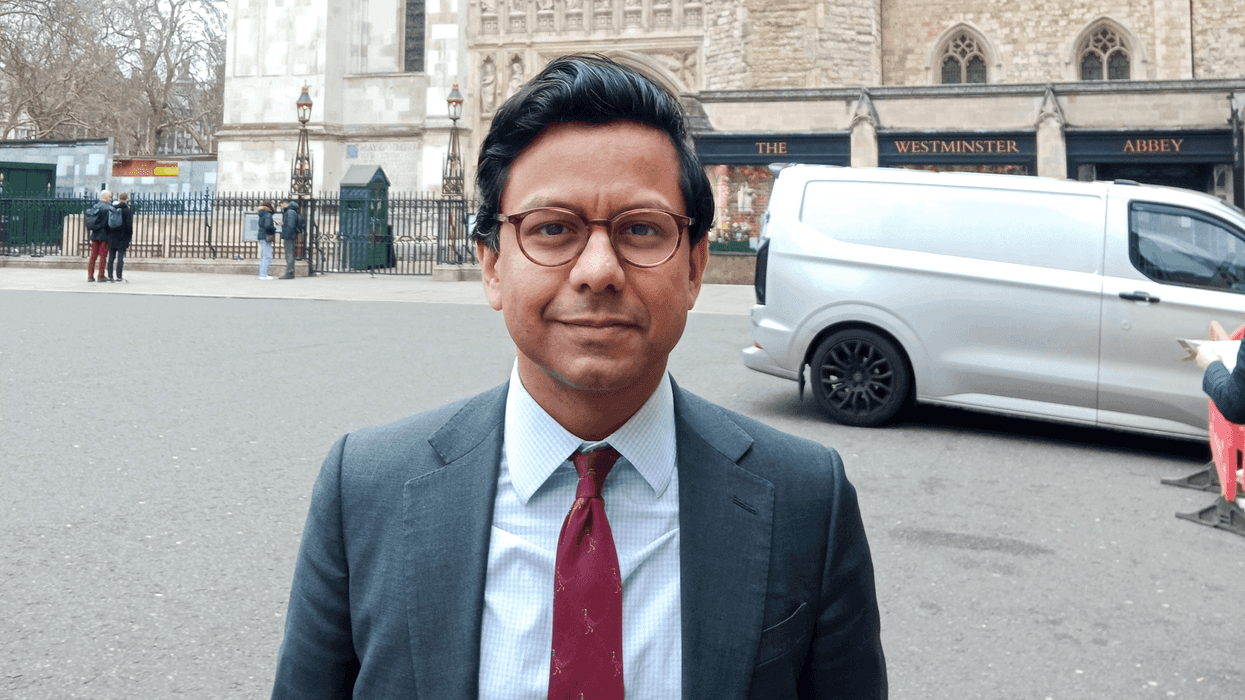

Tipping someone for high office does not always advance someone’s career but there is consensus in Westminster that Kanishka Narayan shows promise. He is considered one of the brighter members of the parliamentary intake from 2024 when he was elected Labour MP for the Vale of Glamorgan in Wales but with a majority of only 4,216.
Still only 36, he represented Britain at the AI summit in Delhi in February this year as parliamentary under secretary of state at the department of science, innovation and technology. He impressed by giving interviews not only in English but also in Hindi.
In Britain, he has been put forward for the media rounds, which is always a sign an MP is trusted by the party leadership.
“Yes, I’ve done quite a few media rounds on behalf of the government,” said Narayan in an interview conducted over an 8am breakfast meeting. “I’ve done a lot of TV and radio. I did Newsnight a few weeks ago. It was partly on AI and partly on student loans, and we also talked about the cabinet secretary's appointment. Chris Wormald had just moved on, and Antonia (Romeo) was being appointed (in his place). Then we also talked about Jim Ratcliffe, the owner of Manchester United, saying that Britain is getting colonised. We talked about the full range of political issues.”
Kanishka Narayan, a descendant of Rajendra Prasad, independent India’s first president, was born in Muzaffarpur in Bihar on 30 November 1989, not far from the capital Patna. He parents shifted to Delhi when he was two. His mother’s uncles, who had trained in the Indian School of Mines in Dhanbad, emigrated to South Wales to work in its mining industry. He moved with his parents to Cardiff when he was 12, and was educated as an Oppidan Scholar at Eton and then read PPE (philosophy, politics and economics) as an undergraduate at Balliol College, Oxford.
The job of AI minister could have been created for him.
“I had spent time investing in AI companies, looking at the landscape, understanding where Britain was, relative to the rest of the world on AI,” he said. “I gave it all up when I became an MP just to avoid any possible conflict of interest. I was doing speeches in parliament saying that the central political question for us is the future of technology in Britain. And so when I got this job in September, I was fired up for it, because I’ve been thinking about AI for a long time.”
He is now using his influence to bring about greater collaboration between Britain and India on collaboration.
He said: “India was amazing. The first summit of the series (masterminded by Rishi Sunak when he was prime minister) was at Bletchley Park in the UK in 2023. There were 250 people there. In India, there were 250,000 people. The scale was just radically different.”
Narayan himself appeared to be a source of inspiration for young Indians. “I had young students from IIT (Indian Institute of Technology) Delhi and IIMs (Indian Institutes of Management) coming up to me to say that they were building this or that. It felt like a much broader conversation than before.”
He explained why a closer partnership with India on AI would be beneficial for Britain. “Young people in India – 65 per cent – say they are excited about AI. They want to grasp the opportunity. They want to grow. 65 per cent of people in Britain say they’re deeply nervous and worried about AI. As a result, we don't clinch as many of those opportunities. If we can partner a lot closer with India and share a sense of how we make AI responsible and mitigate risk, fundamentally focus on how we can grasp the opportunities, I think we’d see a pretty different projection (of AI).”
The two countries are already working together: “We signed a technology security initiative with India, and as part of that, we agreed that we would set up a joint research centre on AI. We’ve also agreed at a couple of specific areas of bilateral commercial exchange. We took a delegation there of companies. We want to welcome an Indian delegation here as well. In semiconductors, in chip design, in areas of applied AI like healthcare, we’re already collaborating pretty extensively, and I want to do even more.”
Narayan came across as an effective spokesman for Britain in key meetings: “I had bilateral ministerial conversations with the White House team from the US. I met the French minister, the Australian minister, the Norwegian minister. It was a genuinely global conversation about how Britain can play into that multilateral context.”
The trip to Delhi brought back childhood memories. “I did this interview with NDTV at the British Council in Delhi. And the British Council of Delhi is very special for me, because when I was growing up, my mum used to take me and my brother on the public bus all the way from south Delhi to the British Council because she thought it was the best library in Delhi for young people. It was air conditioned in the summer. Certainly, as a kid, I thought it would be amazing to move to Britain. To go back after 25 years as the UK AI minister was very special.”
Narayan went to Bangalore as well. “I met the chief minister of Andhra Pradesh, and the IT minister for Karnataka.”
Narayan projected a very positive picture of Britain. “Britain is definitely not broken in technology. There are only three countries that have a trillion dollar tech ecosystem – the United States, China and the UK. When you look at frontier AI development, people would recognise that there are only three countries in town – the US, UK and China. And so across the board, you’re seeing both in terms of our history, our heritage, our present, but really excitingly, where capital is going in terms of bets on the future, people are betting on the UK very materially.”
He said: “British politics has obviously become very volatile over the last five to 10 years. But for now, I feel the technology and AI are moving so rapidly that to be able to just have some continuity of policy, to be able to say, here are bets we’re making and, we’re going to see them through, and we’re going to move with the pace of technology, is really important. I will try to do that for as long as I can do the job.”
ends