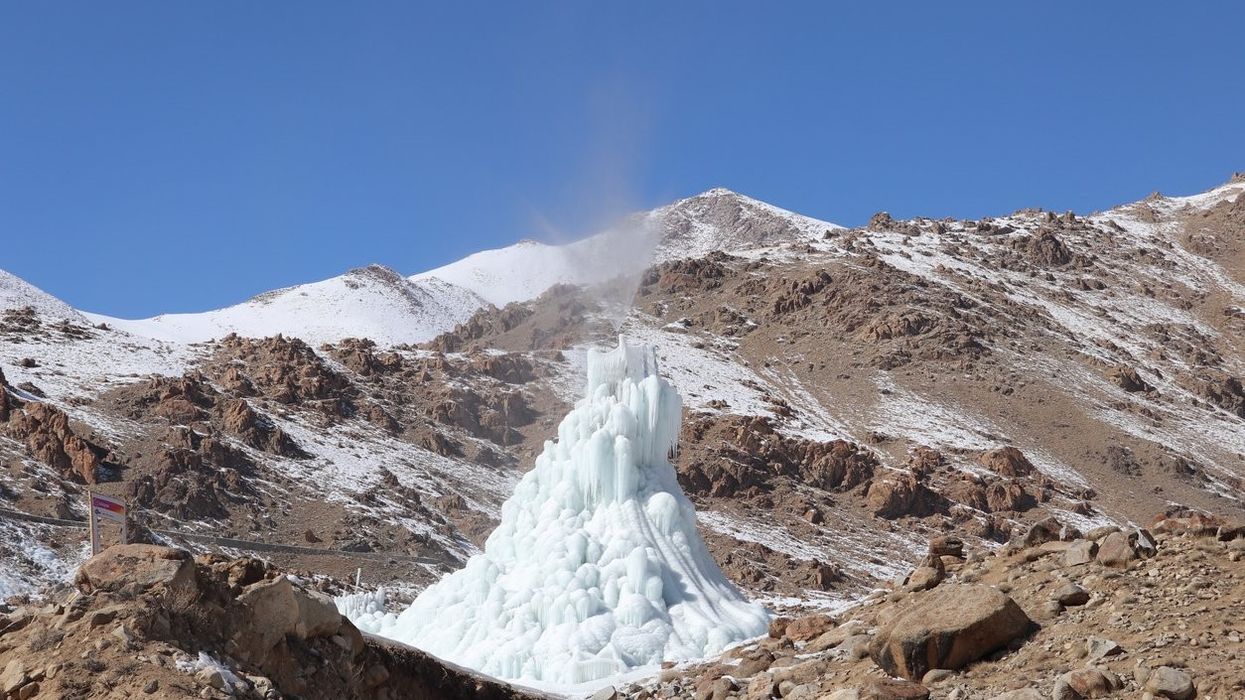

When we read the word 'Ice Stupa', our first thought is that it is some monument, or some naturally made structure related to Buddhism. But this is actually manually constructed in a place called Ladakh in the north-most region of India, a popular tourist spot for bikers and trekkers.
The temperature here falls down to -40 degrees Celsius, making it geographically impossible to have vegetation or fauna, for people to survive. This place is covered in snow, amidst the great Himalayas and just huge rocks. The people staying in Ladakh do not have any access to the rest of the world, due to extreme conditions.
But recently, even though, they don't generate pollution, they have been facing issues of climate change, lacking a source of freshwater. Hence, this project was started to overcome the problem of freshwater.
Ice stupas are a unique form of glacier grafting technique designed to create artificial glaciers, primarily used for storing winter water that would otherwise go unused. Originating from the cold desert region of Ladakh, India, where agriculture is severely limited during the winter due to frozen soil and low temperatures, ice stupas have emerged as an innovative solution to address water scarcity during the dry spring months.
The concept was pioneered and popularised by Sonam Wangchuk, an innovator and social reformer, in collaboration with the NGO Students' Educational and Cultural Movement of Ladakh. The project, known as The Ice Stupa Project, commenced in October 2013, with a test project initiated in January 2014.
Inspiration for the ice stupas came when Wangchuk observed ice persisting under a bridge even in the summer months, due to being shielded from direct sunlight. Recognising the potential of this phenomenon, he conceived the idea of creating conical-shaped ice heaps that would minimise the surface area exposed to the sun, thereby preserving water for longer periods.
In October 2013, Wangchuk constructed the prototype of a 6-meter ice stupa, freezing 150,000 litres of water in Leh without any shade. Gravity-fed piping was used to transport water from upstream, eliminating the need for electricity or machinery. The ice stupa remained intact until May 18, 2014, despite temperatures exceeding 20°C.
The success of the ice stupa concept lies in its ability to mitigate water scarcity during the critical spring season, thereby extending the cultivation period in a region where agriculture is heavily reliant on snow and glacier meltwater. This is particularly significant in light of climate change, which has led to hotter summers and shifts in precipitation patterns, exacerbating water shortages in Ladakh.
Recognising the potential of ice stupas to revolutionise water management in Ladakh, efforts have been made to scale up the initiative. The Ice Stupa Competition, launched in 2019, aims to promote the construction of artificial glaciers for irrigation purposes. In 2019, 12 ice stupas were built, with plans to construct around 25 stupas in 2020.
By harnessing renewable energy sources such as wind, hydro, and solar power, ice stupas offer a sustainable solution to water scarcity without needing energy storage. Through innovative techniques such as snow cannons, it is envisioned that ice stupas could irrigate all cultivable land in Ladakh, supporting agricultural livelihoods and food security in the region.









Netanyahu faces backlash for calling Britain ‘Islamic Republic’