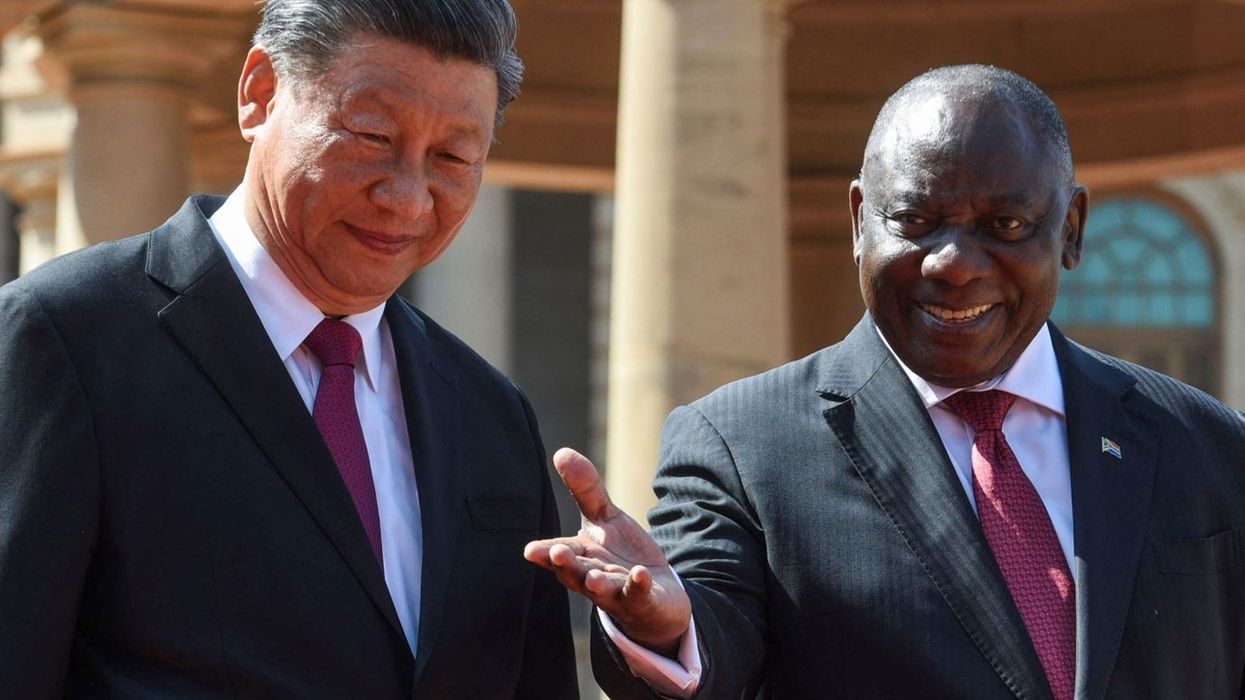

LEADERS of the BRICS nations – Brazil, Russia, India, China and South Africa – were due to open a summit in Johannesburg on Tuesday (22) where they will weigh expanding membership as some members push to forge the bloc into a counterweight to the West.
Heightened global tensions provoked by the Ukraine war and a growing rivalry between China and the United States have added urgency to a drive to strengthen the bloc, which has at times suffered from internal divisions and a lack of coherent vision.
“An expanded BRICS will represent a diverse group of nations with different political systems that share a common desire to have a more balanced global order,” South Africa’s president, Cyril Ramaphosa, said in an address ahead of the meetings.
The theme of its 15th summit is “BRICS and Africa”, but the meeting has also underscored divisions over the war in Ukraine and the support Russia enjoys from its other BRICS partners at a time of global isolation. South Africa, China and India have not condemned Russia’s invasion, while Brazil refused to join Western nations in sending arms to Ukraine or imposing sanctions on Moscow.
Ahead of the summit, Ramaphosa said his country would “not be drawn into a contest between global powers” and had resisted pressure to align with any influential blocs of nations.
Boosting the use of member states’ local currencies is also on the agenda.
South African summit organisers, however, said there will be no discussions of a BRICS currency, an idea floated by Brazil earlier this year as an alternative to dollar-dependence.
Ramaphosa will host Chinese president Xi Jinping, Brazil’s Luiz Inacio Lula da Silva and India’s prime minister Narendra Modi from August 22 to 24.
Russia’s president Vladimir Putin, wanted under an international arrest warrant for alleged war crimes in Ukraine, will not travel to South Africa and instead join virtually.
Expansion has long been a goal of bloc heavyweight China, which hopes that broader membership will lend clout to a grouping already home to some 40 per cent of the world’s population and a quarter of global GDP.
“Today, standing at a new historical starting point, inheriting friendship, deepening cooperation, and strengthening coordination are the common aspirations of the two countries, and are also the important tasks entrusted to us by the times,” said Xi.
The leaders were due to hold a mini-retreat and dinner on Tuesday evening (as Eastern Eye went to press) where they are likely to discuss a framework and criteria for admitting new countries.
But expansion has become a point of contention. Russia is keen to bring in new members to counter its diplomatic isolation over its invasion of Ukraine. South Africa has also voiced support. India, which is wary of Chinese dominance and has warned against rushing expansion, has “positive intent and an open mind”, foreign secretary Vinay Kwatra said on Monday (21). Brazil, meanwhile, is concerned that growing BRICS will dilute its influence.
While a potential BRICS enlargement remains up in the air, the bloc’s pledge to become a champion of the developing “Global South” and offer an alternative to a world order dominated by wealthy Western nations is already finding resonance.
More than 40 countries have expressed interest in joining BRICS, said South African officials.
Of them, nearly two dozen have formally asked to be admitted.
The BRICS operate on consensus and the “ChinaIndia rivalry is probably the major challenge that BRICS will eventually be confronted with” said Jakkie Cilliers, founder of the Pretoria-based Institute for Security Studies (ISS) think tank. (Agencies)






 Curator Emma Slocombe with ikat robes and arabachi coats in the Peter the Great Room in Blickling Hall Amit Roy
 View of the entrance to Blickling Hall on a rainy autumn dayAmit Roy
 Kente cloth from Ghana in the Long Gallery in Blickling Hall
 Decoration in the Great Hall at Blickling Hall Amit Roy
 Palampore fragment made in coastal south-east India in the Brown Room in Blickling Hall Amit Roy
 Bed valance dating from early 1700s in the Italian Print Room at Blickling Hall Amit Roy
 Indian inspired fabric draped on sofas in the South Drawing Room in Blickling Hall Amit Roy
 Indian inspired fabric draped on sofas in the South Drawing Room with Indian carpet in Blickling Hall Amit Roy
 Karun Thakar has picked out the geometric patterns in the bookcase and the Kente cloth in the Long Gallery in Blickling Hall Amit Roy
 Large tapestry depicting Peter the Great defeating the Swedish army at the Battle of Poltava in 1709 Amit Roy
 ikat robes and arabachi coats in the Peter the Great Room in Blickling Hall Amit Roy
 Baghs and kanthas made by women provide contrast to the men only portraits in the Great Hall at Blickling Hall Amit Roy
 Baghs and kanthas in the entrance Great Hall at Blickling Hall Amit Roy
 Baghs and Kanthas in the Great Hall in harmony with stained glass window at Blickling Hall Amit Roy
 Kimonos reflect Japanese influence in Upper Ante Room in Blickling Hall Amit Roy
 Kimono in Upper Ante Room in Blickling Hall
 A view of the Palace and fort at Agra shows romantic side of India Amit Roy
 Blickling Hall Amit Roy
 Table carpet, European 1670-1680 Amit Roy
 Unfinished 17th century Italian embroidery in the Print Room at Blickling Hall Amit Roy
 Picture of Kashmir shows a romantic view of India Amit Roy
 A panel of Ashburnham bed hangings made in Gujarat for sale in Europe in the Brown Room in Blickling Hall Amit Roy
 Colcha made in the 1600s by women in Bengal for the Portuguese market in the Long Gallery at Blickling Hall Amit Roy




