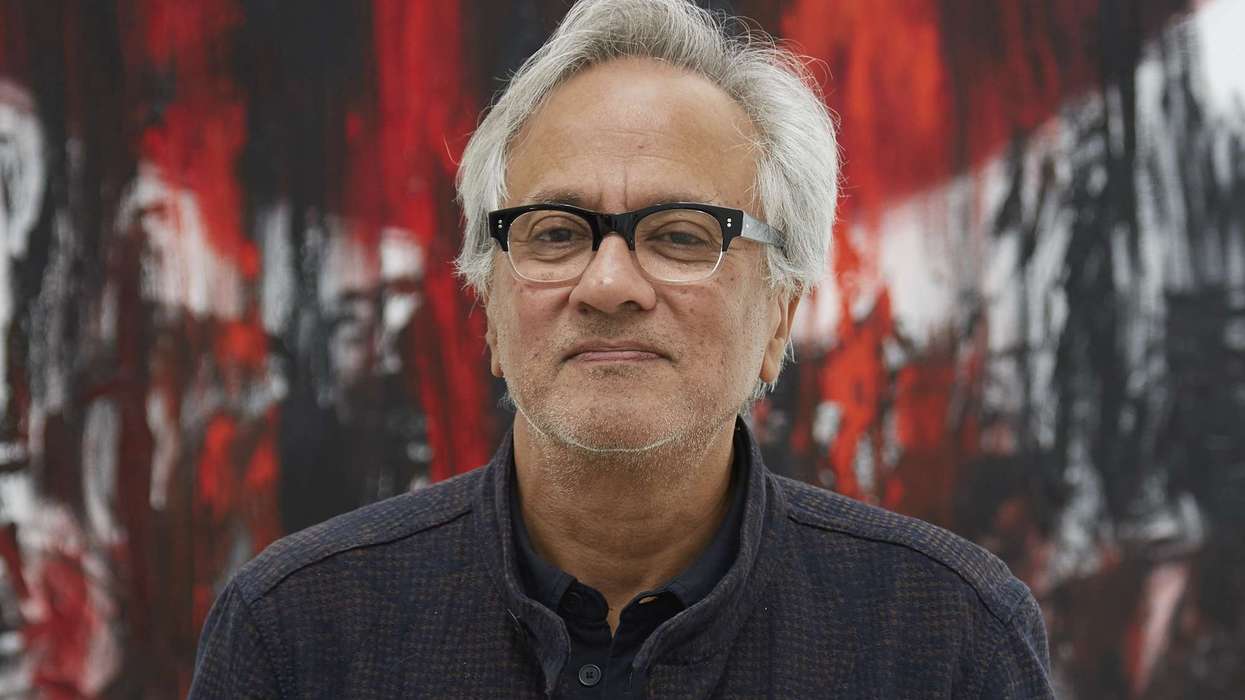

The sculptor Sir Anish Kapoor received the top prize at Eastern Eye’s Arts, Culture & Theatre Awards (ACTA) in June this year for his “outstanding contribution to the creative industries”.
His exhibition at the Hayward Gallery in the South Bank explains why.
The exhibition, which opened on 16 June, is due to close on Sunday (18). On the evening I went last week, most of the people wandering around the five rooms devoted to his sculptures and paintings were not Indian. Kapoor is now after all a global figure.
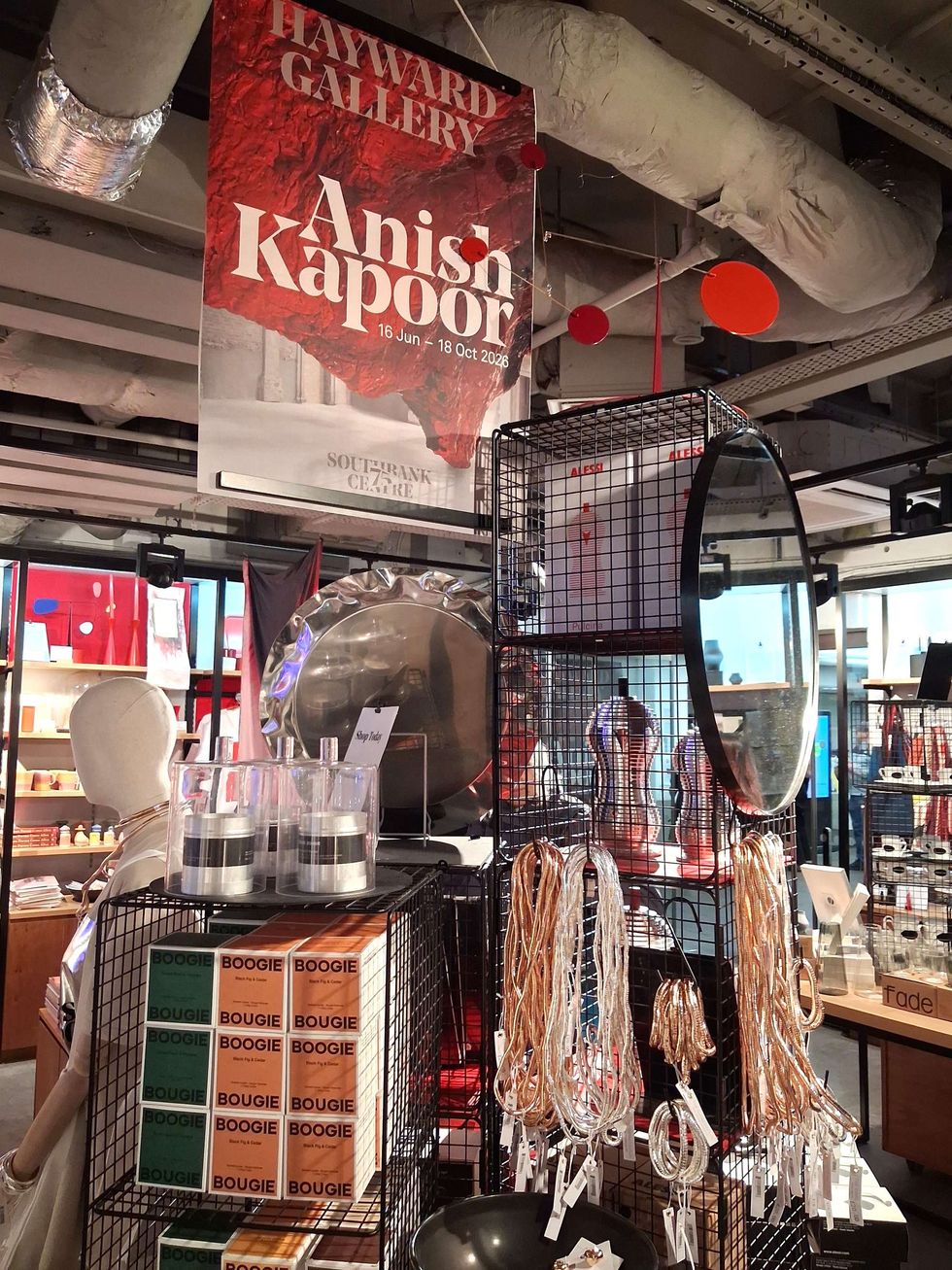 Anish Kapoor merchandise in the Hayward Gallery shopEastern Eye
Kapoor has a distinctive signature with his polished surfaces. There are several examples of that in the current exhibition. One is called Iris. There are also a couple of polished installations on the terrace – Cloak and Tsunami. People have fun walking round those sculptures which “warp perception and space”.
“Large-scale mirrored steel sculptures, placed on the Hayward’s outdoor terraces, further immerse visitors in a perceptual journey that combines discovery and disorientation,” said the Hayward.
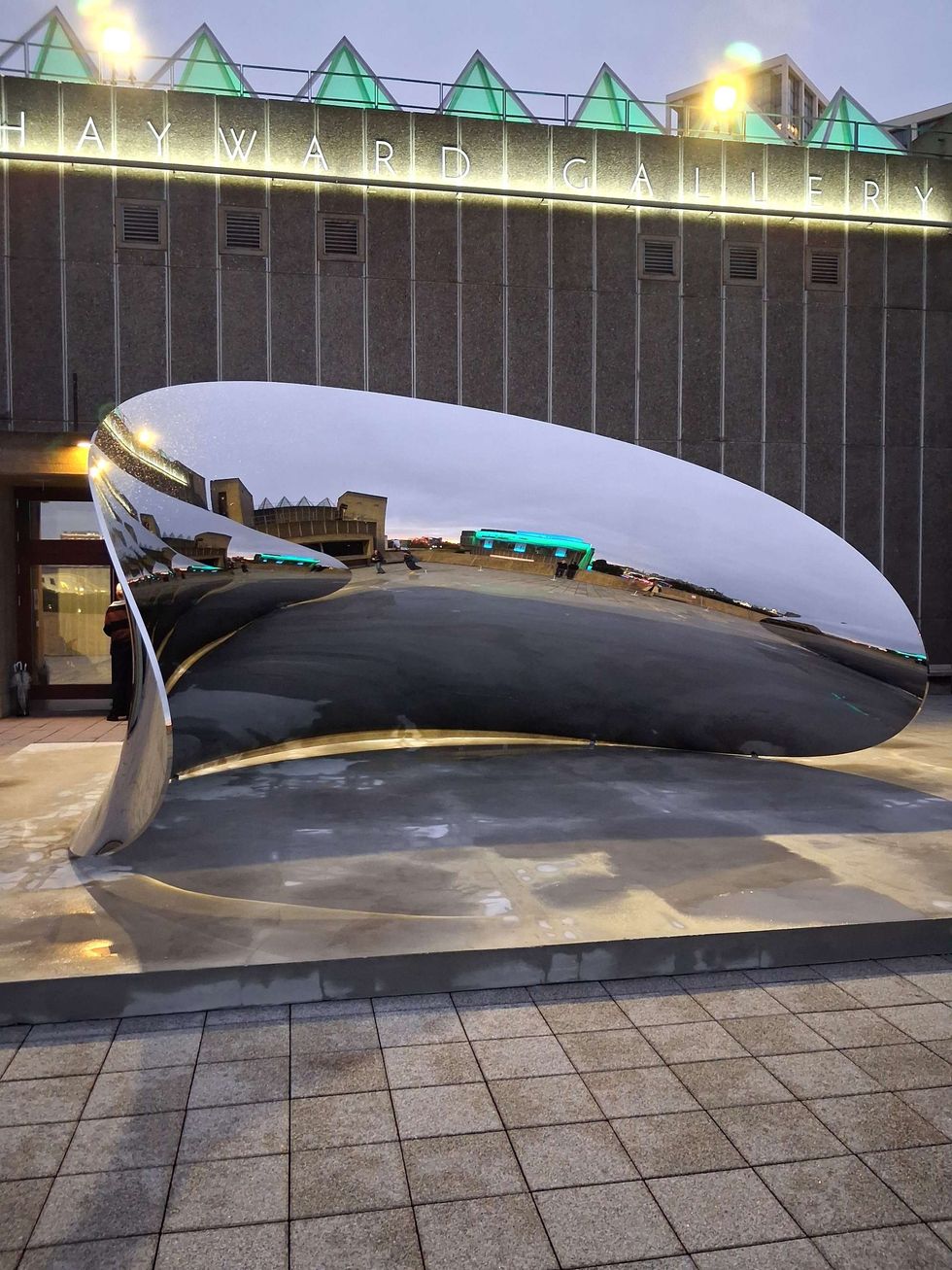 TsunamiEastern Eye
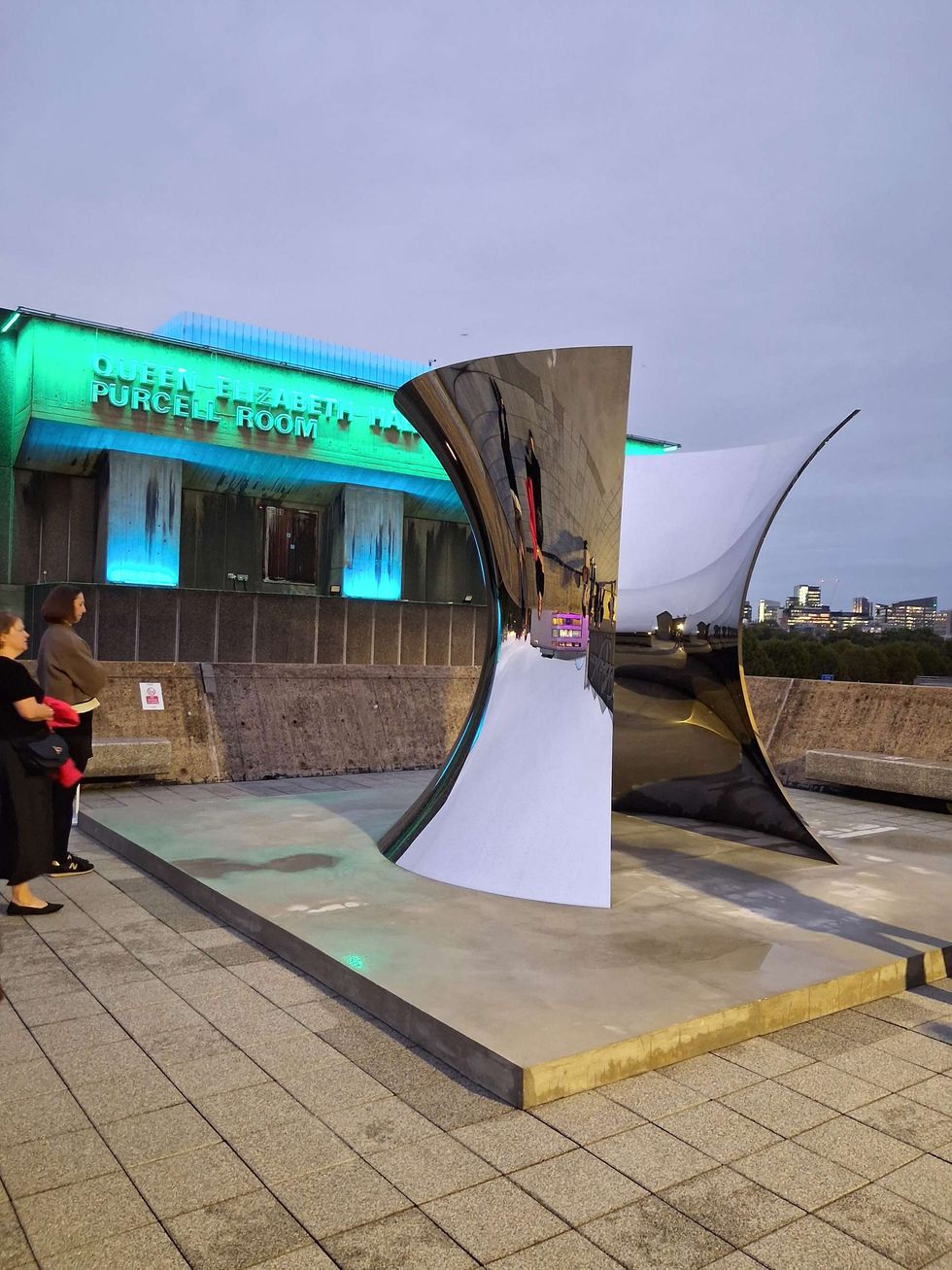 CloakEastern Eye
In recent years Kapoor has been working with a colour called “Vantablack”. It apparently absorbs “99.965 per cent visible light”. Out in space, black holes absorb 100 per cent of the light in his vicinity. In fact, a black hole is able to swallow anything in its path.
I suppose this is the principle that Kapoor has applied in paintings done in Vantablack. I stood close to one and couldn’t tell whether it was a flat surface or a deep dark cavity in the wall. Some were untitled but one on the floor was called Descent into Limbo. This is one of Kapoor’s most famous seminal “void” works. “In the context of his ongoing exploration of the deep black void, it functions as a terrifyingly depthless black hole opening within the gallery floor.”
I suppose Kapoor has great fun with Vantablack.
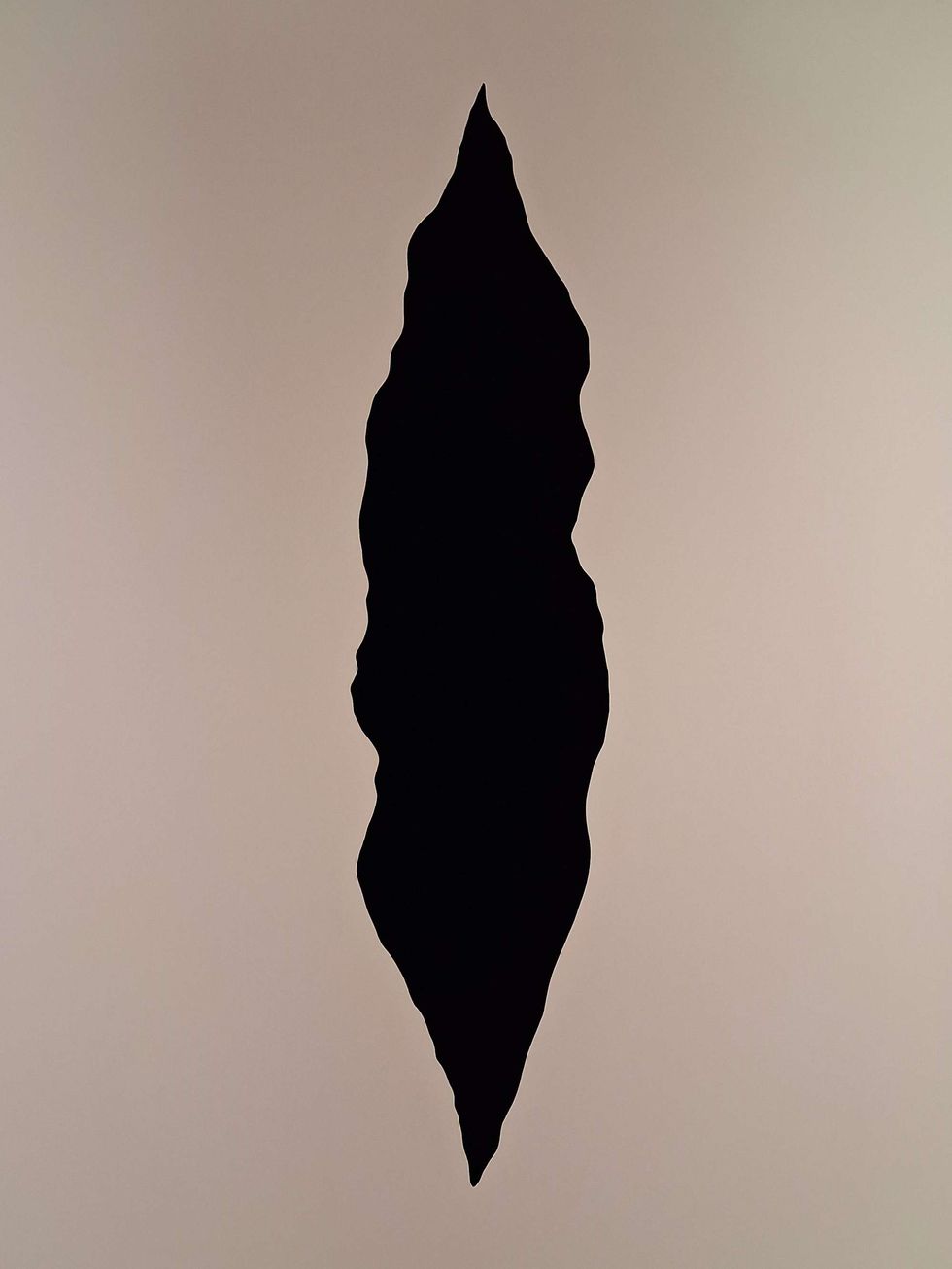 Untitled (work in Vantablack)Eastern Eye
“The exhibition also highlights the artist’s ongoing exploration of perceptual illusions, including seemingly depthless ‘void’ works and sculptures coated with
Vantablack: a light-absorbing nanotechnology so black it makes three-dimensional forms appear entirely flat when seen head-on,” said the Hayward.
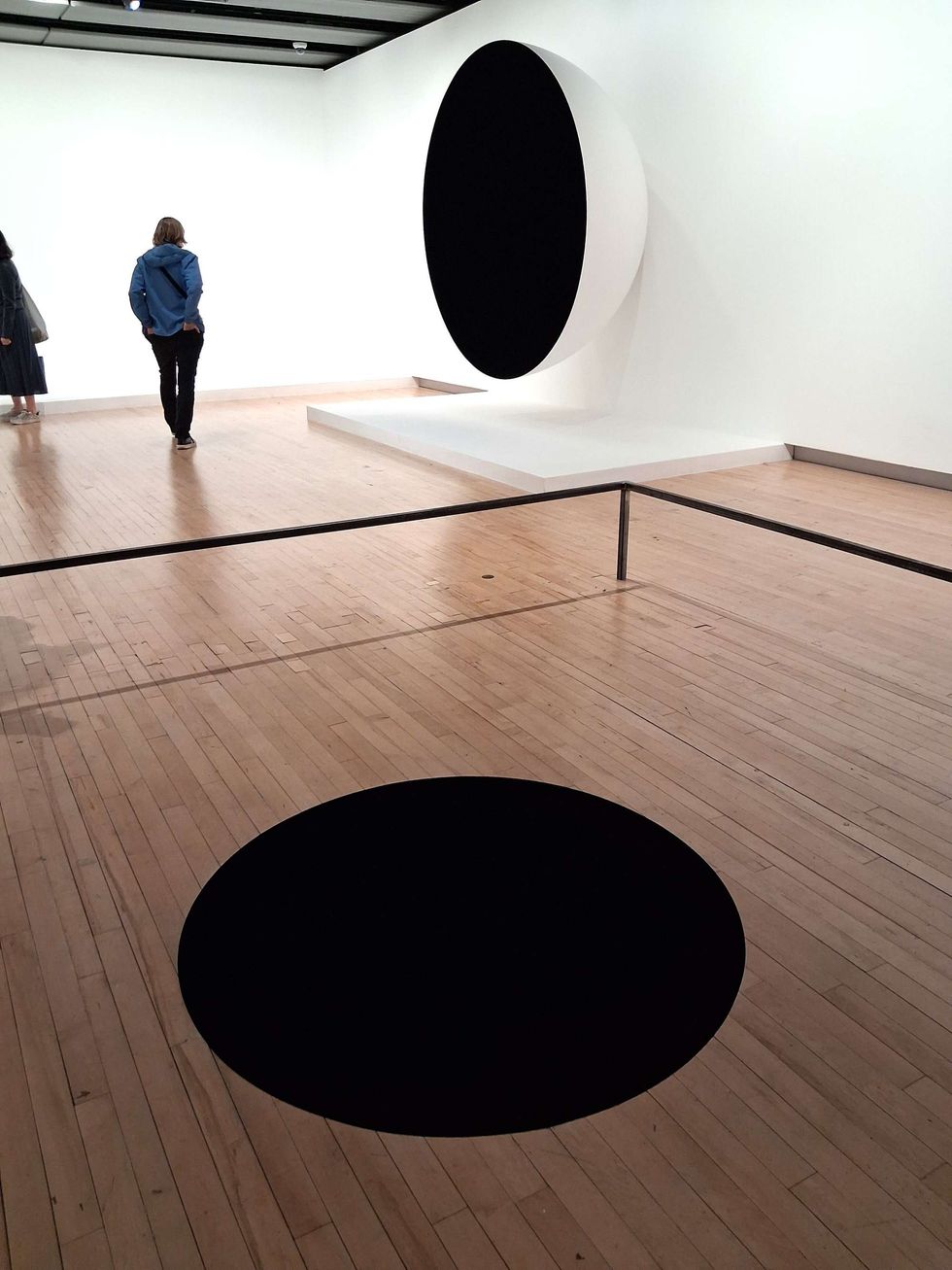 Descent into limbo (work in Vantablack)Eastern Eye
Kapoor also uses red a great deal. Maybe that is his inner Indian manifesting itself. Red is not only a bridal colour in India but is also the colour of blood and life itself. Examples include a couple of giant works – Ha Makom, which resembles a collection of boulders, and Mount Moriah at the Gate of the Ghetto, which is best described as an upside down mountain ridge. There is also an oil on canvas, The Dark.
“In a second new work, a dark mountainous threshold looms down amid a sprawling red landscape contained within the upper gallery,” said the Hayward. “In a third section, Mount Moriah at the Gate of the Ghetto (2022) defies gravity as it descends from the ceiling, hovering inches above the gallery’s floor tiles. Overwhelming in size and emotional intensity, these monumental works elaborate on Kapoor’s fascination with the sublime.”
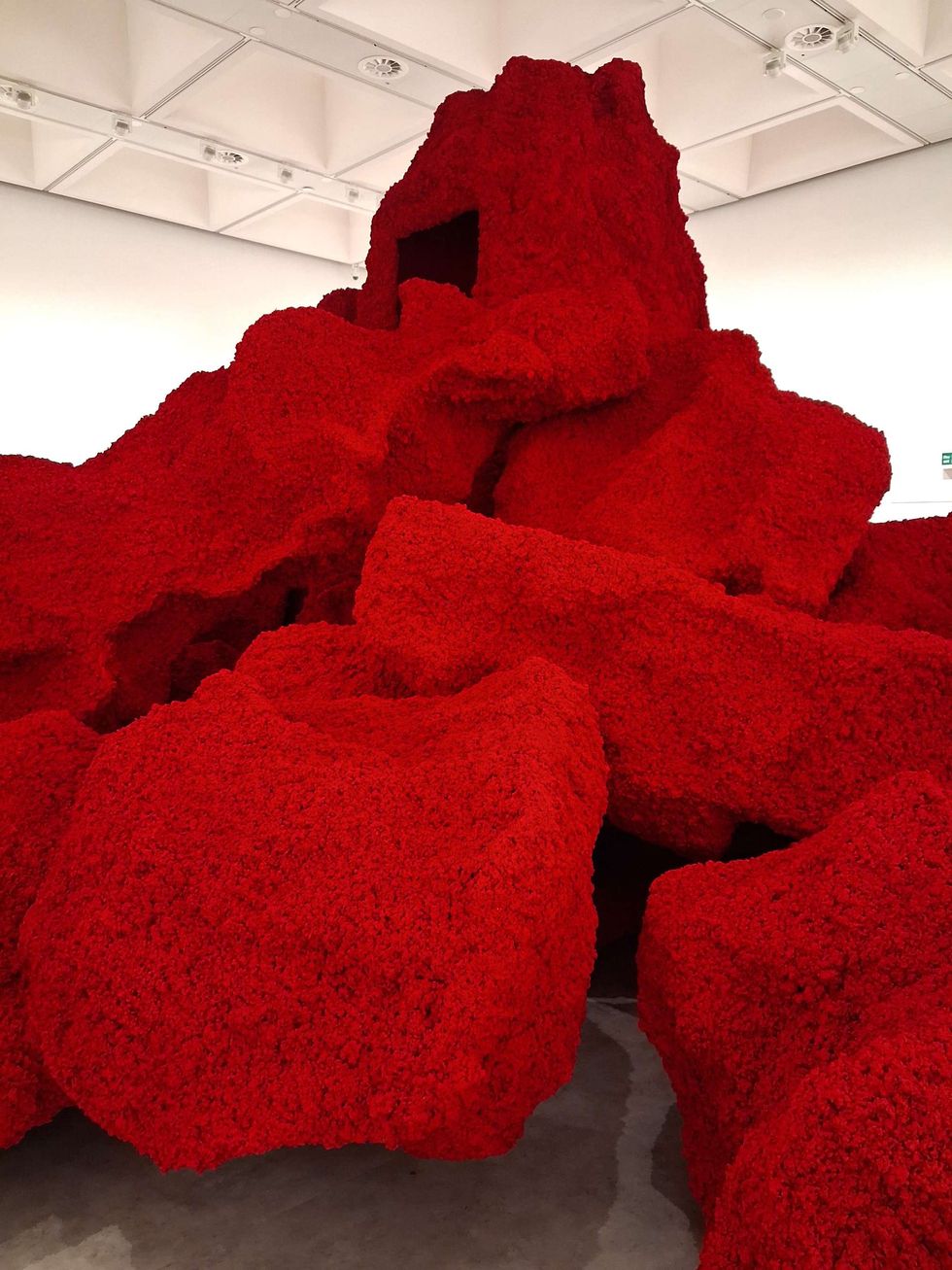 Ha MakomEastern Eye
As you enter the exhibition, there is a sculpture in red, All is Nothing, which looks like exactly like the Babybel Original Mini Lunchbox Snack Cheese you buy at Sainsbury’s. Only this is so big it has to be squeezed into the space between floor and the high ceiling.
“Visitors can first explore a gallery completely transformed by a colossal and imposing new work: an inflated PVC membrane that fills the six-metre-high space, challenging our sense of scale and self,” is how the Hayward puts it.
Some people might feel a bit squeamish entering the room which resembled an abattoir, I have to admit it. The sight of all those entrails – Interior of the Body: evocation of ritual sacrifice – made me do a quick round.
“Lastly, the exhibition features some of Kapoor’s strikingly visceral paintings and sculptures from the past decade,” was the Hayward’s explanation. “Created using silicone, resin, and pigment, these intense works conjure splayed-open bodies and internal organs. The paintings and sculptures challenge our psychological responses, asking us to reflect on what it means to exist in an age where violent images are pervasive.
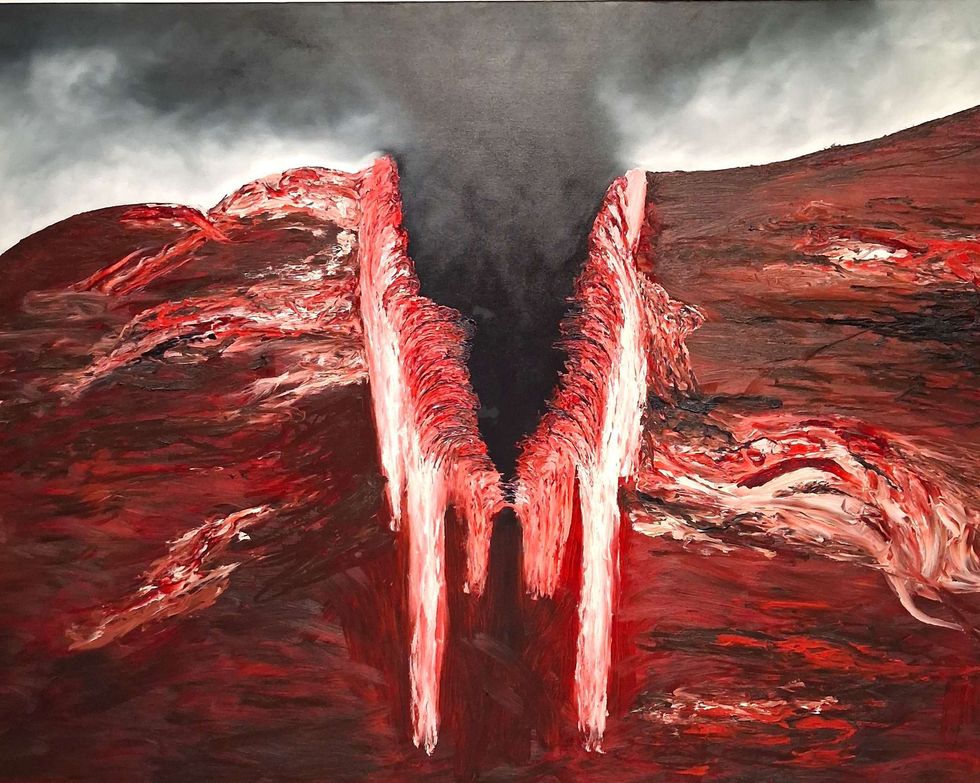 The Dark (oil on canvas)Eastern Eye
“Taken altogether, the artworks in the exhibition ask audiences to shift their attention away from the surface, inviting them to imagine what lies beyond.”
The Hayward Gallery represents a return for Kapoor. This is where I saw his first major solo exhibition in 1998. In 2002, I encountered his monumental sculpture, Marsyas, occupying the entire length of the Turbine Hall at Tate Modern.
In 2008, when I had gone to America to cover the presidential election which gave the US its first black president in Barack Obama, I chanced upon one of Kapoor’s giant mirrors in Rockefeller Plaza in New York.
Kapoor had a big exhibition at the Royal Academy in 2009. He enjoyed himself thoroughly by installing a canon that periodically fired blood-red wax and pigment projectiles on a nice wall. The build up of the wax became the sculpture.
And now Kapoor has come back to the Hayward Gallery to mark the South Bank’s 75th anniversary.
He said he was thrilled “to be returning to the Hayward after 28 years. The Southbank Centre has over the last 75 years been central to London’s cultural life and I am honoured to make an exhibition to celebrate this anniversary.”
From a bus as you go over Waterloo Bridge, the lettering, “Anish Kapoor”, looms large.
“Anish Kapoor is internationally renowned for making art that provokes the senses and the mind,” the Hayward summed up. “Over the last four decades, he has relentlessly experimented with a wide range of materials to create evocative sculptures and paintings that spark a deep sense of mystery. From black holes to boundless mirrors, Kapoor’s work interrogates what he calls ‘the space of the object’, inviting us to look twice and question how we experience our environment.”
It continued: “Since winning the Turner prize in 1991, Anish Kapoor (born Mumbai, 1954) has become recognised as one of today’s leading contemporary artists, with his work permanently exhibited in some of the most important international collections and museums. Kapoor manoeuvres between vastly different scales, across numerous series of work and is renowned for his sculptures that are both adventures in form and engage public space. Whilst Kapoor’s works have always blurred the boundary between architecture and sculpture, his painting practice remains an intense focus, and central to an artist whose work evades categorisation and continues to be rigorously explorative.”
The Southbank Centre’s Hayward Gallery “is a world-renowned contemporary art gallery and Brutalist landmark. Since its 1968 opening by Queen Elizabeth II, the Gallery has built a legacy of showcasing the world’s most daring and innovative artists.”
Ralph Rugoff, the exhibition’s curator and the Hayward’s departing director, commented: “Anish Kapoor has been globally celebrated for making art that is both sensorially engaging and deeply thought-provoking, and we’re delighted to welcome him back to the Hayward 28 years after his first UK retrospective here. Utilising a wide range of scales and adventurously experimenting with different materials, Kapoor takes us on an exhilarating perceptual journey that plumbs existential questions, illuminating surprising links between our experiences of the sublime and extreme abjection, the spiritual and the physical.”
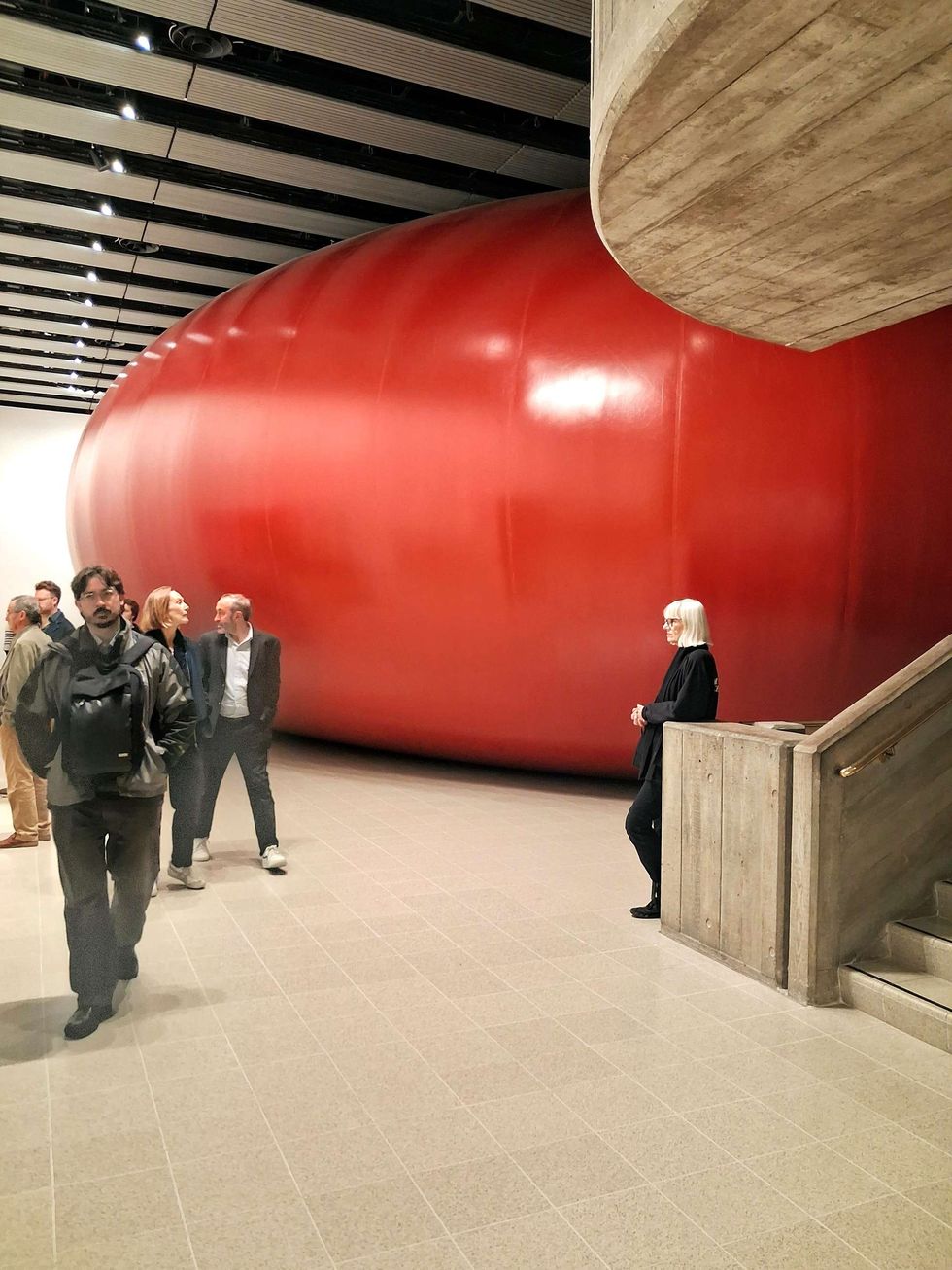 All is NothingEastern Eye
Going room by room, the works in each one are explained very simply for visitors.
For example, the introduction in Room 1 said: “Anish Kapoor creates sculptures and paintings that spark a deep sense of mystery. Ranging from dazzlingly immaculate objects to visions of blood and entrails, his artworks invite us to reimagine some of our most basic ideas about the nature of space and our perception of presence and emptiness. Many works reorient our awareness of spatial and bodily boundaries, of inside and outside, of what’s receding and what’s protruding.
“Kapoor reimagines and refashions a range of materials in ways that seem almost alchemical. He makes monumental sculptures that seem to defy gravity, and transforms solid steel into forms that appear utterly fluid. By paying scrupulous attention to physical detail, he finds ways to activate art’s immaterial dimensions. Integral to Kapoor’s art is his exploration of the liminal: threshold spaces linking different states of being. Insisting that sculpture involves much more than an encounter with a physical object, he makes things that are not only meant to be looked at, but function as experiences that we inhabit and which, in turn, inhabit us.”
The note in Room 2 with the Vantablack works stated: “Several works in the next gallery present seemingly depthless voids that confront the limitations of the human eye. Kapoor imagines the void as ‘a space full of what doesn’t exist’. He notes, ‘Perhaps the darkest black is the black we carry within ourselves’, suggesting that the void might be understood as an interior or metaphysical space.
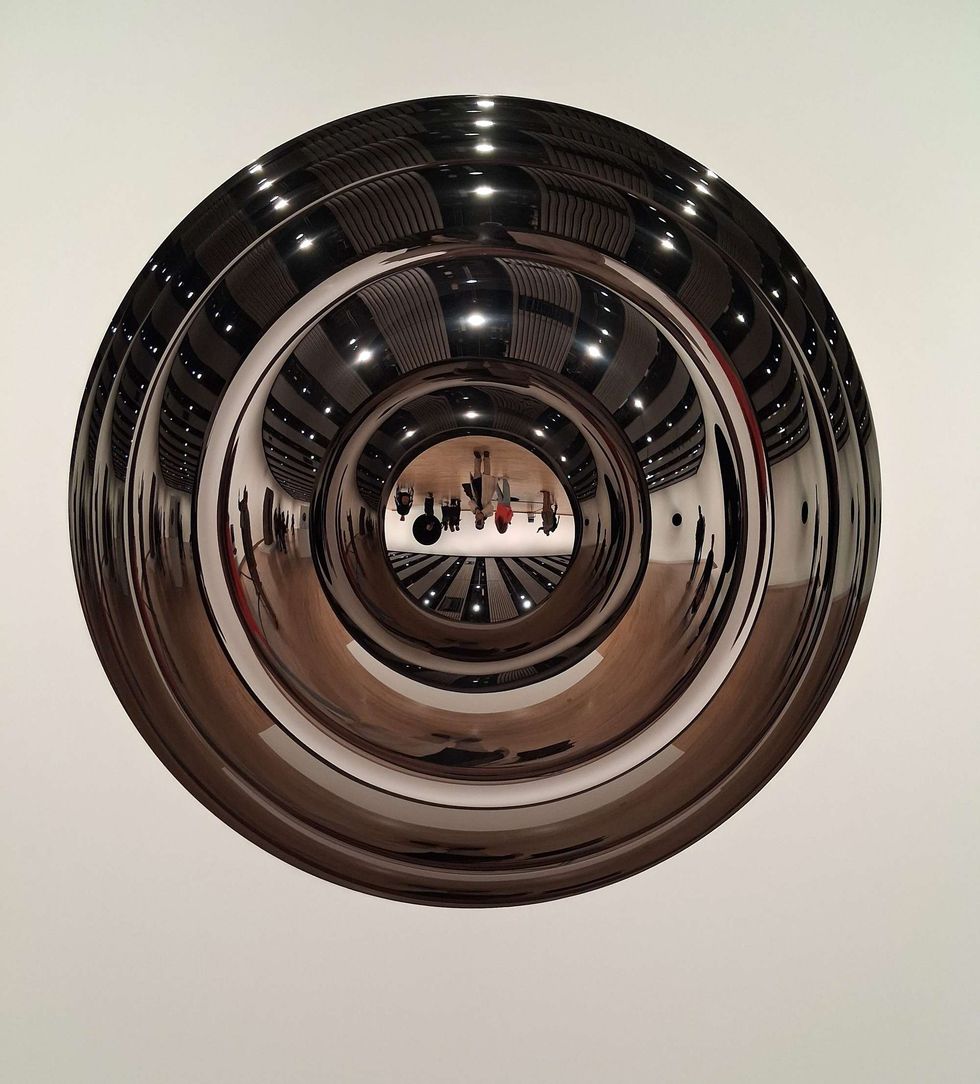 IrisEastern Eye
“Many of the works in this gallery modify our perception of the surrounding architecture. Descent into Limbo, located centrally in the room, transforms the gallery floor into an entry point to ‘limbo’ – a perplexing state of in-betweenness and spatial ambiguity – as if the building itself rests atop a gigantic void.
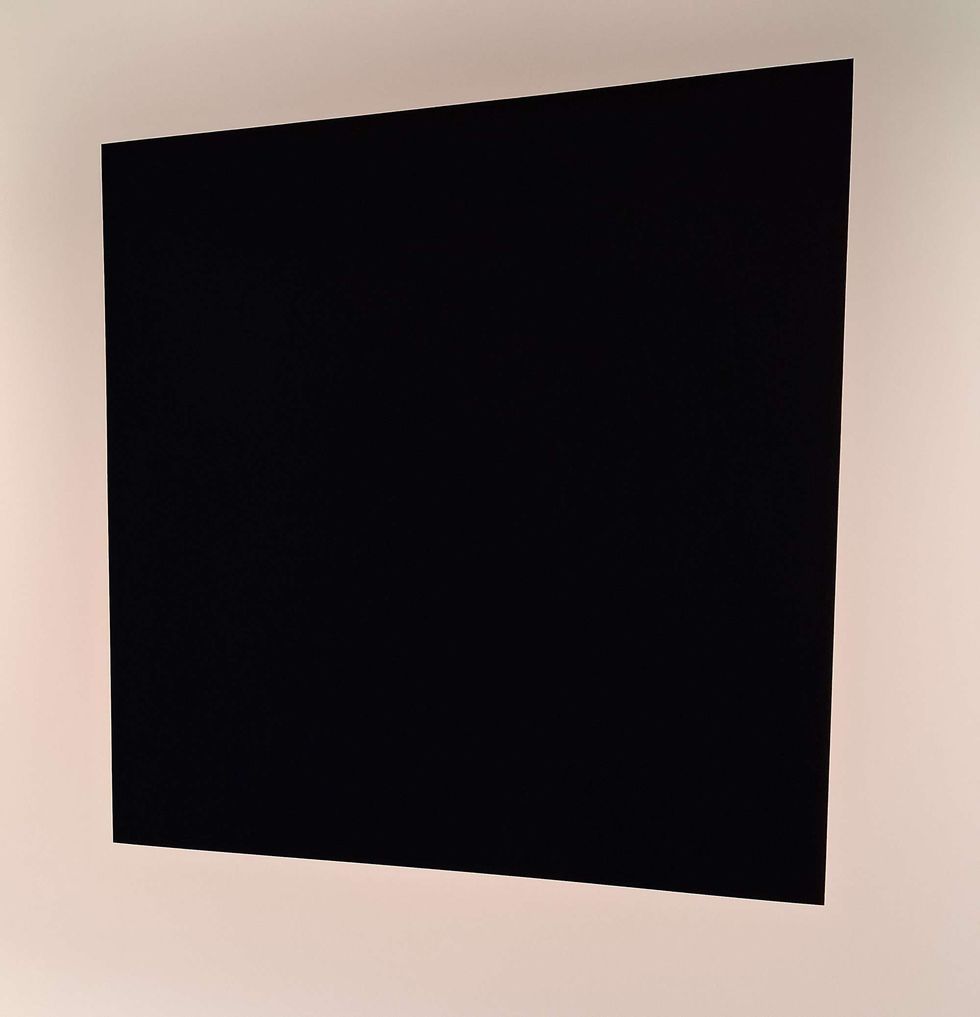 Untitled (work in Vantablack) Eastern Eye
“The artist’s exploration of what he calls ‘non-objects’ – works that seem to disappear or dissolve into an immaterial experience – includes smaller sculptures coated with Vantablack, a substance created with nanotechnology that absorbs up to 99 per cent of visible light. Subverting our capacity to detect depth, contour or texture, these enigmatic objects seem to exist in an uncertain state, hovering between the physical and the immaterial.”
On to Room 3: “The artworks in this gallery draw on darker aspects of the human experience, invoking in particular the ancient practice of ritual sacrifice – a focus of the artist’s recent work. Likewise, the motif of the mountain – present in Kapoor’s work since his earliest sculptures – imbues these works with a sense of the sublime, hovering between wonder and horror.
“The title of the central work refers to Mount Moriah, which in the Old Testament is described as the place where God commanded Abraham to sacrifice his son Isaac. Only as Abraham raised the knife did God provide a ram to be killed in the child’s place. Resembling an upside down mountain, the sculpture suggests a world out of joint, with its oil painted surface evoking blood running from a wound.
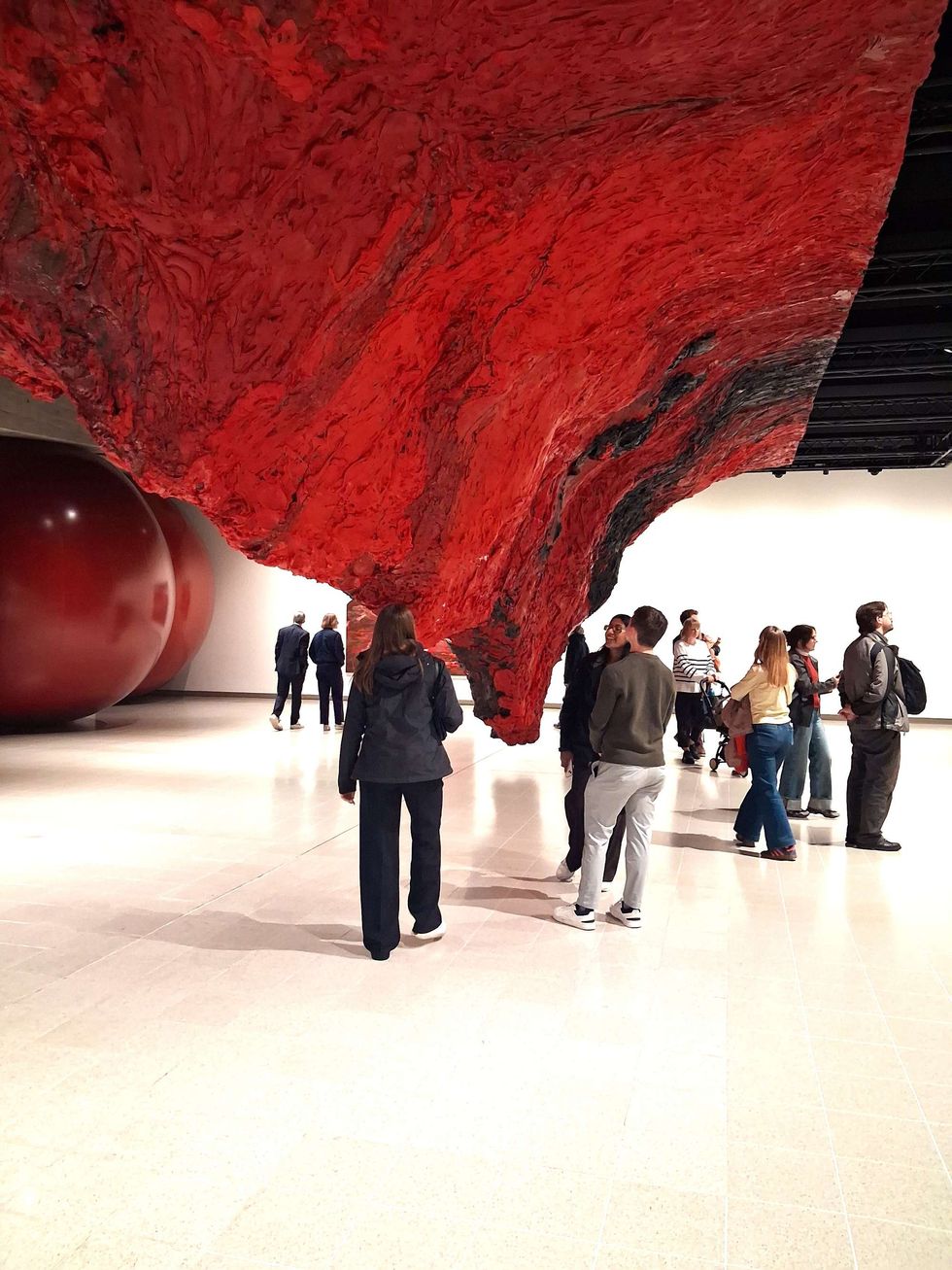 Mount Moriah at the Gate of the GhettoEastern Eye
“Reflecting on the human connection to sacred rites and ritual, Kapoor observes: ‘I believe deeply that we are religious beings, that we carry within ourselves the mystery, the masked fear that sits behind the ritual act the fear of death.’
The note in Room 4 said: “Kapoor has been influenced by visits to significant rock formations, including Uluru, the sandstone monolith in central Australia, which he described as ‘the most religious place I’ve ever been to’. As if recalling that experience, this work suggests an otherworldly landscape, punctuated by a rectangular aperture that implies a hollow or a threshold to the unknown. Its title, Ha Makom, derives from a Hebrew phrase meaning ‘The Place’, used to express the universal presence of the divine across space and time.
“Sprawling outward on a monumental scale, Ha Makom embodies Kapoor’s belief that scale is inherently mysterious, allowing an inanimate object to invite the viewer closer. Kapoor often uses red in his work, a colour infused with emotion and ceremonial associations. ‘This open and visually beckoning colour also associates itself with a dark interior world,’ the artist notes. ‘I try to make a condition of colour, not a painted surface. I want to make something that’s red in such a way that its redness occupies the whole space of your vision.’ ”
And so finally to Room 5: “Throughout his career, Kapoor has explored the interior of the body through abstract means. However, in these recent works, he confronts the subject with unflinching directness.
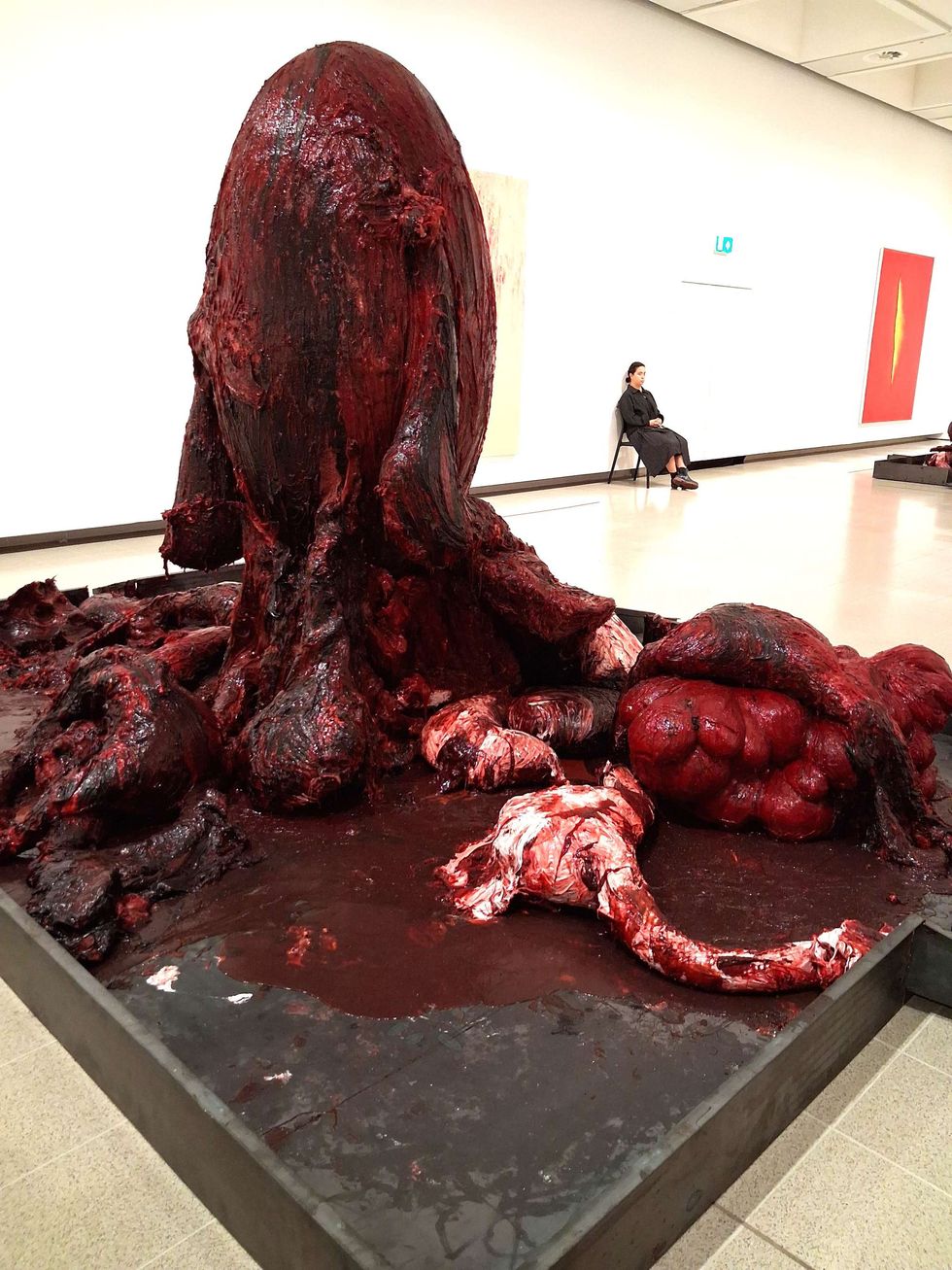 Interior of the body: evocation of ritual sacrificeEastern Eye
“Metal trays hold thickly painted silicone forms that resemble bloodied masses of bodily tissue. Trailing intestinal shapes and clumps of white sinew slump across the containers which are fitted with spouts as if to drain blood or other vital fluids. Two of the works feature forms with seemingly depthless openings, enhancing their unsettling presence.
“Kapoor describes these sculptures as an evocation of ritual sacrifice. Practised throughout the ancient world, sacrifice can be understood as an encounter with the darker aspects of our collective consciousness – including fear, horror and disgust – bringing the witness to a heightened sense of aliveness. As Kapoor observes, ‘The red of blood is violent but also the matter of life.’ ”
At the end, it is worth popping into the Hayward Gallery shop to browse through the Anish Kapoor merchandise on sale. I think I might go back for the £5 fridge magnet but I’ll have to hurry.


 Cover of the biography Sam Naidu
 Sam NaiduEastern Eye


