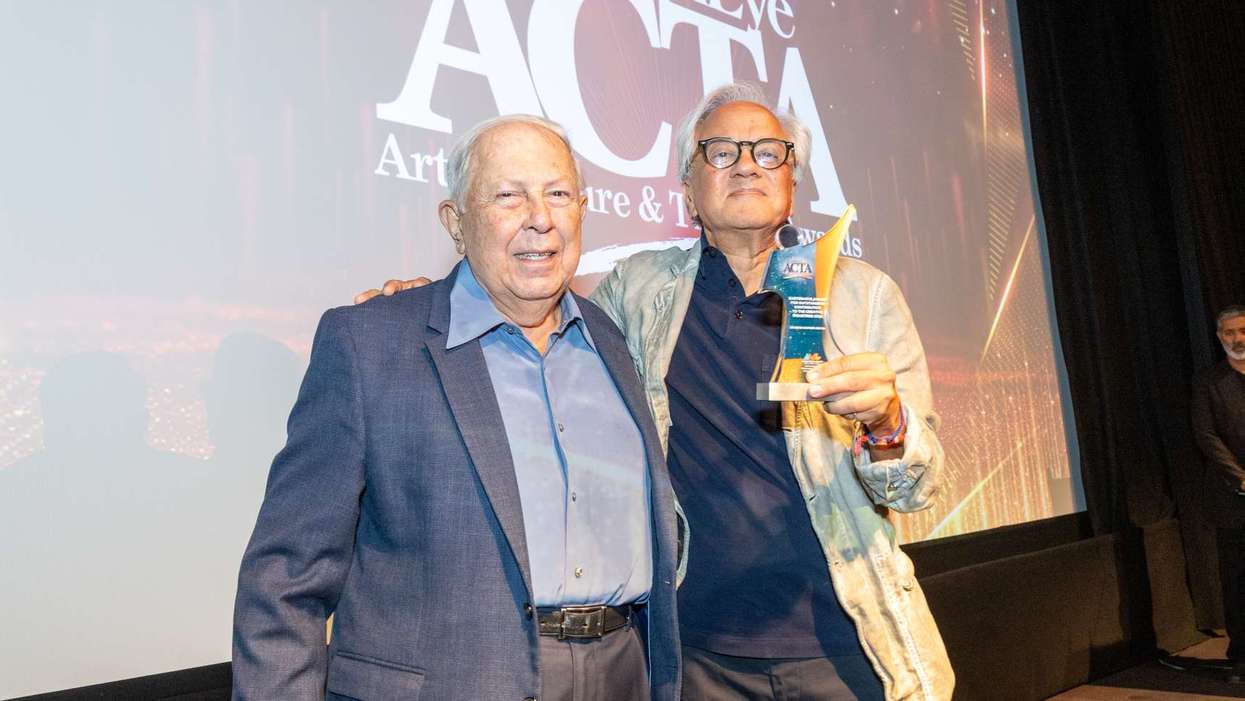

SIR ANISH KAPOOR, Britain’s most eminent living sculptor, took the top prize at Eastern Eye’s Arts, Culture & Theatre Awards (ACTA) in London last Friday (26).
The award for “Outstanding Contribution to the Creative Industries” was conferred on him by Dr Yusuf Hamied, head of Cipla, one of India’s largest pharmaceutical companies.
ACTA was established in 2016 to recognise British Asian artistic talent. Between 500 and 600 people have been nominated in the past 10 years.
Describing Sir Anish’s work, Hamied said: “Not many artists can claim to have reshaped the skyline of an entire city, but tonight’s winner of our top award is an exceptional individual. He was born in Bombay, raised between India and Israel – and forged in the crucible of London’s art world.”
Hamied added: “Our winner arrived at Hornsey College of Art with little more than curiosity and an instinct for the infinite. What followed was one of the most remarkable careers in the history of contemporary art, and I think all of us here today are privileged to have this outstanding individual in our midst. He has filled the Grand Palace in Paris, transformed Chicago’s Millennium Park, and turned the Tate Modern Turbine Hall into a landscape of pure colour and wonder.
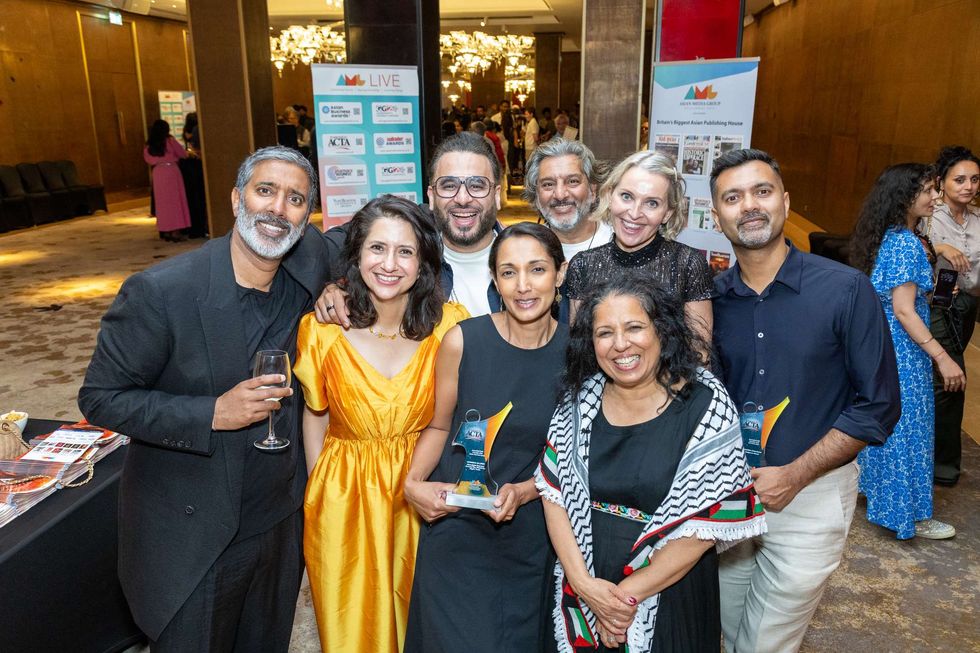 Nihal Arthanayake, Sangita Myska, Ameet Chana, Monisha Rajesh, Nitin Ganatra, Nikki Bedi, Shobu Kapoor and Manish Chauhan at the ACTA awards
“His work hangs in the world’s greatest collections, and his public installations have been experienced and seen by tens of millions of people across six continents.”
The evening was compered by the broadcaster Nihal Arthanayake (known universally as just “Nihal”). He was characteristically ebullient and said he was greatly encouraged by the array of young talent taking over from the previous generation.
The presence of Sir Anish added a touch of “greatness”, said Nihal.
Sir Anish, who showed early promise by winning the Turner Prize in 1991, was elected a Royal Academician in 1999 and was knighted in 2013. He had come with his wife, Lady (Oumaima Boumoussaoui) Kapoor and their seven-year-old daughter, Habiba.
Sir Anish, who greeted the audience with folded hands, was emotional in his response as he remembered his late father.
He told Nihal who had asked whether Sir Anish had a mission statement: “I very much like what you’ve said through the evening about parents. When I was growing up, my father, bless him, wanted me to be an engineer. It’s what we did – young boys growing up in India.”
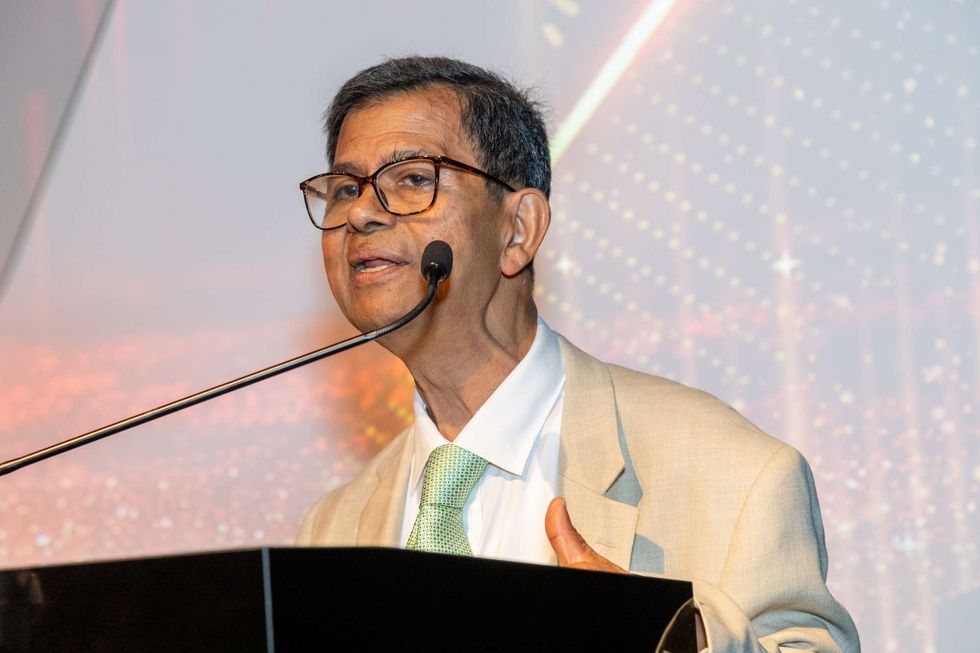 Amit Roy
He recalled his father “had the courage to say, when I told him I was going to be an artist at 17 years old, when I kind of knew it, he didn’t say, ‘No way.’ He just said, ‘Oh, well, you’re never going to make a living. I’m going to have to…. (look after you).’ My father was in the (Indian) navy. He didn’t have any money. He was a hydrographer, which was ocean map making in those days.
“It was all about dropping a piece of string with a weight at the bottom to see how deep the ocean was. I love the idea of that, like looking for what’s invisible. I feel that’s what I’ve taken on in one way or another.”
Asked about his comfort zone, Sir Anish replied: “Comfort doesn’t come to me easily. The other thing is that I’m a child. I play, so the question doesn’t arise. I go to the studio every day, and I try. I have this strange thing, which says first idea, best idea. Just go for it.”
On who he was creating art for, Sir Anish reflected on the interaction between his sculpture and the viewer: “Sculpture is, of course, all about the body, inevitably, and I truly believe that if it works on my body, it’ll work on yours. And yet I also believe that I have nothing to say as an artist. I’m not interested in what I can tell the world. I’m interested in that strange thing that happens when the viewer is in front of a thing and forces them or is forced by the thing to bring their own psychic history into play and make the work. It’s as if you make the work. I don’t.”
He explained: “Somewhere along the way, I came across this thing I’ve called the non-object. We live in a world full of objects. But somewhere I seem to have tumbled into the idea that in an object is also its non-object, its other side. That’s a very Indian philosophical notion.
“Many years ago, I made a thing that was an empty space that I painted dark blue, very dark Prussian blue. And to my astonishment, when I looked at it after the paint had dried, it wasn’t an empty space. It was a space full of darkness, full of void, full of nothingness.
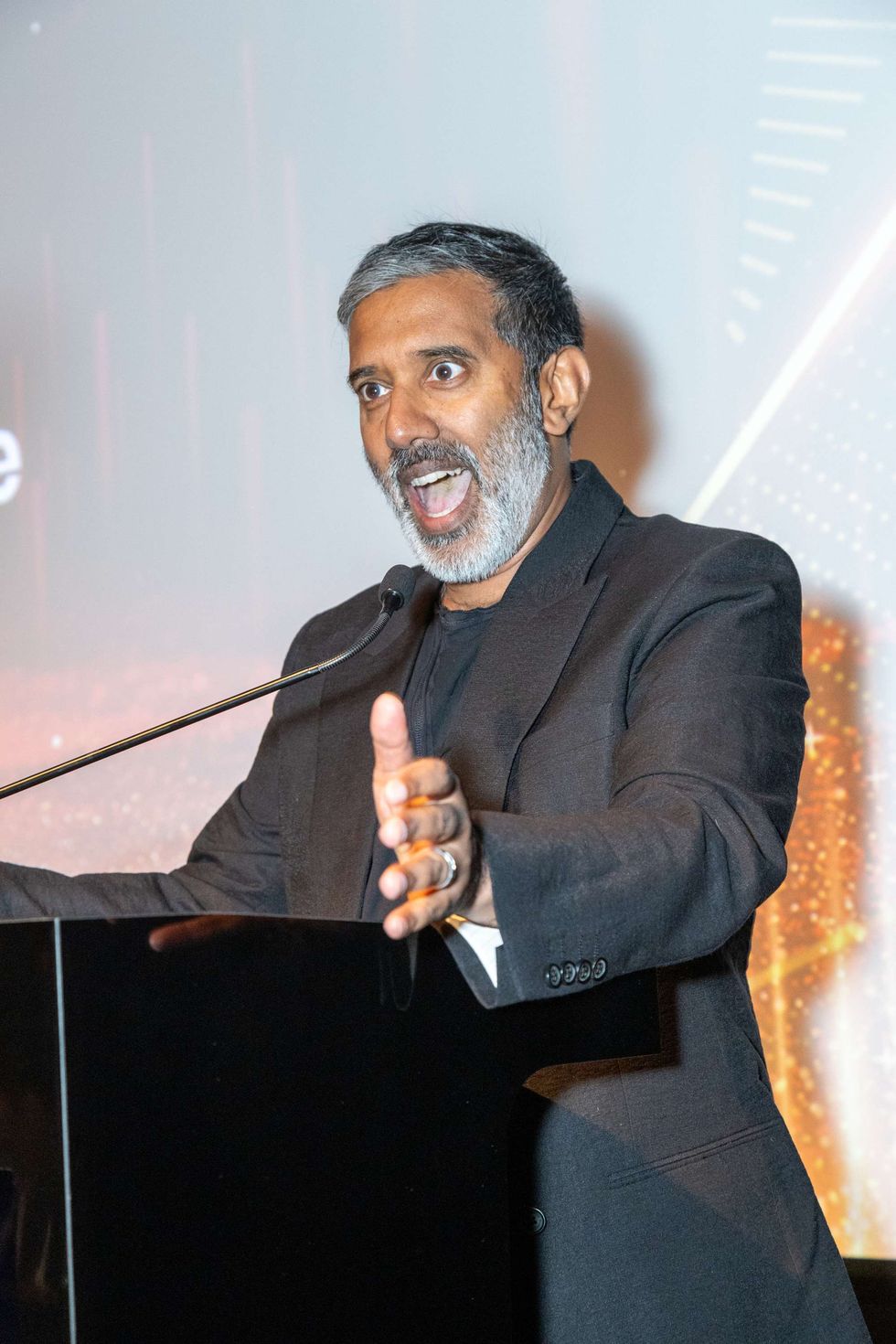 Arthanayake addresses the audience
“I then decided that I was going to make a piece of stone. I got a piece of stone about two and a half metres tall. You stand a stone up, of course, it’s immediately human, and I carved a negative space in it, which I also painted this same dark Prussian blue. Astonishingly, the negative space was heavier than the stone, and I must say I was floored by that. And that’s something I’ve returned to again and again. It’s what happens to us when we close our eyes, there’s that other you in there.”
Highlights of the evening included giving the Trailblazer Award jointly to Arti Shah and James Hameed for their central role in Paddington The Musical.
“It’s pure joy, honestly,” enthused Shah. “There is just so much that’s involved, all the emotions that anybody can feel, you feel in one night.”
Hameed commented: “As someone who is half brown, half white, it’s that whole thing of stepping into two worlds at the same time, which Paddington does himself very often. As someone who wants to hold on to his culture, whilst also integrating, it’s really important for us to remember to hold on to the things that unite all of us here.” The community engagement award went to the British Museum for its landmark exhibition, Ancient India: living traditions, which consulted the Hindu, Jain and Sikh communities in the UK.
It was collected by the exhibition’s curator, Dr Sushma Jansari, and John Stokes, the museum’s head of national programmes, who said: “It’s really important for us to be able to engage with communities and to bring communities’ voices through to our exhibitions.”
The ACTA for Best Production was given to Hampstead Theatre for putting on Indian Ink by Sir Tom Stoppard, the playwright who died a week before opening night.
It was collected by Hampstead Theatre’s chief executive and executive producer, Greg Ripley-Duggan, who revealed: “The most important thing was to get the atmosphere of India on stage. He (Stoppard) said that’s the thing, and every decision we made there afterwards about doing that. And we brought together this amazing company of actors, the six Indian actors and the six British actors, and it was a glorious and wonderful thing to work on, and the fact that he never got to see it is a complete tragedy.”
Raj Ghatak, who is playing Carmen Ghia in The Producers at the Garrick in London’s West End, won an ACTA for best theatre actor. He was not able to attend, but sent a video message and his trophy was collected by Anna Woodside, associate choreographer of The Producers. Raj’s parents, Sunit and Indira Ghatak, also came on stage.
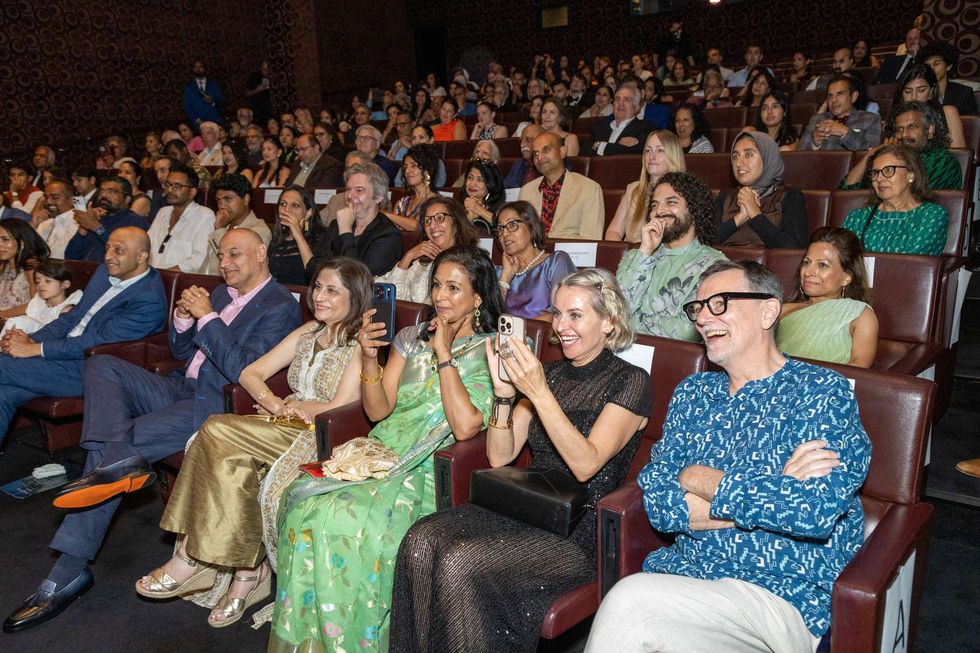 Guests enjoy the ceremony
Anoushka Shankar, daughter of sitar maestro Pandit Shankar, also sent a video acceptance after winning an ACTA for music (contemporary) for her collaboration, The Mountain with Gorillaz.
The Labour MP Naz Shah, who won the editor’s special award for her painful memoir, Honoured: Survival, Strength and My Path to Politics, was also unable to attend for personal reasons. The award, collected on her behalf, was announced by Kalpesh Solanki and Shailesh Solanki, group managing editor and executive editor of the Asian Media Group, publishers of Eastern Eye, Garavi Gujarat newsweeklies and several other titles.
Many of the presenters at the event were distinguished themselves, none more so than Hamied.
In introducing him, Nihal pointed out that Hamied’s “dollar-a-day cocktail of drugs saved the lives of 15 million AIDS sufferers in Africa, a contribution so remarkable that Cambridge University, his alma mater, conferred on him an honorary Doctorate of Science”.
Hamied entered into the spirit of the occasion and said his wife, Farida, was the daughter of the film producer and director, AR Kardar. And her uncle, Mehboob Khan, made the classic, Mother India.
Other presenters included the ACTA judges – Divia Patel (a senior curator at the V&A); Mira Kaushik (former director of the Akademi dance company); Viram Jasani (an authority on music); and Russell Elliott (an arts expert).
Prizes were also handed out by Sundaram Tagore (who has just opened an art gallery in Pall Mall in London); veteran MP Barry Gardiner; Lord Jitesh Gadhia, chair of the British Asian Trust; Swati Dhingra (member of the Bank of England’s monetary policy committee); Old Bailey judge Anuja Dhir; Her Honour Judge Kaly Kaul; entrepreneur and philanthropist Dr Nik Kotecha; Kavita Reddi (chair of the Board of Trustees of the University of London); and Tazim Essani, (council member of the Royal Horticultural Society).
Other prominent presenters included best selling crime novelists, Abir Mukherjee and Vaseem Khan; former Bafta chair Krishnendu Majumdar; broadcaster Sangita Myska; actor and former ACTA winner Mikhail Sen; actor Rehan Sheikh; Nikki Bedi (who was named Best Presenter herself for The Arts Hour on BBC World Service); and Taha Shah Badussha (star of the Netflix period drama Heeramandi).