
Highlights
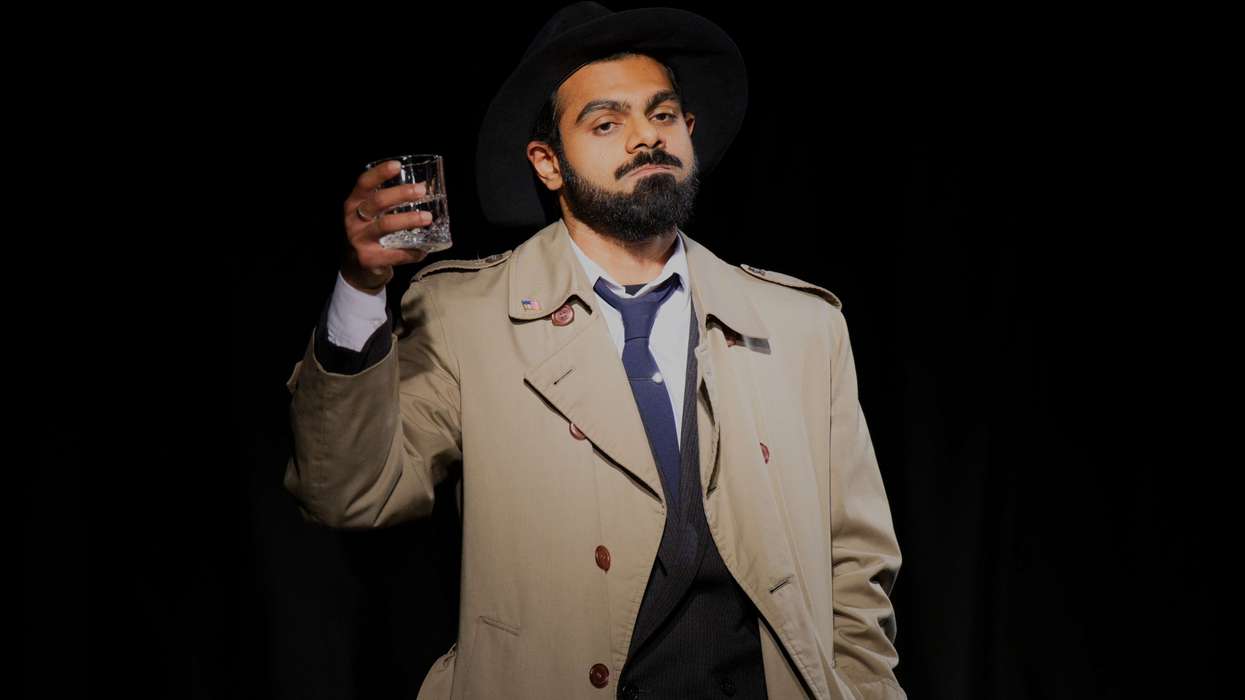
- Shashank Sharma makes his Edinburgh Fringe debut with The Stuff That Dreams Are Made Of.
- The partially blind actor believes disabled performers should be cast across all genres, not just disability-focused stories.
- He says greater accessibility benefits both audiences and artists, and should become the industry standard.
Making his Edinburgh Fringe debut this year is a milestone Shashank Sharma has long worked towards. For the actor, however, the festival is about more than stepping onto one of theatre's biggest stages. It is also an opportunity to champion a simple idea: disabled actors should be seen for their talent first, with disability becoming just one part of who they are rather than the defining feature of every role.
Speaking to Eastern Eye, Sharma reflected on his journey into acting, the importance of accessible theatre and why he hopes the industry moves beyond casting disabled performers only in stories about disability.
From film student to Fringe performer
Sharma's route into acting was anything but planned. Having grown up in Dubai, he moved to the UK to study film at Lancaster University, where he initially imagined a career behind the camera.
That changed during a trip to Delhi, where he met an actor from Disney's stage production of Beauty and the Beast. The encounter introduced him to theatre director Faisal Alkazi, who encouraged him to pursue acting after graduation.
Looking back, Sharma believes every step naturally led him to the stage.
"This will be my first time at the Edinburgh Fringe Festival, so I'm very excited for that," he said. "That alone makes it something that's very meaningful for me."
'My disability has nothing to do with the story'
As a partially blind actor, Sharma says his preparation differs only in practical ways. Before rehearsals, he familiarises himself with the performance space, memorising stage layouts and the movement of fellow actors to build confidence in his surroundings.
Once that groundwork is complete, his process is the same as any other performer, focusing on script analysis, character development and voice work.
More importantly, he wants casting to reflect that same mindset.
"When I came back to England and went to drama school, I wanted to play characters written as able characters where my disability has nothing to do with the story," he said.
For Sharma, disabled actors should be equally at home in love stories, thrillers, action films and comedies because disability does not limit the kinds of lives people live.
Why accessibility matters on and off the stage
Alongside his Fringe debut, Sharma has praised theatre company Extant for its work in making more productions accessible to visually impaired audiences.
He believes accessibility is often viewed solely as a benefit for audiences, but says it is equally valuable for performers, who rely on watching other productions to develop their own craft.
Recalling his own experiences, Sharma said inaccessible performances often made it difficult to fully engage with theatre as an audience member. While he welcomed the progress made at this year's Fringe, he believes the goal should be much broader.
"If I could change one thing, I would make every performance accessible," he said, adding that accessibility should also extend to deaf and hard-of-hearing audiences.
A story that leaves audiences thinking
At this year's Fringe, Sharma stars in The Stuff That Dreams Are Made Of, a mystery thriller inspired by film noir and New Hollywood cinema. Through the story of detective Samuel Spade, the production examines the political events that shaped modern Iran, encouraging audiences to question how history unfolded rather than offering simple conclusions.
Away from the stage, Sharma hopes his own journey encourages others facing similar barriers to keep believing in themselves.
"The work that you do when nobody else is watching is the work that's really going to make an impact," he said.
"Don't ever lose hope. Just keep trying."



 Kate Varah Adama Jalloh
 Hiran Abeysekera (Hamlet) in Hamlet at the National Theatre. Sam Taylor
  Ncuti Gatwa as Algernon in The Importance of Being Earnest at the National Theatre Marc Brenner
 Sharon D Clarke as Lady Bracknell in The Importance of Being Earnest at the National Theatre Marc Brenner
  Indhu Rubasingham left and Kate Varah Amit Roy
 The company of Bacchae at the National Theatre Marc Brenner
  Ballet Shoes poster National Theatre
  Rosamund Pike (Jessica) in Inter Alia at the National Theatre resize Manuel Harlan