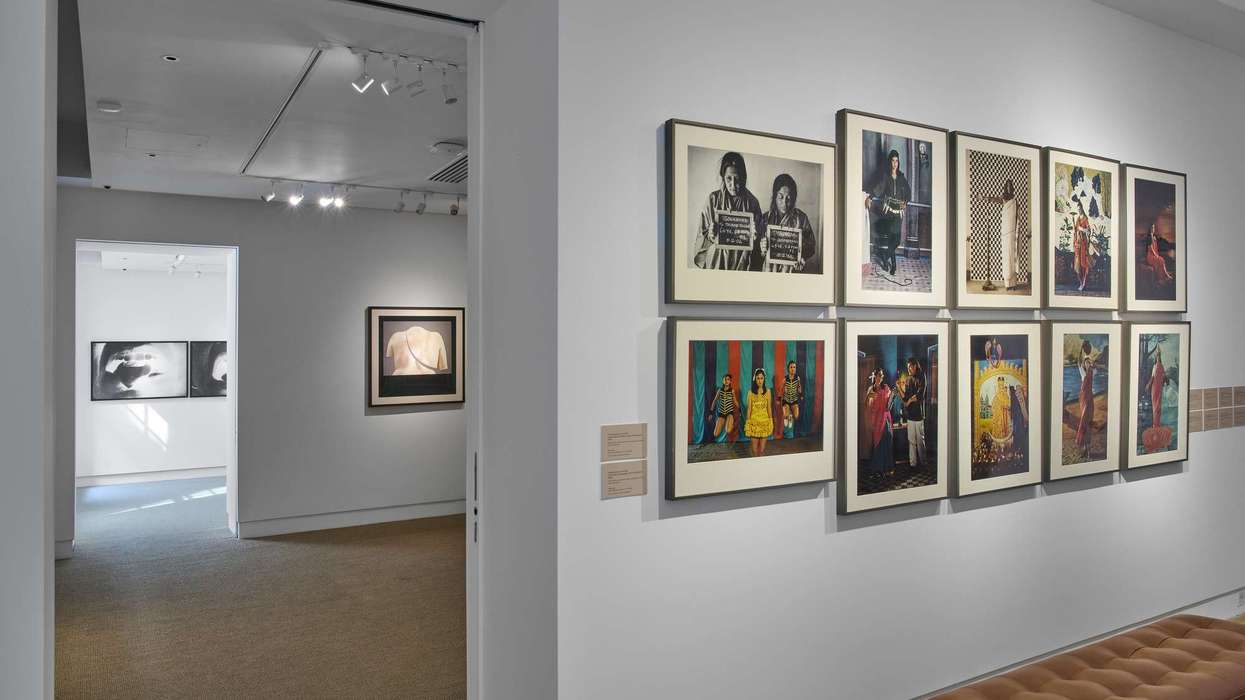

Those who want to learn about modern and contemporary Indian art by visiting just one exhibition should head – now – to Christie’s in King Street in London to see The Meeting Ground, a collaboration between the UK auction house and the Kiran Nadar Museum of Art (KNMA) in New Delhi.
But they need to hurry because the exhibition closes on Friday, August 21.
Christie’s has put out a message to all arts lovers and especially the British Asian community: “There is still time to experience this landmark exhibition.”
 The Meeting Ground scenes from the KNMA CollectionChristie/KNMA
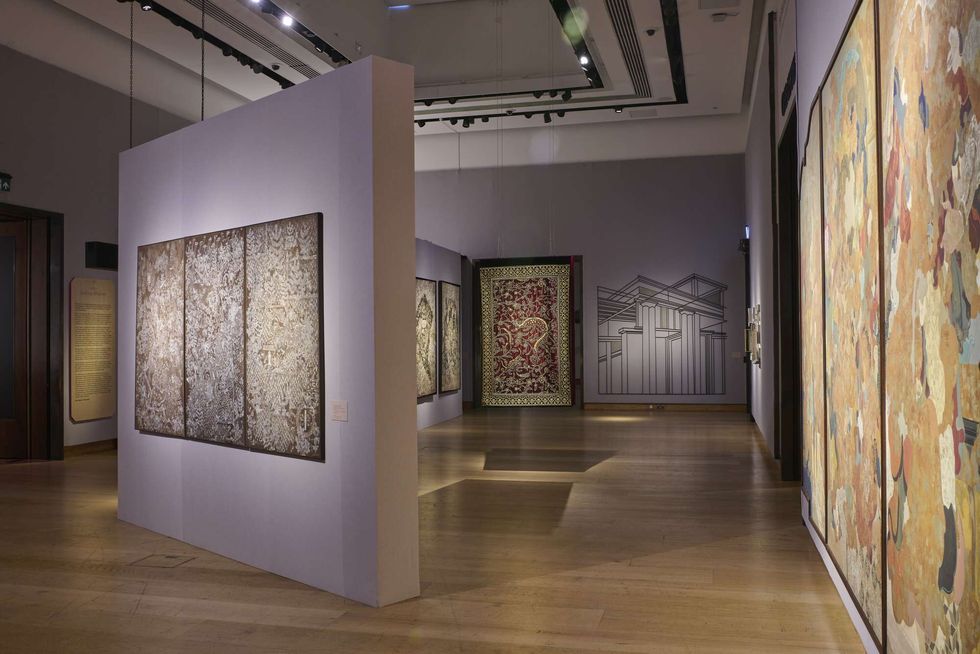
It added: “Presented through a series of unfolding ‘scenes’ across five distinct sections, The Meeting Ground explores modern and contemporary South Asian art through a deeply immersive multimedia experience. Bringing together leading artists and emerging voices, the exhibition reflects the breadth and diversity of South Asian art across generations and regions. Discover it in person at Christie’s London.”
There are approximately 180 works of art displayed in the exhibition created by 67 artists. The majority are Indian but Pakistan and Bangladesh are also represented.
To be sure, Eastern Eye has already covered the exhibition, having been present at the preview. But a deeper insight is obtained by joining a guided tour given by one of the curators.
 The Meeting Ground Scenes from the KNMA CollectionChristie/KNMA
Eastern Eye joined one given by Premjish Achari, who began by introducing himself: “I am a curator at the Kiran Nadar Museum of Art, and in short form, we call it KNMA. It’s located in New Delhi, and it is South Asia’s largest private museum. We started as a museum collecting the modern and contemporary art of South Asia, and from there we expanded to around 20,000 objects. So from modern and contemporary, now we are also collecting folk, indigenous, antiquities, and miniatures. This (selection for London) is a very small percentage of that collection. This represents the modern, contemporary, indigenous, and folk. It’s also intergenerational.”
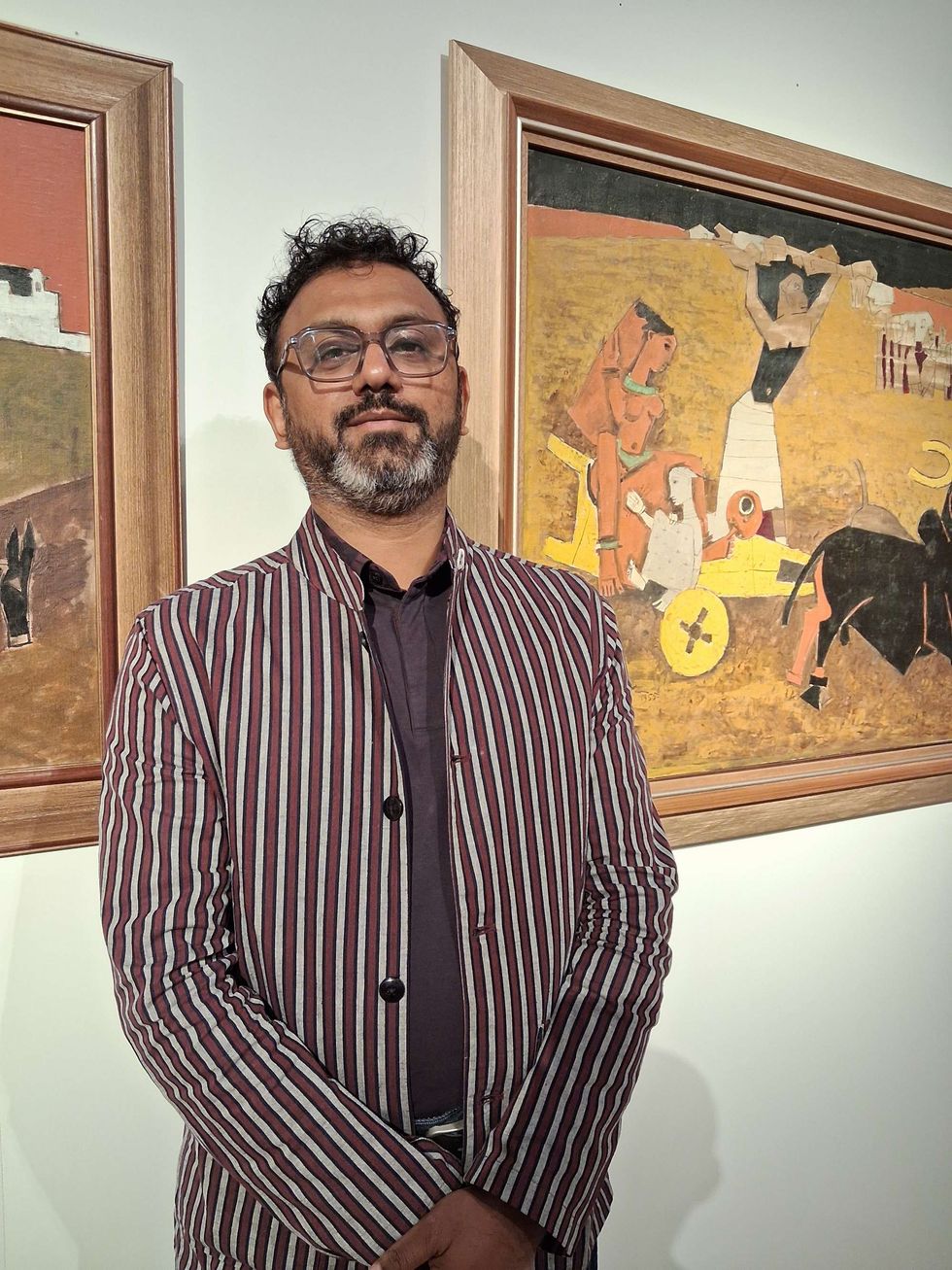 Premjish AchariAmit Roy
He explained: “This exhibition is called The Meeting Ground: Scenes from KNMA Collection. The exhibition is a meeting ground of conversations, friendships, dialogues, and people coming together and working together, creating spaces, dialogues using mediums and practices.”
The displays are divided into five sections: Seeking affinities; Regions of remembrance; Body – present continuous; Clearing; and Unfinished Homelands.
The last is one that might be of special interest to British Asians.
Achari said: “This is a section that I have curated. It’s called Unfinished Homelands. And in this section, we are talking about the idea of home and homeland. What is home and homeland for a South Asian?
“I start with this particular artist called Zainul Abedin. This (work) is from 1970, just one year before Bangladesh was formed. Abedin was born as a British colonial subject. When British India was partitioned, he became part of East Pakistan. So, from colonial subject, he became a Pakistani citizen. And towards the end of his life, he becomes a Bangladeshi citizen.”
He referred to a painting of “fishermen standing, not knowing what future is lying ahead of them”.
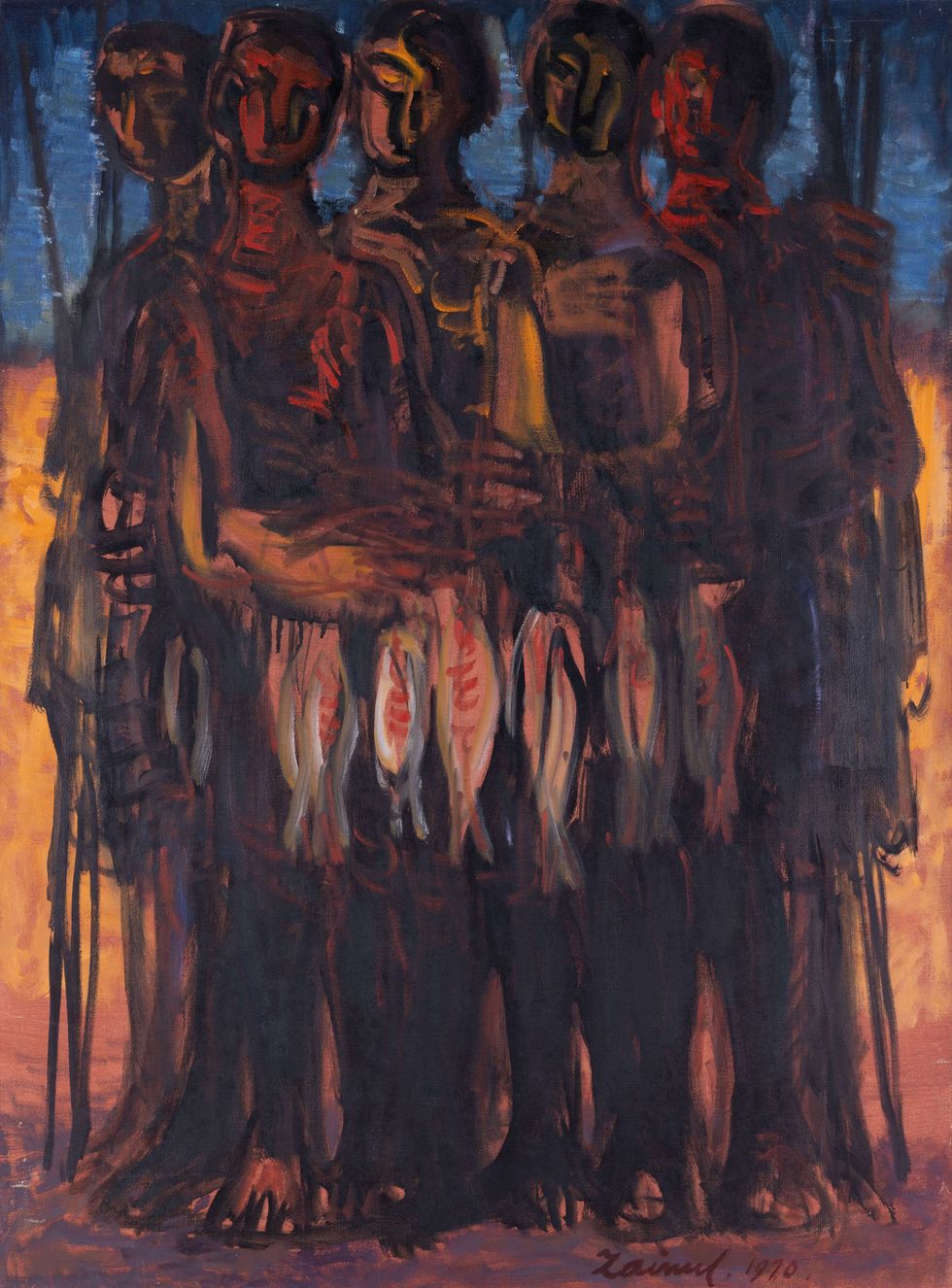 Fishermen by Zainul AbedinKNMA
In his section, there were “different artists belonging to the subcontinent talking about exodus, looking at exile, looking at situations of uncertainty “
He talked of Zarina Hashmi, “somebody who was born in Aligarh in India, travelled to Latin America, stayed in the US, and stayed in London for a long time. There are various ways in which she is representing the idea of home – through doors, rain, wind, dew, the cycles of the moon, various ways in which we think about the idea of home.”
Another artist, Bani Abidi, did two videos – one impersonating an Indian news reader, and another as a Pakistani one. “They are talking of similar things but in different ways.”
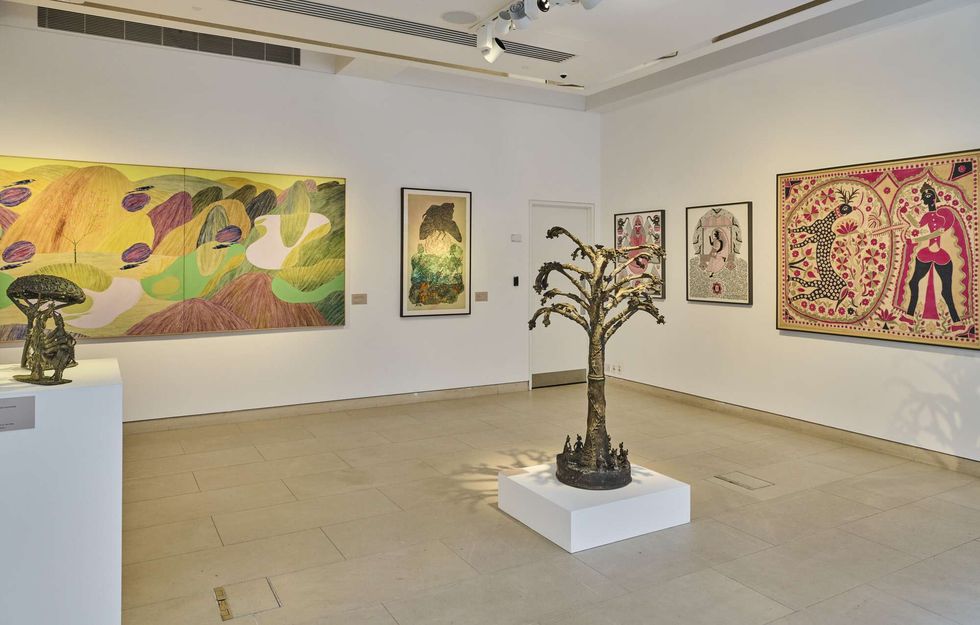
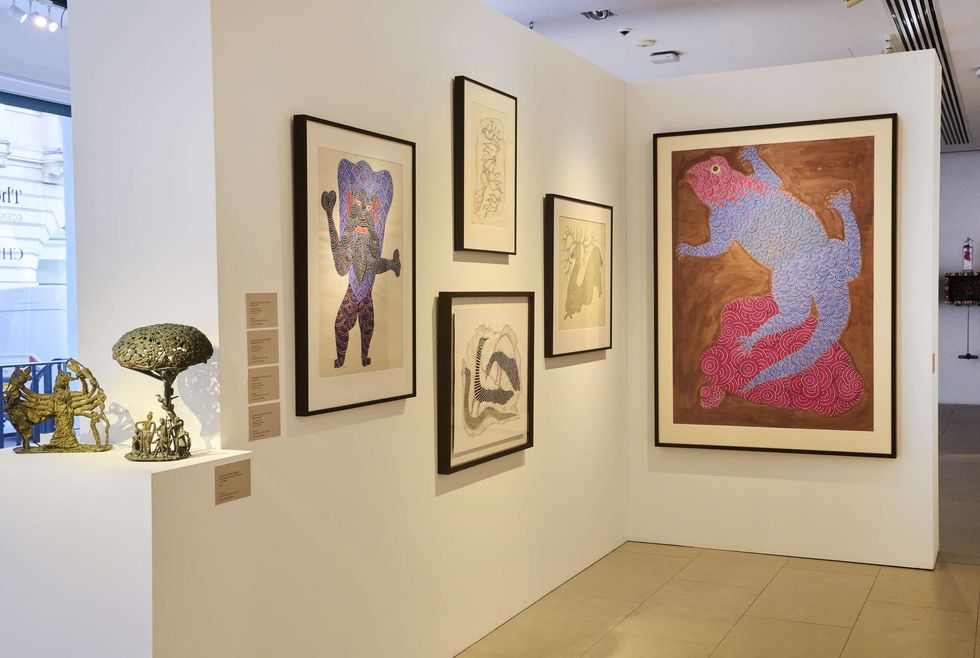 The Meeting Ground Scenes from the KNMA CollectionChristie/KNMA
She had also done an installation, Memorial to Lost Words. “What you are seeing on the marble plaques are letters written by Indian soldiers who took part in the First World War. They were enlisted by the British Empire, the British Army. They were fighting a war that was not their war. These letters were written by them. They were censored and archived. Bani created a memorial for people who were not given recognition. Usually there is a background song, a hundred-year-old Punjabi folk song, where the women are telling these men, ‘Don’t go to this war, it’s not your war to fight.’ So this is acting like a tombstone, a shroud, a memorial for those soldiers.”
The adjacent room was given over “the great Indian modern artists, the superstars of modern Indian art”.
In 1947, when India became independent, they formed the “Progressive Art Group in Bombay”.
He pointed out the works by, among others, M F Husain, Vasudeo Santu Gaitonde, F N Souza, Mohan Samant, Krishen Khanna, Ram Kumar and Akbar Padamsee. S H Raza is also represented.
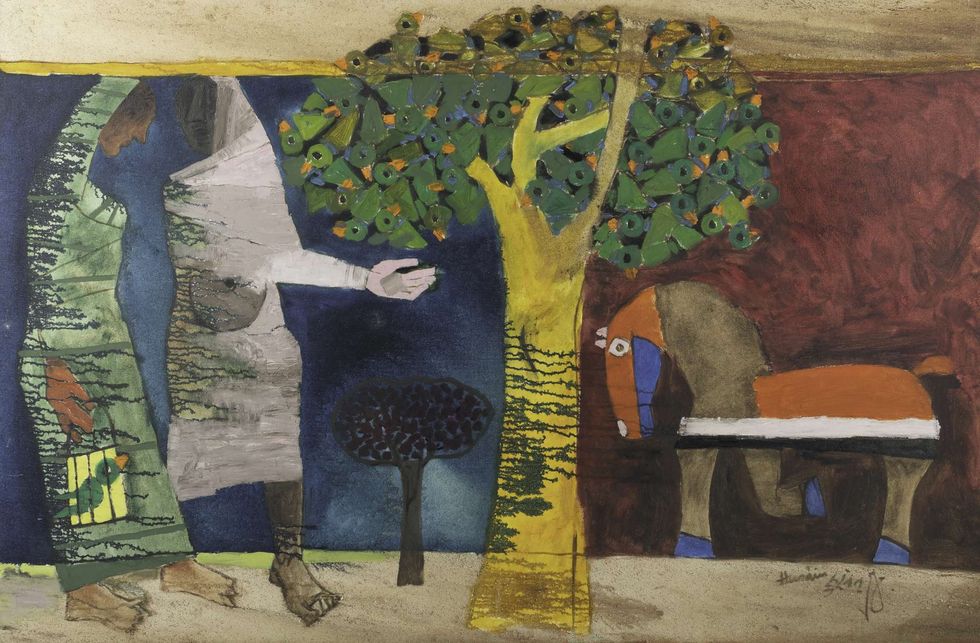 Birds in a Tree by MF HusainKNMA
He said: “They all have different stories to tell, but they came together for a common purpose to create an idea of the visual art practice of modern Indian art. They were influenced by cubistic, impressionistic style, but they are infusing that with the colours of India, the stories of India, the imaginations of the new nation.”
He began the tour on the ground floor with the section on Seeking affinities, starting in south India.
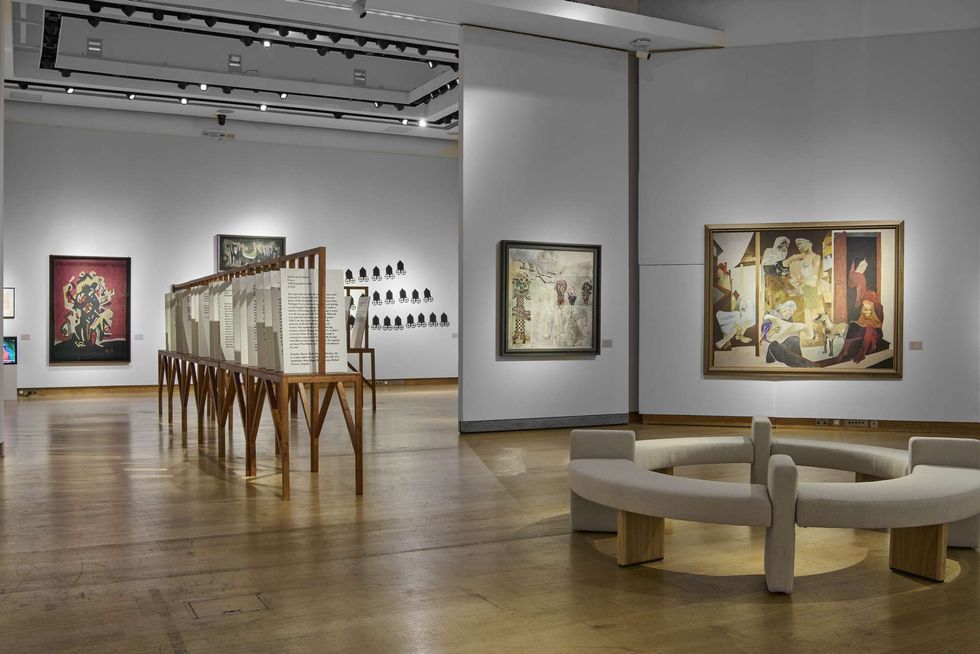 The Meeting Ground scenes from the KNMA CollectionChristie/KNMA
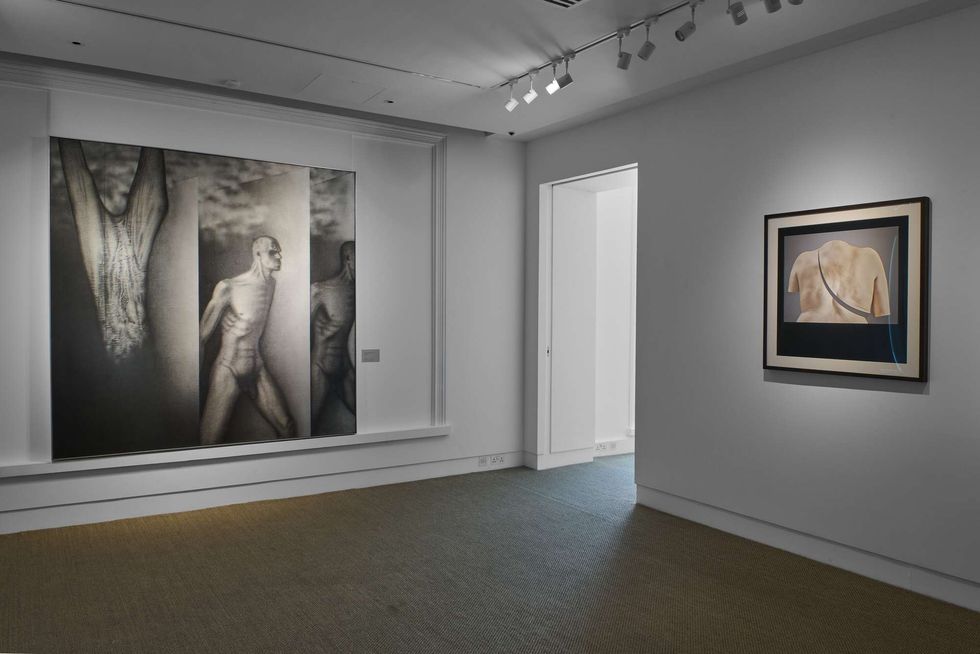 The Meeting Ground scenes from the KNMA CollectionChristie/KNMA
He spoke about “K C S Paniker, who was principal of the Madras College of Art. Now Madras is called as Chennai. KCS introduced a new style, a different visual style, moving towards abstraction, but an abstraction influenced by local visual traditions.
“He also established the Cholamandal Artists’ Village, where artists could come together. They created their own studios, and also started to work on craft practices. They were not only creating paintings and sculptures, but also creating terracotta vessels. And at weekends, they would go to the market and sell these vessels. And this was also an attempt to blur the difference between craft and arts.”
A talented artist who studied under Paniker was K Ramanujam, who committed suicide at a very young age. But he was hugely influenced by the fantasy style of cinema. On display was one of his long scrolls, in which the artist was present, signifying he was “almost inhabiting the dreamland himself”.
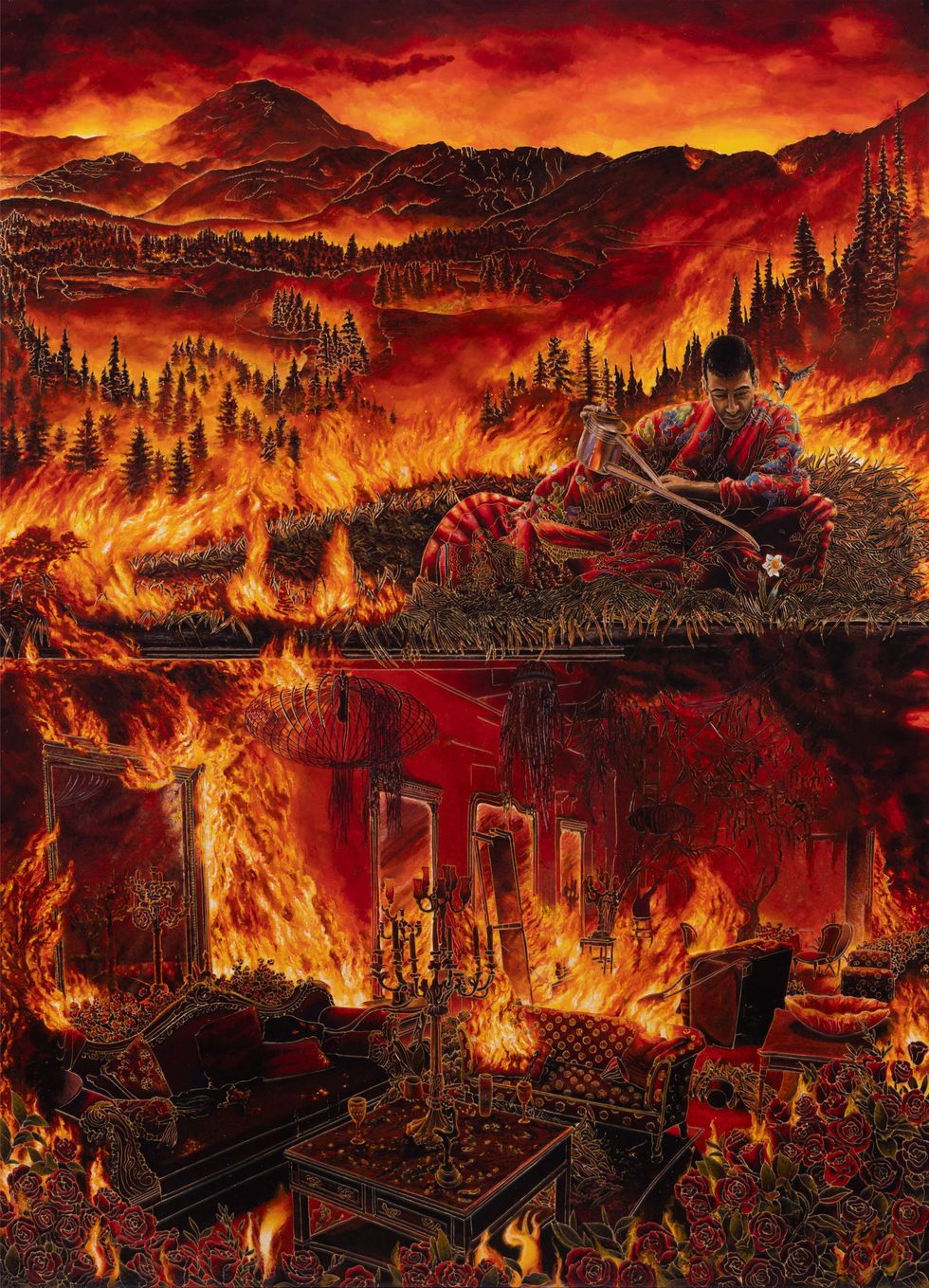 When the Thing with Feathers Turned Red by Raquib ShawKNMA
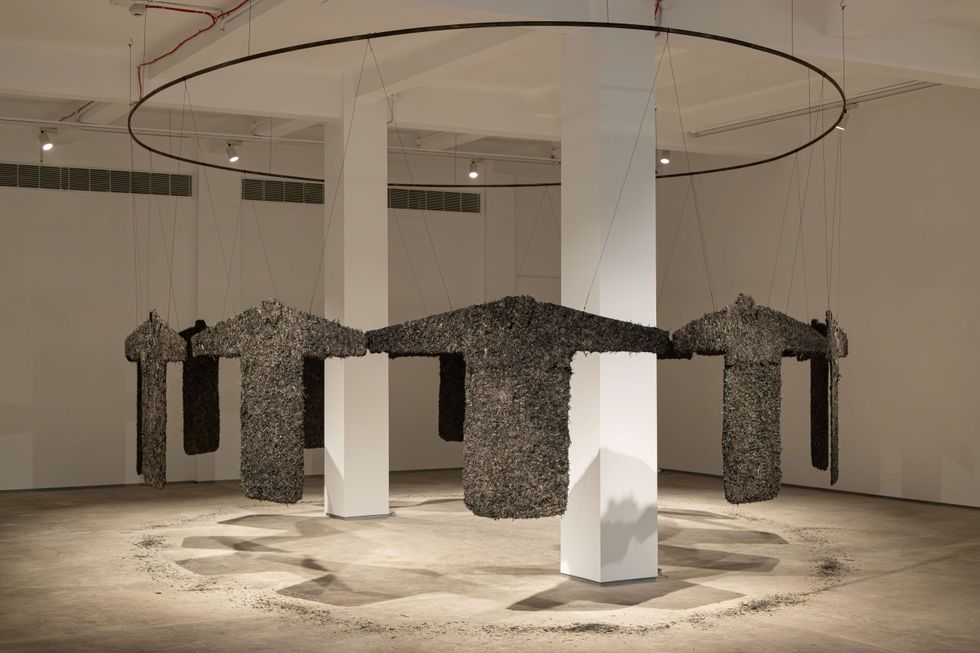 Indelible Black Marks by Kulpreet SinghKNMA
From Baroda, which had an important institution in the Maharaja Sayajirao University, he brought the tale of two friends – Jeram Patel and Himmat Shah. They set up “Group 1890”, which was “heavily critical of the realistic practices of modernism. They were inspired by the abstract practices of what was happening in US and Europe.”
“Himmat accidentally put his cigarette on paper which started burning,” said Achari. “They realised it creates a different effect on paper and started experimenting with this particular format.”
He mentioned the friendship between two female artists, Nasreen Mohamedi and Nalini Malani. They were invited to Bombay by Padamsee and experimented with abstract photography. “They were experimenting in different ways but creating a language of abstraction.”
He also drew attention to the conversation of two artists who studied in Kerala – K P Krishnakumar and N N Rimzon. The latter became the principal of the college where he had studied., “a cycle of life and friendship and art practice”.
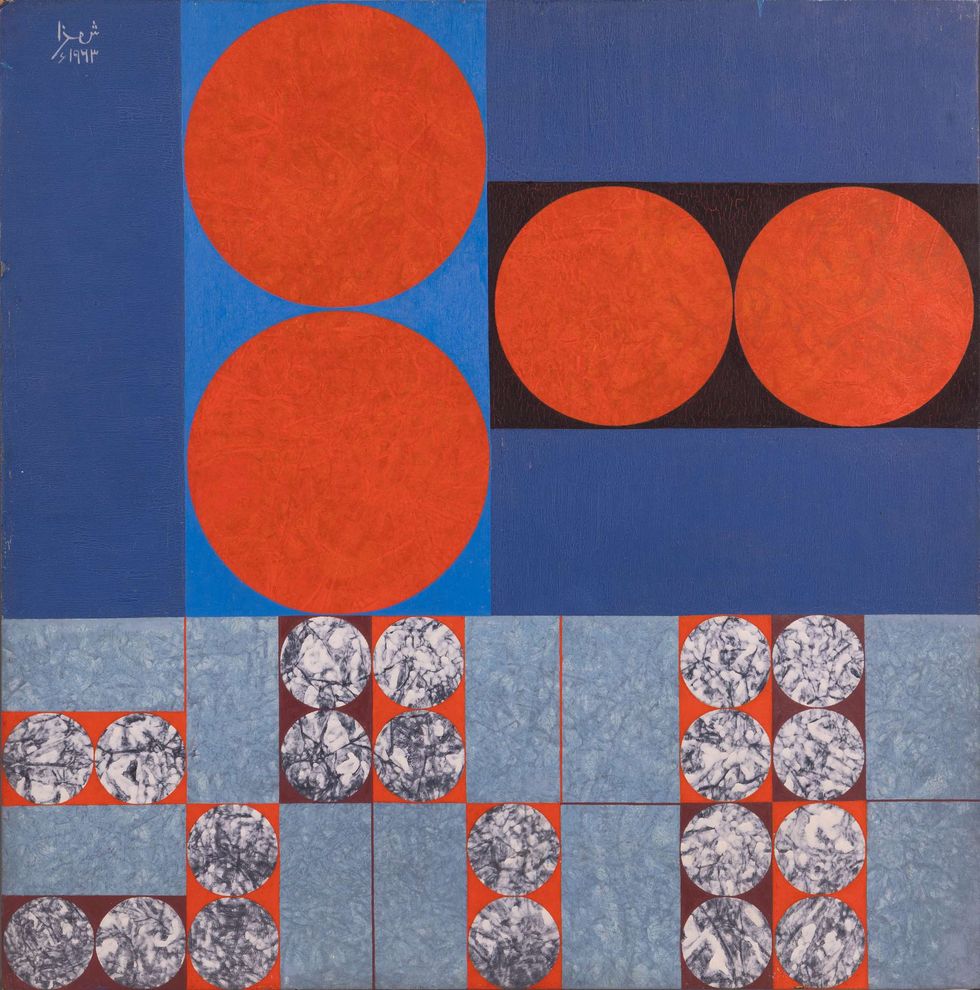 Square Composition II by Anwar Jalal ShemzaKNMA
 Interference by LN TallurJunagadh Museum, Gujarat, Varia Kiran(Videography), Vandita Jain (Sound Engineer) andBhanu Pratap Singh.
Achari referred to the Bangladeshi artist, Naeem Mohaiemen, who made a memorable video in 2011 based on the 1977 hijack of a Japanese airliner which ended up in Dhaka.
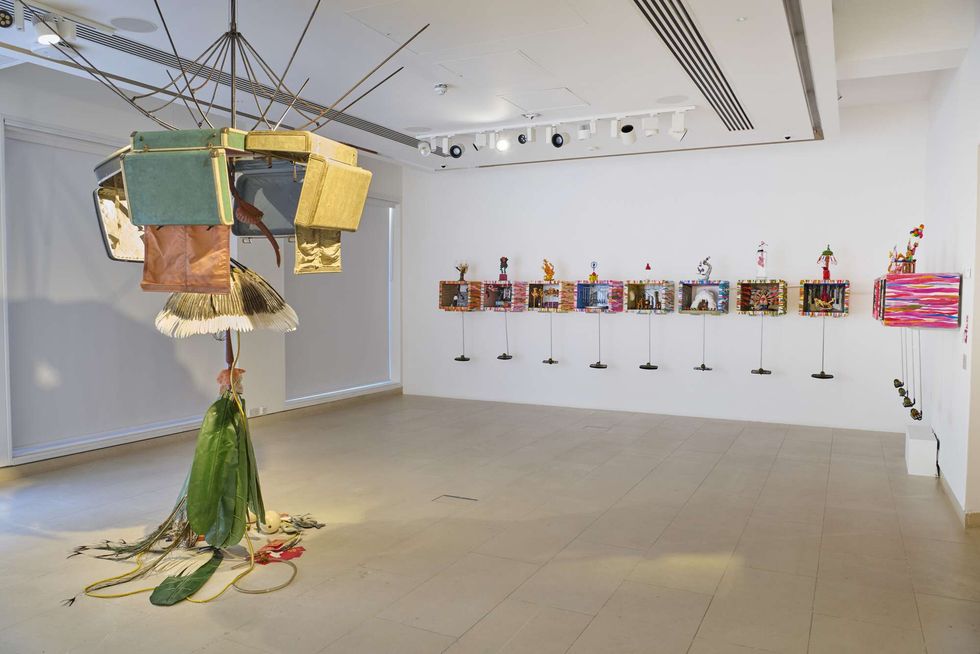
A Mumbai-based artist, Anant Joshi, made 12 boxes representing 12 months in “a very surreal, dreamlike manner – like a diorama”.
An intriguing work was that of Rina Banerjee. It shows the contents of a typical suitcase in the tropics spilling out – “you have eggshell, banana leaf, ostrich feathers, everything is falling out”.
He pointed out the conversation between Ganesh Gopal Jogi, an indigenous artist, with this modern artist anthropologist called Haku Vajubhai Shah, who was inspired by Gandhi.
He gave examples of art work, from the Warli style of painting, on photographs of industrial wasteland. He mentioned Shilpa Gupta, Rajesh Vangad and Gauri Gill.
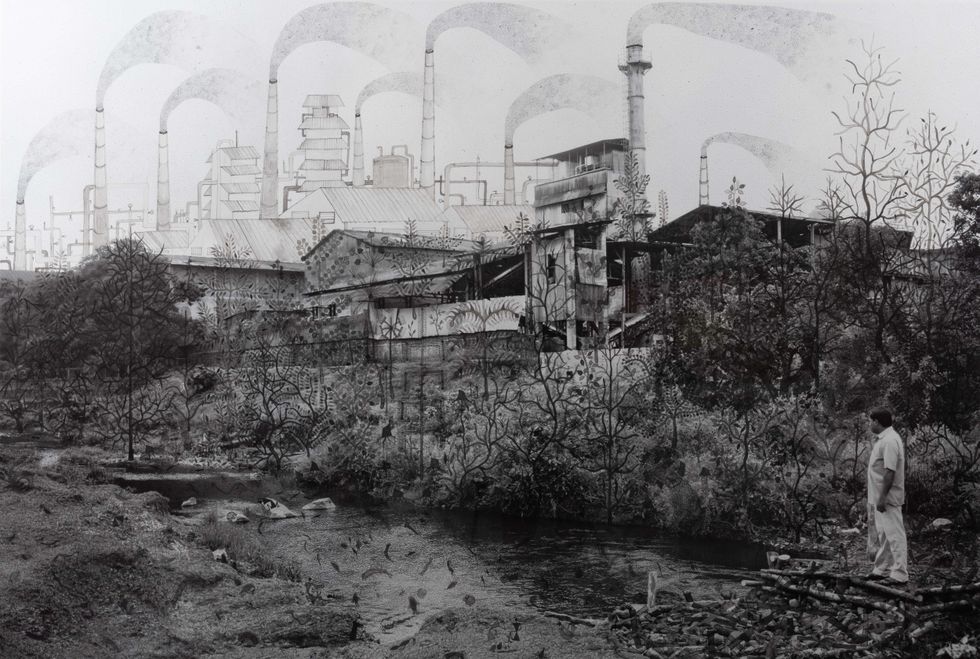 Factory and River II by Gauri Gill and Rajesh VangadKNMA
 The Meeting Ground Scenes from the KNMA CollectionChristie/KNMA
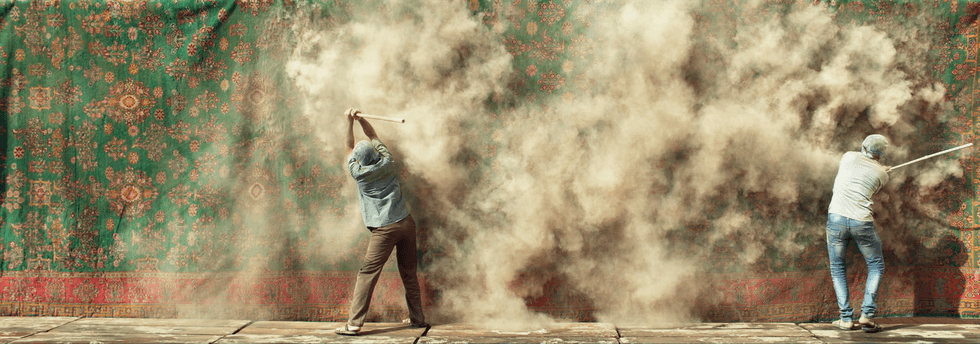
He said an important work in the exhibition shows what happens when a carpet is beaten with sticks resulting in clouds of dust coming out. But it isn’t any old carpet – but a 19th century one made by freedom fighters sent to jail by the British.
He commented: “It’s history is unsettling, moving out like this cloud, a haunting spectre.”
He mentioned Manjunath Kamath, “influenced by the Buddhist southeast Asian art, the murals of Ajanta, but he has also erased the faces”.
He talked of the “duality of beauty and violence” in how Aisha Khalid, a Pakistani, had adapted the idea of Mughal miniatures.
And Kulpreet Singh had been moved by the farmers’ protests in India in recent years to produce their kurtas, which shed ash to show their vulnerability.
He summed up: “So broadly, this is the exhibition about different stories of South Asia, different narratives of South Asia, how different generations they see the subcontinent, how they are representing the memories, and also artistically the experiments happening in South Asia right now.”
Entry is free to the exhibition, The Meeting Ground, at Christie’s, 8 King St, London SW1Y 6QT, which is open at the following times:
Monday 10 August - Friday 14 August, 9am - 5pm
Saturday 15 August - Sunday 16 August, closed
Monday 17 August - Friday 21 August, 9am - 5pm
Christie’s specialists & KNMA curators will offer free guided tours of the exhibition, revealing the stories behind the art. But booking is necessary.
Available tours
Wednesday 12 August, 3pm – 4pm
Thursday, 20 August, 3pm – 4pm




 Kate Varah Adama Jalloh
 Hiran Abeysekera (Hamlet) in Hamlet at the National Theatre. Sam Taylor
  Ncuti Gatwa as Algernon in The Importance of Being Earnest at the National Theatre Marc Brenner
 Sharon D Clarke as Lady Bracknell in The Importance of Being Earnest at the National Theatre Marc Brenner
  Indhu Rubasingham left and Kate Varah Amit Roy
 The company of Bacchae at the National Theatre Marc Brenner
  Ballet Shoes poster National Theatre
  Rosamund Pike (Jessica) in Inter Alia at the National Theatre resize Manuel Harlan