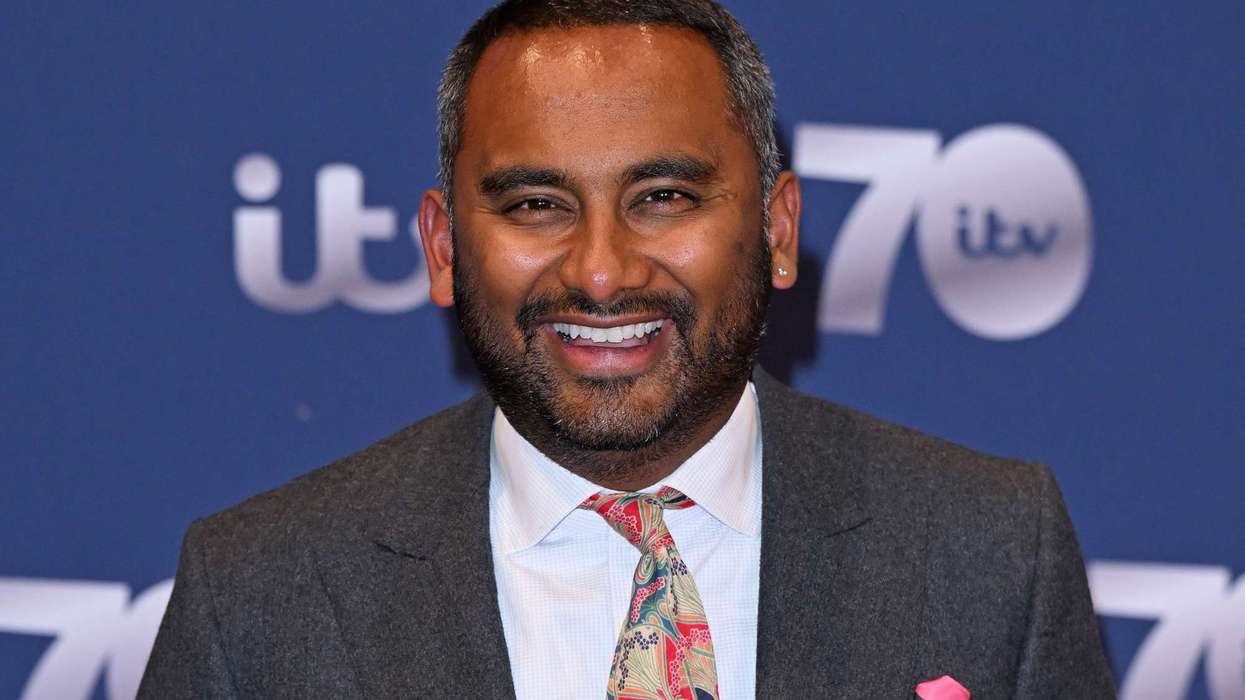

BEFORE dawn breaks across Britain, the radio airwaves carry the familiar sequence of notes known simply as the pips. For decades they have signalled the start of the BBC’s flagship morning broadcast, a programme that shapes the political rhythm of the day. In recent years, one of the voices guiding that national conversation has been Amol Rajan – a journalist, interviewer, and one of the most visible British Asian figures in modern broadcasting.
At the start of 2026, Rajan announced that he would step down from BBC Radio 4’s Today programme to launch his own media company. The decision marked a notable turning point in a career that has already traversed Fleet Street and the BBC at remarkable speed.
“The pips have sounded, and it's time to get my coat,” Rajan said of his departure, acknowledging both the symbolism and the affection he holds for the programme. Leaving Today, he admitted, “might be mad”.
That sense of risk has long been part of Rajan’s professional trajectory. He has built a career by navigating periods of upheaval within the media industry, often occupying roles that place him close to the centre of those changes.
Rajan joined the BBC in 2016 as its first media editor, a role created to reflect the growing influence of technology platforms and the increasingly complex economics of news. From that vantage point he has covered the transformation of global media – from the rise of digital platforms and subscription models to the political debates surrounding public service broadcasting.
Alongside his reporting duties he developed a distinctive presence across television and radio. In 2021 he joined the presenting team of Today, one of the most influential news programmes in the UK.
Owenna Griffiths, editor of Today, described him as “an exceptional talent with a rare combination of intellectual dexterity, impressive breadth of interest and a brilliant sense of humour”. Perhaps most importantly, she added, he was “a great team player who always champions the hard work of producers”.
Rajan’s media career began in print journalism, during another turbulent moment for the industry.
He joined The Independent as a young researcher before rising rapidly through the newsroom ranks. In 2013, aged just 29, he was appointed editor of the newspaper – becoming the youngest editor of a national broadsheet and the first from an ethnic minority background.
His tenure coincided with one of the most disruptive periods in British newspaper history. Print circulation was declining sharply while audiences migrated online. Rajan oversaw the paper’s transition towards a digital-first strategy, reshaping editorial operations and expanding its digital reach at a moment when many newspapers were still grappling with how to survive in the internet era.
The experience placed him at the centre of the structural changes reshaping journalism – a theme that would later define his reporting as the BBC’s media editor.
At the BBC he became a regular presence across platforms, contributing to news bulletins, radio programmes and documentaries that examined politics, business and culture. His long-form television series Amol Rajan Interviews brought him face to face with figures ranging from former prime ministers Tony Blair and John Major to global cultural and technological leaders such as Bill Gates and Greta Thunberg.
“I genuinely couldn't be prouder of Amol Rajan Interviews, which will stand the test of time,” he reflected when announcing his departure from Today. Travelling “all around the world (or indeed Essex)” to spend extended time with such figures, he said, had been “an unforgettable privilege”.
Born in Calcutta (now Kolkata) in 1983, Rajan moved to the UK as a child and grew up in Tooting, south London. He attended Graveney School before studying English at Downing College, Cambridge, where he edited the student newspaper Varsity.
Among his most personal recent projects was the 2025 BBC documentary Amol Rajan Goes to the Ganges. The programme followed his journey to the Kumbh Mela, the vast Hindu pilgrimage that draws hundreds of millions of devotees to the banks of the Ganges.
The trip was prompted by a deeply personal moment. Rajan’s father had died unexpectedly three years earlier, leaving him, as he put it at the start of the programme, “in a bit of a funk”. The documentary became both a spiritual journey and a meditation on grief, belonging and identity.
Returning first to his childhood neighbourhood in Tooting, Rajan reflected on the experiences that shaped him as the son of Indian immigrants in Britain. The programme’s most intimate scenes unfold in conversation with his mother – moments of affectionate humour mixed with lingering grief. At one point, overcome while looking at a portrait of his father, Rajan admits: “I really miss that smile. I miss his love. Oh god, I loved him so much.”
The documentary revealed a different side of a broadcaster better known for interrogating politicians. It was a reminder that Rajan’s public voice – analytical, curious and occasionally mischievous – is also shaped by personal history and cultural inheritance.
Now, with his departure from Today, Rajan appears ready to apply that curiosity to the next transformation of media itself. “Twenty years after I first flirted with the idea, I'm extremely excited to jump into the Great Digital Narnia of the Creator Economy,” he said, describing his plan to build a new media company.
Entrepreneurial ambition has always lingered beneath the journalist’s career. As a boy growing up in south London he admired the fictional wheeler-dealer Del Boy from Only Fools and Horses. “Del Boy was my hero growing up,” Rajan said, explaining his desire to “unleash my inner entrepreneur”.
Even so, his relationship with the BBC remains close. Rajan will continue presenting University Challenge and the Radical with Amol Rajan podcast, maintaining a presence within what he described as “Britain's noblest cultural institution, whose Reithian spirit is such a generous gift to a world in flux”.
That phrase – a world in flux – neatly captures the context in which Rajan’s career has unfolded. Few journalists of his generation have moved so fluidly between print, broadcast and digital platforms, while simultaneously analysing the forces transforming them.
If the next chapter takes him into the unpredictable terrain of the creator economy, it will be consistent with the restless curiosity that has defined his path so far. After all, stepping into uncertainty has long been Rajan’s preferred route to influence.