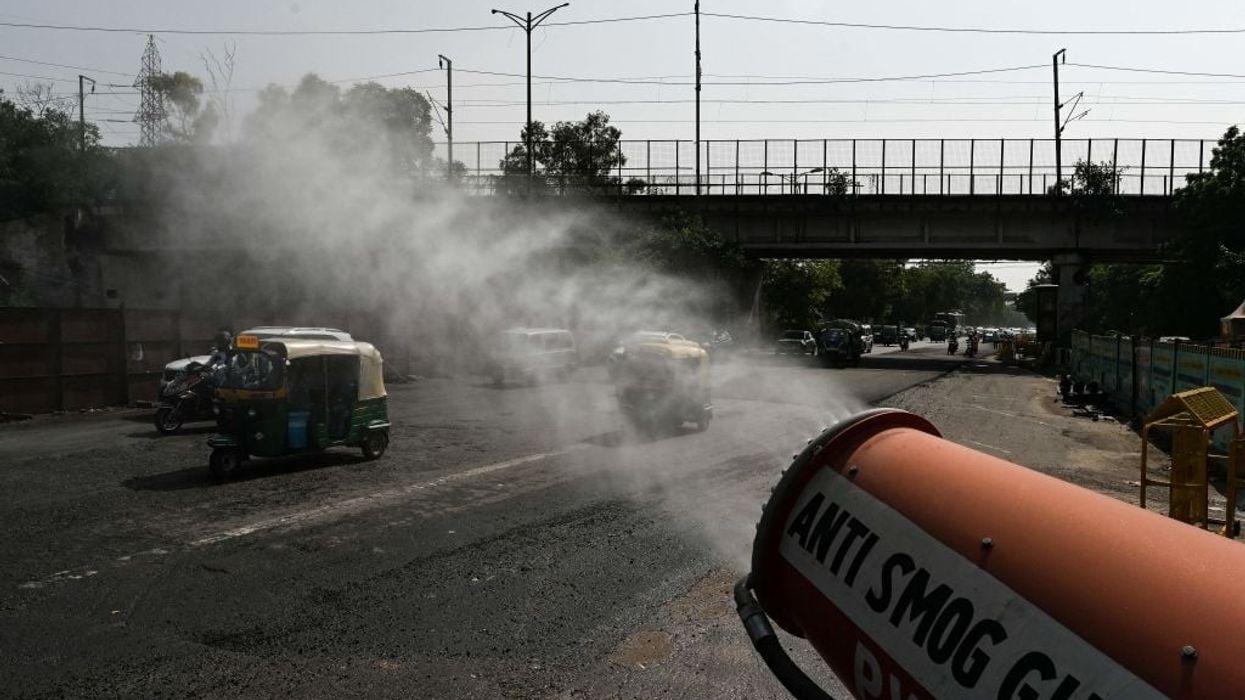

INTERMITTENT rain and winds led to a rare drop in pollution in India's capital last month, with residents breathing the cleanest air in at least four years, but authorities warn that air quality is set to drop sharply in November.
A delayed end to the monsoon and a sharp pick-up in wind speeds ensured that the concentration of hazardous, small airborne particles known as PM2.5 in a cubic metre of air averaged 72 in October when air quality typically takes a turn for the worse.
That was sharply down from an average concentration of 126 recorded in October 2020 - 25 times over the World Health Organization's safe limit - according to data gathered by the state-run Central Pollution Control Board.
But factors including falling temperatures, a drop-off in wind speed and farmers torching crop stubble are likely to turn the air hazardous.
"Because of frequent rains, most farmers didn't get to burn crop stubble, and now they have an even shorter window to dispose of crop waste," said Anumita Roychowdhury, an executive director at the Centre for Science and Environment think tank.
New Delhi's air pollution is a reminder of the challenges India faces as world leaders meet at the UN COP26 summit in Scotland to agree on strategies to fight global warming.
Prime minister Narendra Modi, whose government often invites criticism for not doing enough to curb pollution, on Monday (1) told the COP26 climate summit that India would achieve a net-zero carbon emission target by 2070.
Scientists said India's target is at least two decades late.
India, the world's third-biggest emitter of greenhouse gases after China and the US, had earlier rejected calls to announce a net-zero carbon emissions target, and British Prime Minister Boris Johnson pressed New Delhi to submit an ambitious emissions reduction target.
India should actively strive for an earlier date of zero-emissions after reassessing the situation in coming years, said Avinash Kumar Chanchal, senior climate campaigner at Greenpeace India.
"The next ten years are going to be crucial in achieving the climate target, and the action plan must start reducing emissions at sources, as fast and as much as possible," he said.
Adding to concerns over air quality in New Delhi, the Diwali festival of lights falls on Thursday (4) when Indians set off firecrackers as part of an ancient Hindu tradition.
Delhi has banned the sale of firecrackers, but authorities rarely enforce such curbs.
"The October air was clean, but we're really worried about November," said a senior government official involved in framing policies to curb air pollution. "Stubble burning could peak right after Diwali."
Since 2018, India has given individual farmers a 50 per cent subsidy and farm cooperatives an 80 per cent subsidy to buy machines that dispose of rice stubble left out in the field by mechanised harvesters.
Despite the subsidies, the machines are expensive. Farmers also complain that they need to pay upfront and then claim subsidies later - a process that takes about 10 months.
In October, crop waste burning came down by 52 per cent against the same month last year, government data showed.
In Lahore in neighbouring Pakistan, not far from the border with India, the air quality index rose to 341, the worst in the world on Monday, according to IQ Air. On Tuesday (2), air quality in Pakistan's second-most populous city was 162.
In the winter months, industrial and vehicular emissions, smoke from brick kilns and crop stubble fires lead to a sharp spike in air pollution in Lahore, just as in India.