

OLYMPIC champion Neeraj Chopra became the first Indian to win a gold medal at the World Athletics Championships when he pipped Pakistan's Arshad Nadeem in the men's javelin on Sunday (27) with an 88.17 metre effort in the final.
Chopra won Olympic gold in Tokyo but managed only a silver at the worlds in Eugene last year. The only other Indian to win a medal at the worlds was Anju Bobby George, who took bronze in the women's long jump in 2003 in Paris.
Pakistan's Nadeem, coming back from elbow surgery and a knee injury, produced his season's best effort of 87.82 on his third attempt to win the silver medal, while the Czech Republic's Jakub Vadlejch took the bronze with 86.67.
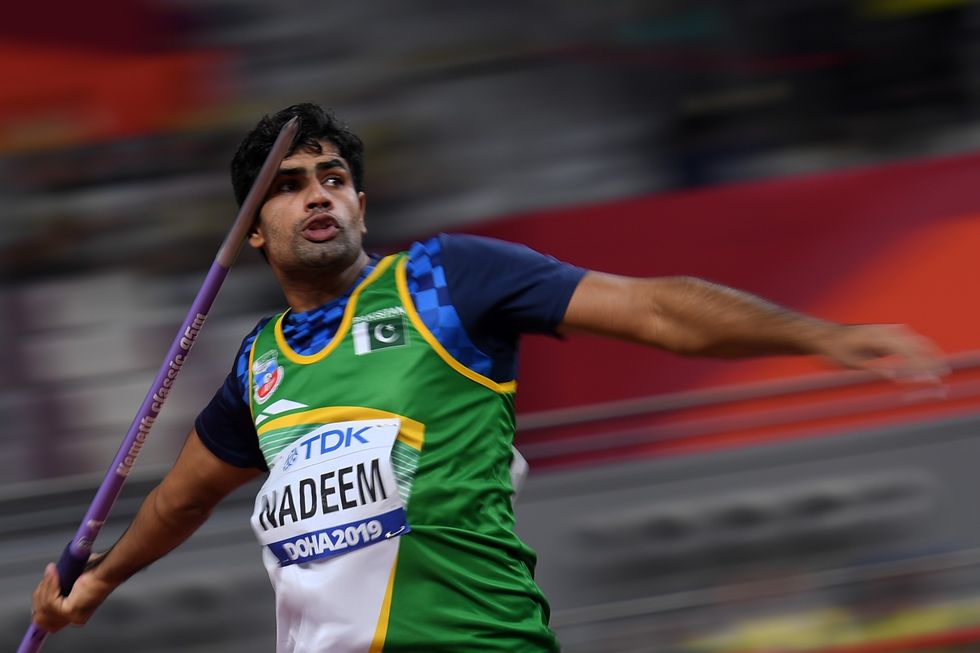 Pakistan's Arshad Nadeem (Photo by KIRILL KUDRYAVTSEV/AFP via Getty Images)
"This was great. After the Olympic gold I really wanted to win the world championships. I just wanted to throw further. This is brilliant for the national team but it was my dream to win gold at the world championships," Chopra said.
"This has been a great championship for India and I am proud to bring another title to my country. I don't think I am the best thrower here. I wanted to throw more tonight.
"I wanted to throw more than 90m tonight but it needs all parts of the puzzle to be there. I couldn't put it all together this evening. Maybe next time."
Chopra needed only one attempt in the qualification round to lead the field with a season-best 88.77 metres.
But the Indian was unhappy with his first effort in the final, deliberately stepping over the line for a foul.
Under pressure, the 25-year-old then soared into the lead on his second attempt, turning his back and celebrating in trademark fashion with his arms aloft while pointing at the sky immediately after his throw, knowing it was good.
Nadeem was competing in his first event of the year and as soon as the javelin landed on his third attempt, he broke into a wide grin as he moved up to second.
India and Pakistan may have a heated rivalry in cricket but on a warm night in Budapest, all eyes were on two athletes competing for javelin gold.
But that was as close as Nadeem, the 2022 Commonwealth Games champion, got to Chopra as he ran out of steam.
Julian Weber was close to giving Germany their first medal in Budapest on the final day of the championships, but he was pushed down to fourth when Vadlejch saved his best for his fifth attempt.
"It was a big fight and I am afraid that Julian Weber will not like me anymore," Vadlejch said.
Kishore Jena and DP Manu finished fifth and sixth, respectively, to give India three athletes in the top six.
(Reuters)


 (Photo credit: PTI)




 Kendrick Lamar and SZA commands the stage at Villa Park during his explosive opening setInstagram/
