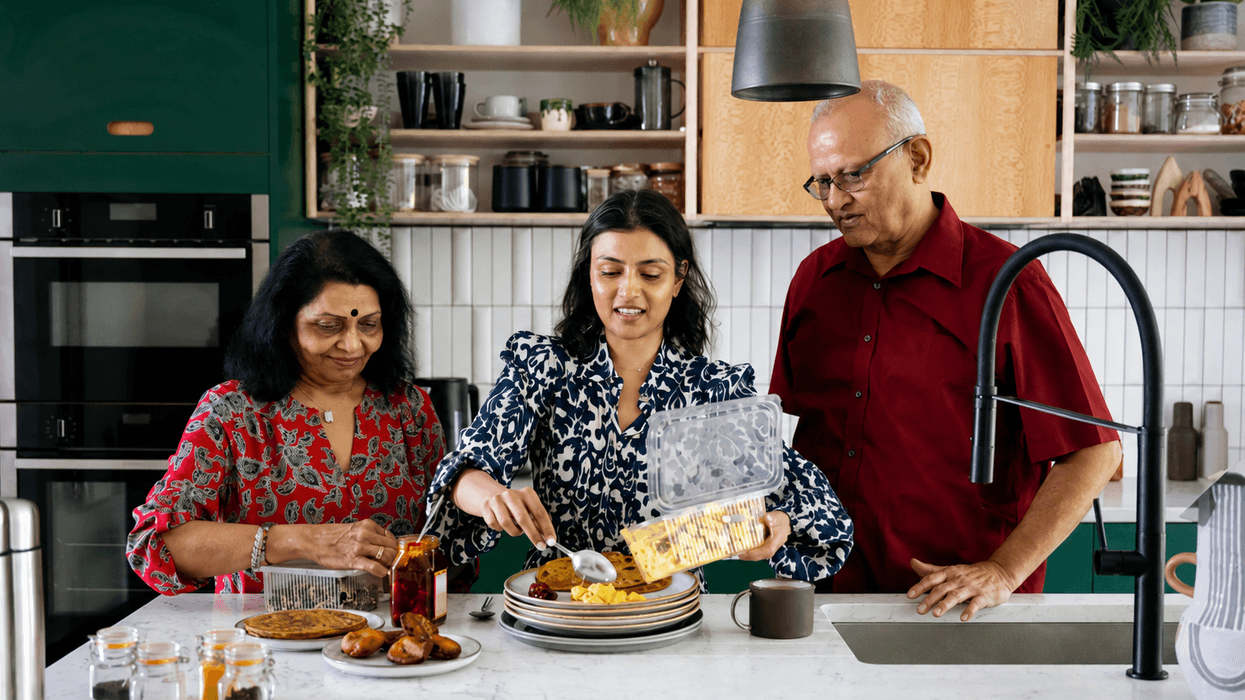

Growing up in London, Sunday in our house meant my grandmother's kitchen running on a schedule of its own. Dal would be on by nine, onions caramelising on the back burner while she argued with my mother about the right amount of chilli, and by mid-morning the smell of garam masala would drift upstairs and pull everyone towards the staircase. For years, I assumed that ritual belonged to her generation — something I admired from a distance but never quite inherited. Then last autumn, after looking at how often I had ordered takeaway that month, I decided to try it myself. I set aside a Sunday, pulled out an old family recipe for lamb biryani, and invited everyone over for dinner.
Among some younger British South Asian households, there appears to be a renewed interest in cooking this way. The reasons are as much about memory and family as they are about everyday spending. Delivery apps made ordering a family curry effortless, and for many households that convenience became part of the weekly routine. But as grocery bills, takeaway prices and other household expenses have become harder to ignore, cooking at home has started to feel different. A long Sunday meal can be practical without feeling like a compromise, particularly when several people are eating together. More importantly, it creates the kind of afternoon that cannot easily be recreated by four separate takeaway containers arriving at the door.
The economics have certainly changed the texture of the weekly routine. Planning starts earlier, ingredients are bought with several meals in mind, and family members increasingly swap tips about where they found something worth buying. Comparing prices has become an ordinary part of those conversations. Someone will mention a cheaper butcher, another person will know where a particular spice is on offer, and somebody else will have checked UK discount codes while ordering something the household already needed. The advice moves quickly because it is useful, but it rarely becomes the point of the conversation. Saving a few pounds here and there simply leaves a little more room for the things families actually want to spend on.
What keeps Sunday cooking alive, though, is less the saving than the company. Cooking together creates an easy reason for people to stay in the same room long enough to properly catch up. One person takes responsibility for the rice, another starts chopping coriander, and someone inevitably disagrees with the amount of spice going into the pot. Recipes also change as they pass between generations. Fresh ingredients sometimes become frozen ones, a pressure cooker replaces the heavy pot a grandmother trusted for decades, and dishes are adjusted around work schedules, dietary preferences and whatever happens to be available locally. The details change, but the familiar rhythm of people moving around the same kitchen remains.
There is also something different about learning a family dish as an adult. As children, many of us experienced these meals only from the dining table. We knew what arrived in front of us but not necessarily how much preparation happened before it got there. Cooking those dishes ourselves reveals the small decisions that were never written into recipe books: how dark the onions should become, when to lower the heat, or how much water is meant by “a little.” Those details are often passed down through observation rather than measurement, which makes spending time together in the kitchen part of preserving the recipe itself.
For those who did not grow up standing beside a parent or grandparent at the stove, that gap is increasingly being filled elsewhere. A search for "how to make proper dal" or "biryani like my mum used to make" now returns hundreds of videos from home cooks and second-generation creators, many filming in kitchens that look a lot like the ones they grew up in. Some approach a recipe from Instagram or YouTube with a certain amount of caution, treating it as a rough guide rather than gospel, then adjusting it once a parent tastes the result and says it needs more salt or less water. Others use these videos to settle long-running family disputes about the "correct" way to make something, only to discover that three different aunties have three different answers, all delivered with equal confidence. Either way, the phone propped up against a spice jar has become its own kind of kitchen companion, sitting somewhere between a cookbook and a grandmother looking over your shoulder.
None of this needs to be framed as a return to an imagined past. British South Asian kitchens have always changed with the people using them, and convenience still has its place. Takeaway will remain useful after long working days, and nobody needs to spend every Sunday standing over a stove to maintain a connection with family or culture. But for some households, cooking has quietly become one of the easiest ways to slow the week down, feed several generations at once and stay connected to food that carries memories with it. The kitchen may look different from the one many people remember growing up in, but by mid-morning on a Sunday, the smell of onions and garam masala can still make it feel remarkably familiar.