
Highlights
- The Moon will cover up to 96 per cent of the Sun over the UK this evening, with maximum eclipse around 7.12pm BST from London.
- Certified ISO 12312-2 eclipse glasses are the only safe way to look directly at it — but a cereal box pinhole viewer works just as well, and takes minutes to build.
- The eclipse isn't visible from India this time, since it falls during India's night-time hours — but it is visible from the UK, which means the traditional Hindu Sutak Kaal observance (where practised) applies differently for British Hindu households than for relatives back home.
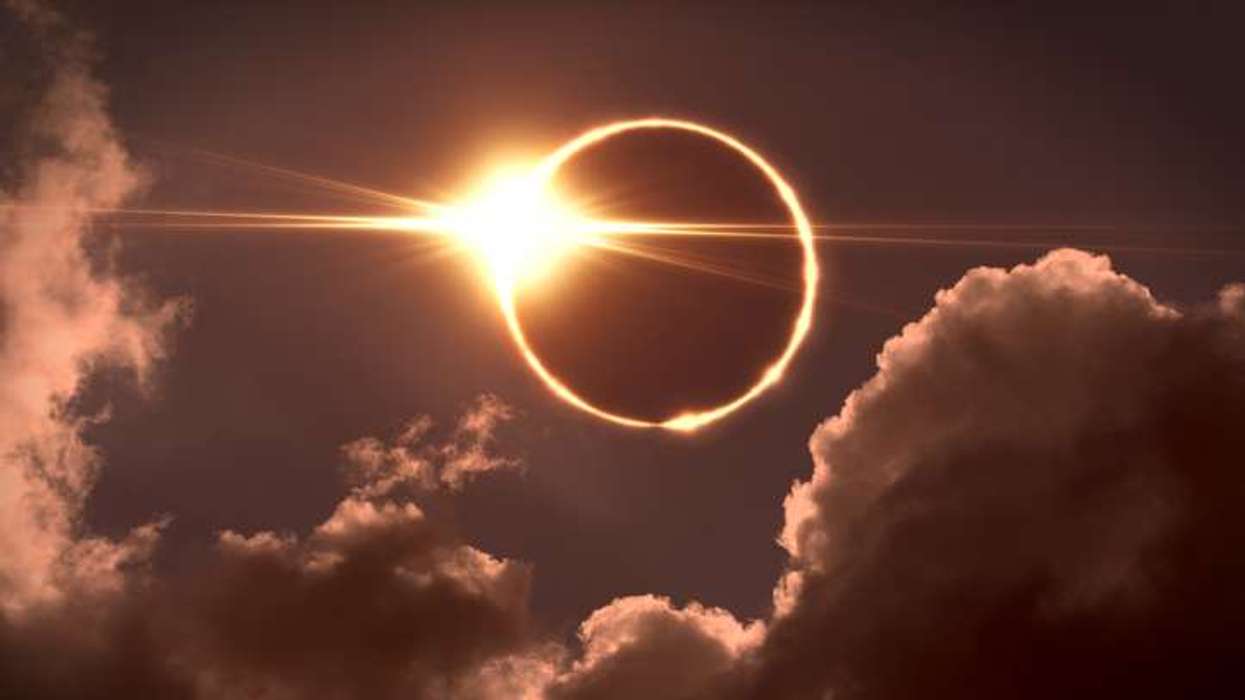
Today's solar eclipse is the first total solar eclipse to cross mainland Europe since 1999, and while totality itself is reserved for Greenland, Iceland and northern Spain, the UK is in for a genuinely dramatic show of its own: a deep partial eclipse covering up to 96 per cent of the Sun. It happens during the early evening, meaning most of the country can watch it without taking time off work or school.
Here's exactly when to look, how to do it without risking your eyesight, and the one detail this year's eclipse raises for British Hindu households that hasn't come up in over a decade.
What time is the solar eclipse in the UK today?
From London, the eclipse begins around 6.17pm BST, when the Moon first appears to bite into the edge of the Sun — timings shift by a few minutes depending on where in the UK you are. It builds steadily to maximum eclipse at around 7.12pm in London (7.05–7.13pm BST is the range across the whole UK), before the Moon clears the Sun's disc entirely roughly an hour later. The whole event lasts about one hour and fifty minutes.
Coverage is deepest in Cardiff, which narrowly beats Belfast for the best view in the UK, though the difference across the whole country is small — most of Britain will see somewhere between 90 and 96 per cent of the Sun blocked out. Because the eclipse happens low in the western sky in the early evening, the Moon will cross the Sun from right to left, leaving a downward-curving crescent rather than the "smiley face" shape many expect.
| UK timing | Detail |
|---|---|
| First contact (London) | 6.17pm BST |
| Maximum eclipse (London) | ~7.12pm BST |
| Duration | ~1 hour 50 minutes |
| Deepest coverage | Cardiff, narrowly ahead of Belfast |
| Coverage across UK | 90–96% of the Sun |
How can I look at the eclipse safely?
Never look at the Sun directly at any point during a partial eclipse, even for a second — not with the naked eye, sunglasses, a phone camera, binoculars or a telescope. The only safe way to view it directly is through glasses certified to the ISO 12312-2 standard, checked beforehand for scratches or damage.
If you don't have certified glasses, the safest option is to stop looking at the Sun altogether and watch a projected image of it instead — which is exactly what a pinhole viewer does.
How do I make a cereal box eclipse viewer?
Empty a cereal box and tape a piece of white paper inside, at the bottom, to act as a screen. Seal the top of the box shut, then cut two rectangular holes into it — one on each side.
Cover one hole completely with a piece of aluminium foil, then use a pin to poke a single small hole through the centre of the foil. Leave the other hole open. To use it, stand with your back to the Sun, let light pass through the pinhole, and look through the second hole to see a small projected image of the eclipsed Sun on the paper screen inside — you're watching a projection, never the Sun itself.
If cardboard and foil aren't to hand, the Royal Observatory Greenwich is livestreaming the eclipse from 6.10pm on YouTube and Facebook. NASA is running its own live coverage from multiple camera locations, and the European Space Agency is broadcasting from an observatory in Spain, for anyone who wants to see totality itself.
Does Sutak Kaal apply in the UK this year, unlike in India?
This is the detail that's easy to miss if you're only reading Western science coverage. In Hindu tradition, Sutak Kaal — a period of restraint observed before and during a visible eclipse, when many households pause cooking, avoid starting new work, and focus on prayer or mantra chanting — is described in several astrology and religious-lifestyle guides as applying only where the eclipse is actually visible to the naked eye. There's no single central religious authority that governs this, and observance varies by tradition, region and household — some families follow it strictly, others treat it as optional, and some don't observe it at all.
What multiple sources do agree on is the basic visibility fact: because today's eclipse happens during India's night-time hours, it isn't visible there, so families in India, the Gulf, Singapore or Australia have no eclipse to observe either way. The UK, by contrast, is inside the visible zone. That means British Hindu households following the traditional view are, for once, in a different position from relatives back home — some may choose to observe the restraint through the visible window this evening, even though nobody watching from India has an eclipse to mark at all. Those who do keep it often avoid eating during the visible window, sit for quiet mantra chanting or meditation, and close the period with a short prayer once the eclipse has passed — but none of this is a fixed rule everyone follows, and it's worth checking with your own family or temple rather than treating any single guide as definitive.