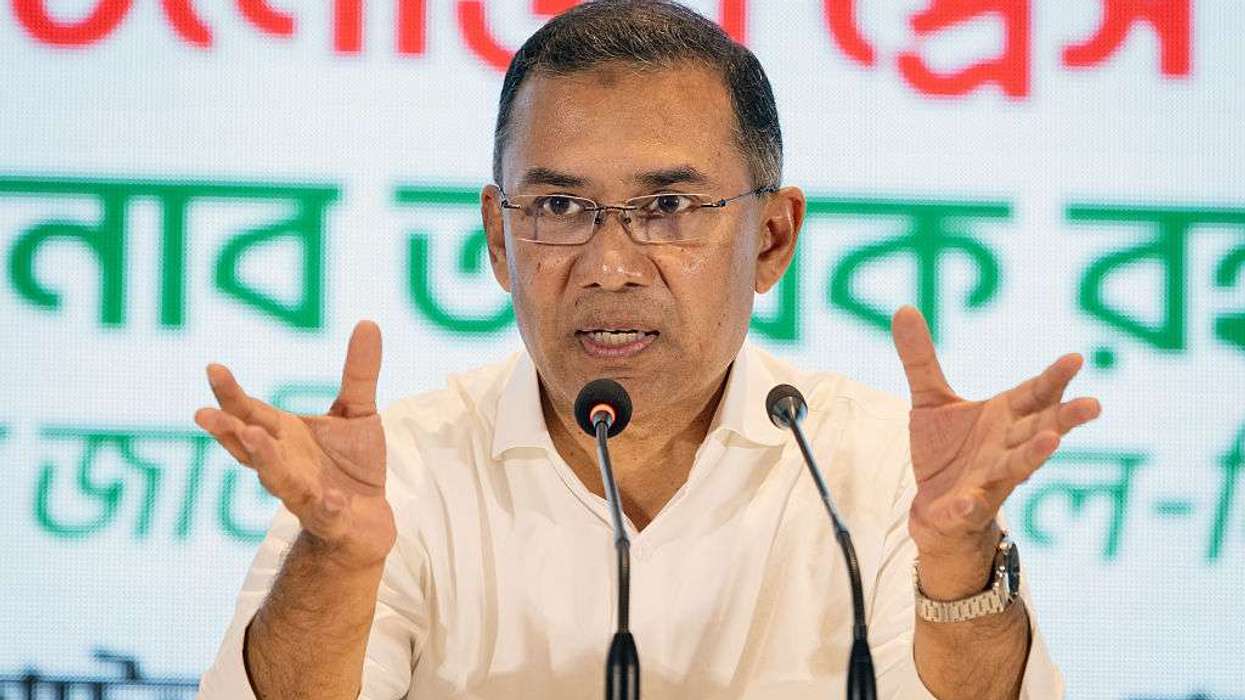

BANGLADESH's newly elected prime minister Tarique Rahman has vowed to strengthen the rule of law and said his government would turn the country into a safe land for people of all faiths, irrespective of party affiliation, opinion, religion or ethnicity.
In his maiden televised address to the nation after assuming office, Rahman outlined his government’s priorities, saying that improving the law and order situation and strictly controlling corruption to restore peace and security were at the top of his agenda.
“We want to turn this country into a safe land for every citizen. Muslims, Hindus, Buddhists and Christians — regardless of party, opinion, religion or ethnicity — whether living in the hills or the plains, this country belongs to all of us,” said the prime minister, who is also the chief of the Bangladesh Nationalist Party (BNP).
“Whether you voted for the BNP, did not vote for the BNP, or did not vote at all — everyone has equal rights over this government. As Bangladeshis, all of us have equal rights in this country,” he said.
Bangladesh’s Hindu population has been affected by a series of incidents targeting minority communities following the ouster of former prime minister Sheikh Hasina in August 2024.
Under the interim government led by Muhammad Yunus since August 2024, the country witnessed a rise in mob violence, extrajudicial killings and attacks on minority communities, particularly Hindus.
Rights group Manabadhikar Shongskriti Foundation (MSF) said that in January 2026 alone it documented 21 incidents of lynching and 28 cases of mob beatings. The Bangladesh Hindu Buddhist Christian Unity Council reported 522 communal attacks in 2025, including killings, rapes and temple vandalism. It said 116 people from minority faiths — mostly Hindus — were murdered between June 2025 and January 2026.
The reports suggested that leaders and activists of the Awami League, which was disbanded under the Yunus administration, were the victims of most attacks.
India has repeatedly expressed concern over attacks on minorities, especially Hindus, in Bangladesh.
Earlier, Mirza Fakhrul Islam Alamgir, the senior-most minister in the new government, said law and order was one of its three main priorities and that steps would be taken to end “mob violence”. Alamgir, who is also the BNP’s secretary general and holds the local government portfolio, said such violence would be brought under control.
Home minister Salahuddin Ahmed echoed the sentiment, saying mob culture “cannot be tolerated in any way”.
In his address, Rahman said all constitutional, governmental and non-governmental institutions would function strictly in accordance with established laws and regulations.
“Not party or political influence, but the rule of law will be the final word in governing the state,” he said.
Rahman said his government’s goal was to build a self-reliant, secure, humane and democratic Bangladesh. He added that the administration had begun its journey amid a fragile economy weakened by corruption and misrule, poor governance and a deteriorating law and order situation.
He also extended greetings to the people on the occasion of the holy month of Ramadan. On the supply of gas, water and electricity during the period, he said authorities had been instructed to ensure uninterrupted civic amenities during iftar, tarawih and sehri.
Referring to his earlier pledge that a BNP government would follow the ideal of justice espoused by the Holy Prophet, Rahman said the decision of the BNP parliamentary party reflected that principle.
Rahman, 60, was sworn in as Bangladesh’s 11th prime minister on Tuesday (17) after leading the BNP to a decisive victory in the 13th parliamentary elections held on February 12. He replaced interim government chief Yunus.
The son of late president Ziaur Rahman and former prime minister Khaleda Zia, Rahman returned to Bangladesh in December after living in self-imposed exile in London for 17 years.
Along with Rahman, 25 cabinet ministers and 24 state ministers also took the oath of office on Tuesday.
(PTI)