
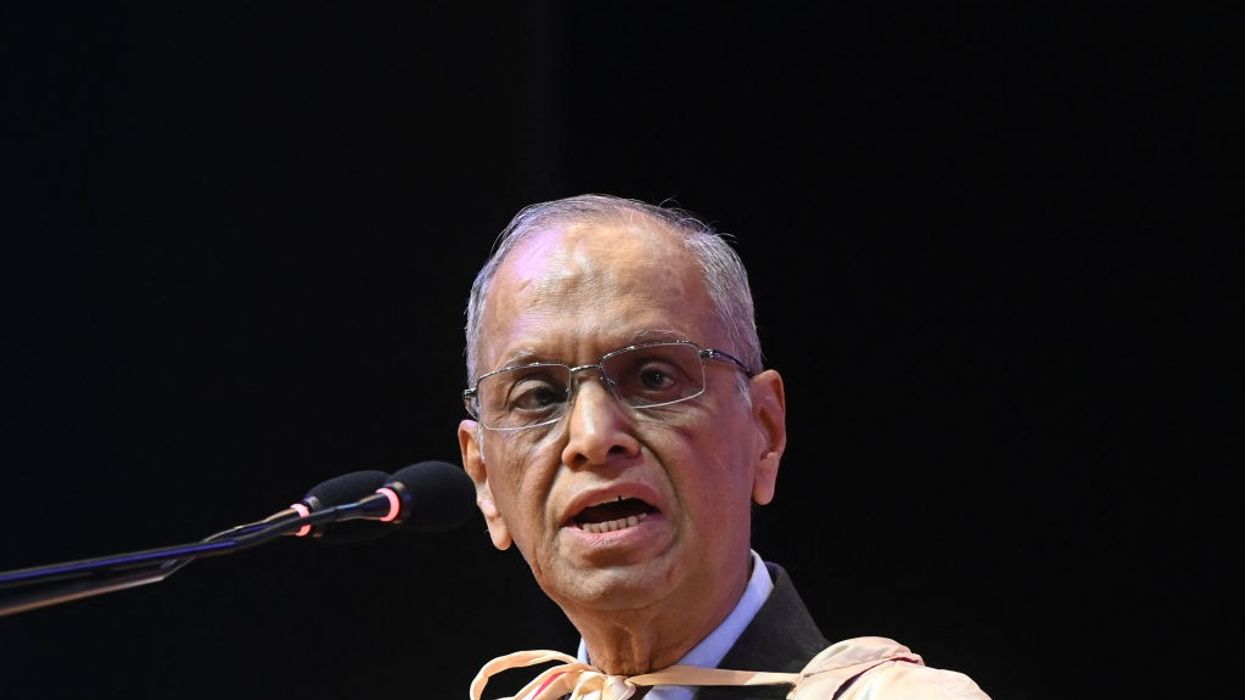
PRIME MINISTER Rishi Sunak’s entrepreneur father-in-law has suggested Indian youngsters should work for 70 hours a week to help the south Asian nation compete with bigger economies.
NR Narayana Murthy said India should emulate Japan and Germany which made rapid progress after World War II by “working a certain number of extra hours”.
He is the co-founder of the Indian software major Infosys in which his daughter and Sunak’s wife Akshata Murty holds a minority stake.
Murthy, 77, told the company’s former chief finance officer Mohandas Pai for a podcast that India's work productivity was “one of the lowest in the world”.
"Unless we improve our work productivity, unless we reduce corruption in the government at some level, because we have been reading I don't know the truth of it, unless we reduce the delays in our bureaucracy in taking this decision, we will not be able to compete with those countries that have made tremendous progress."
"Therefore, my request is that our youngsters must say, ‘This is my country. I’d like to work 70 hours a week’," Murthy said, adding this was how the Germans and Japanese progressed.
According to him, the government alone cannot change the fortunes of a country.
"Our culture has to change to that of highly determined, extremely disciplined and extremely hard-working people. We need to be disciplined and improve our work productivity. I think unless we do that, what can poor government do?"
However, his remarks sparked a debate on work-life balance.
But Murthy’s wife Sudha defended his remarks saying they reflected his own work culture.
“He has worked 80 to 90 hours a week, so, he doesn’t know what less than that is”, the writer told News18, adding her husband believed “in real hard work and he lived like that.”
Tech Mahindra CEO CP Gurnani also endorsed Murthy’s view saying the entrepreneur meant a part of the 70-hour work week should be used for one’s own progress.
“He hasn't said (one should) work 70 hours for the company - work 40 hours for the company but work 30 hours for yourself…” he said.
Sunak’s father-in-law suggests youngsters should work for 70 hours a week
He says India should emulate Germany and Japan which, according to him, achieved progress by working extra hours after World War II






 Curator Emma Slocombe with ikat robes and arabachi coats in the Peter the Great Room in Blickling Hall Amit Roy
 View of the entrance to Blickling Hall on a rainy autumn dayAmit Roy
 Kente cloth from Ghana in the Long Gallery in Blickling Hall
 Decoration in the Great Hall at Blickling Hall Amit Roy
 Palampore fragment made in coastal south-east India in the Brown Room in Blickling Hall Amit Roy
 Bed valance dating from early 1700s in the Italian Print Room at Blickling Hall Amit Roy
 Indian inspired fabric draped on sofas in the South Drawing Room in Blickling Hall Amit Roy
 Indian inspired fabric draped on sofas in the South Drawing Room with Indian carpet in Blickling Hall Amit Roy
 Karun Thakar has picked out the geometric patterns in the bookcase and the Kente cloth in the Long Gallery in Blickling Hall Amit Roy
 Large tapestry depicting Peter the Great defeating the Swedish army at the Battle of Poltava in 1709 Amit Roy
 ikat robes and arabachi coats in the Peter the Great Room in Blickling Hall Amit Roy
 Baghs and kanthas made by women provide contrast to the men only portraits in the Great Hall at Blickling Hall Amit Roy
 Baghs and kanthas in the entrance Great Hall at Blickling Hall Amit Roy
 Baghs and Kanthas in the Great Hall in harmony with stained glass window at Blickling Hall Amit Roy
 Kimonos reflect Japanese influence in Upper Ante Room in Blickling Hall Amit Roy
 Kimono in Upper Ante Room in Blickling Hall
 A view of the Palace and fort at Agra shows romantic side of India Amit Roy
 Blickling Hall Amit Roy
 Table carpet, European 1670-1680 Amit Roy
 Unfinished 17th century Italian embroidery in the Print Room at Blickling Hall Amit Roy
 Picture of Kashmir shows a romantic view of India Amit Roy
 A panel of Ashburnham bed hangings made in Gujarat for sale in Europe in the Brown Room in Blickling Hall Amit Roy
 Colcha made in the 1600s by women in Bengal for the Portuguese market in the Long Gallery at Blickling Hall Amit Roy




