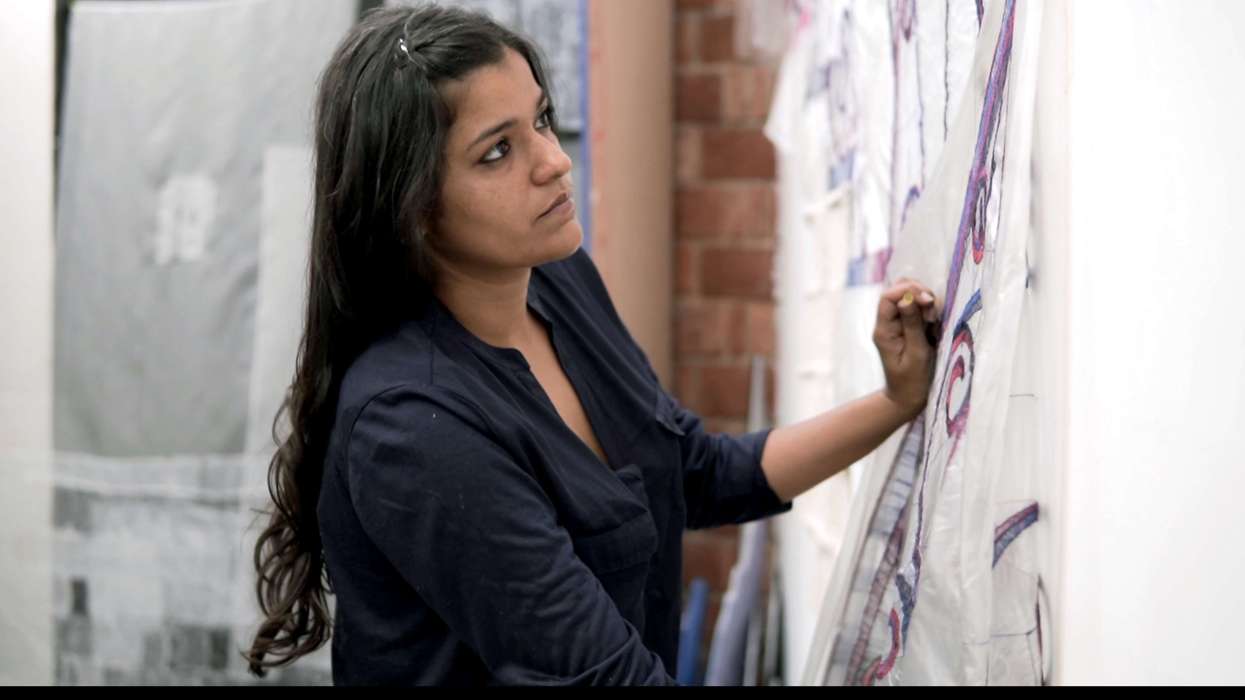

A BRIDGE can connect two places, but for artists Sumakshi Singh and Kaimurai, it can also represent something less tangible – memory, culture, spirituality and the relationships that exist between people.
Their works, developed in the context of an India-Korea cultural exchange, have been on display at the Whitworth in Manchester since July as part of the Hyundai Translocal Series: Entangled and Woven exhibition.
The exhibition brings together newly commissioned works by eight contemporary textile artists and collectives from Korea and India with historic Indian and Korean textiles from the Whitworth’s collection.
Singh uses thread to transform architectural forms into fragile, suspended structures, while Kaimurai works with khadi and indigo to explore questions of memory, spirituality, reflection and what connects people beneath differences of language and appearance.
Both artists were influenced by a research trip to Cheongju, Korea, where encounters with textile traditions, architecture, museums, temples and other cultural spaces prompted them to look beyond visual similarities and towards deeper connections between cultures.
Gurugram-based Singh’s contribution, Spanning the Void, takes the form of a fragile bridge made from thread.
Kaimurai, whose real name is Abishek Ganesh Jayashree and who is based in Bengaluru, showcases The Answer to All My Prayers Is in the Questions I Never Asked.
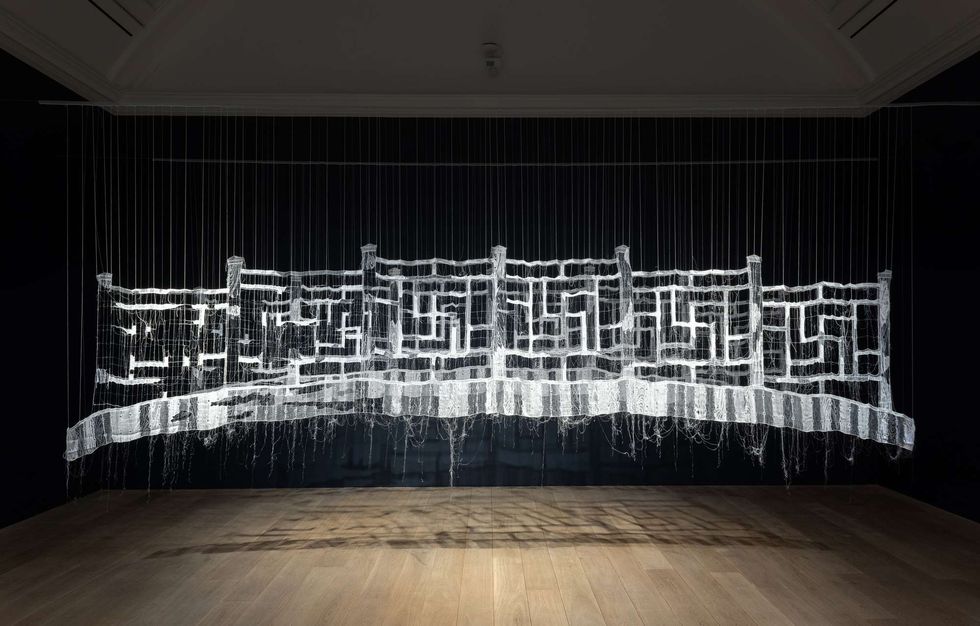 Sumakshi Singh’s Spanning the VoidMichael Pollard
It brings together indigo textile paintings with a traditionally cast bronze temple bell and a carved stone sphere, drawing on ritual practices and the symbolic role of bells in Korea and south Asia.
The exhibition places their contemporary works alongside textiles spanning more than 400 years, linking Manchester’s industrial textile history with wider histories of craft, exchange and human connection.
According to Singh, her work takes the form of a bridge inspired by one she encountered outside a temple in Cheongju.
She told Eastern Eye, “It immediately attracted my attention, not only because of its architectural form, but because of what it could represent within a project intended to create intercultural connections. I felt like the bridge was a perfect metaphor for that.”
The bridge Singh saw in Korea also carried a swastika symbol, which she associated with the historical movement of the symbol from India to Korea with the spread of Buddhism.
Kaimurai’s response to the Korea exchange was less about directly translating what was seen into visual form and more about the thoughts that emerged from the experience.
“My work has been evolving and the research trip made me reflect on the parallels in our cultures,” Kaimurai told Eastern Eye. “I started seeing that wherever we go, we might look different from each other and speak different languages, but the innate nature is one and the same.”
That thought became a starting point for his installation, and the title itself emerged during the process of working on it, as Kaimurai reflected on ideas of oneness, letting go of material desire and a form of higher thinking.
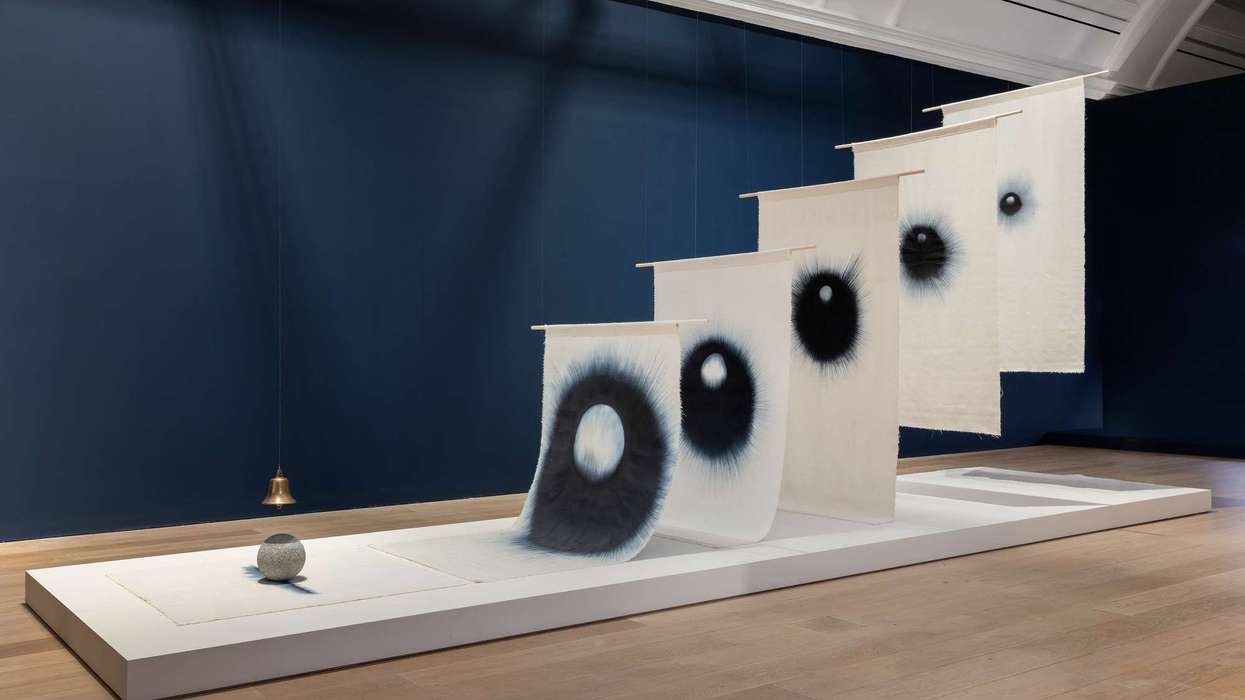 Kaimurai, “The answers to all my prayers are in the questions I never asked”, Hyundai Translocal Series_ Entangled and Woven installation (2026) the Whitworth, The University of Manchester. Photo by Michael Pollard
He added that the experience of visiting temples, museums and palaces, and particularly seeing bells, became a subconscious starting point for the work.
Thread has been central to Singh’s practice for reasons that are both personal and material. She grew up embroidering and knitting with the women in her family, giving thread an early association with community, intimacy and touch.
Her more sustained engagement with thread began after the death of her mother in 2013. In 2015, Singh started embroidering letters her mother had written to her.
Initially, the act was connected to preservation. But as she worked, Singh became conscious that she was trying to hold her mother’s words in place by stitching them into fabric.
She experimented with different surfaces before discovering soluble fabric. After the words had been embroidered, the fabric could be dissolved, leaving the words suspended in space.
Singh describes this as one of the most important aspects of creative practice – while an artist is refining something outside themselves, something inside can also change.
Kaimurai similarly describes the act of making as a reflective and contemplative process.
“My work is like a ritual,” Kaimurai said, describing sound, materials and memories as part of that process. “My work starts with wetting the fabric with water. I spend a lot of time doing that, which in-turn tells my hands what to do next.”
The importance of hands is also embedded in the name Kaimurai. The artist chose the name rather than using their own because, as the work develops, “my hands take over my mind”.
The name also acknowledges the many hands involved in making the materials used in the work. Kaimurai said that Kai means hand and Murai means method, describing the name as a small ode to the people whose hands have contributed to the making. “It is like a relay of channels in the flow of the materials and the work itself,” Kaimurai said.
Khadi and indigo are the key materials in the installation.
“These are the materials of my expression which I have been using for a while,” Kaimurai said. “It is like paper and pen for me. At least, for now.”
Singh, meanwhile, does not see her work as an attempt to balance India’s textile traditions with a contemporary artistic language. She was not trained as a textile artist or designer and comes from a background in painting and drawing. She moved into installation work around 25 years ago and has worked across different forms.
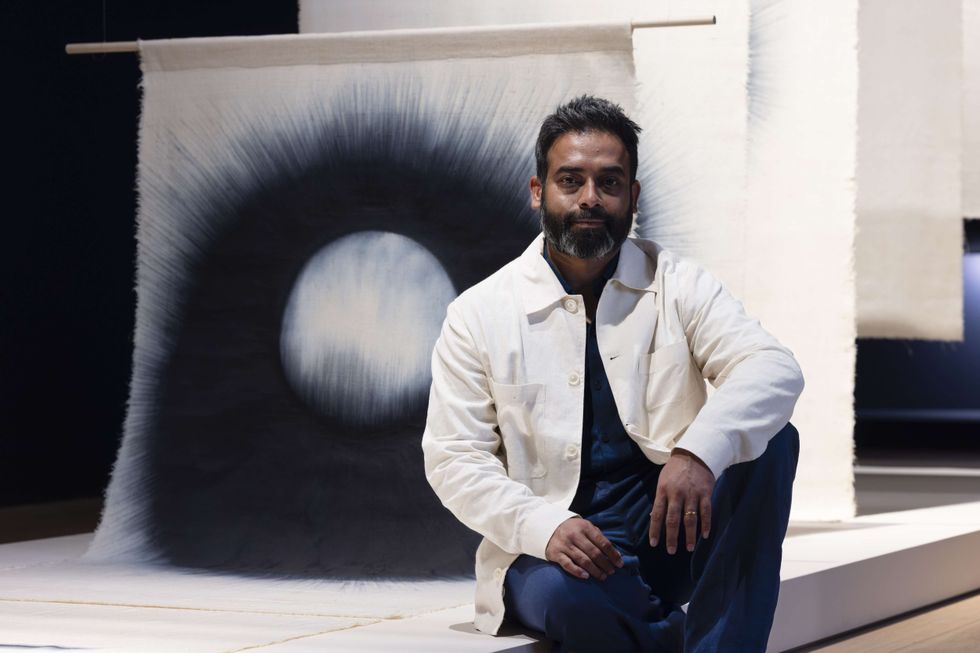 KaimuraiDavid Oates
The exhibition places particular emphasis on making as a social practice – one built on time, trust and shared knowledge rather than speed or mass production.
For the exhibition, Odisha-based art and fashion collective Boito brings together painting, weaving, embroidery and metalwork, drawing on regional mythology. PÉRO, founded by Aneeth Arora, presents garments developed through long-term collaboration with artisan communities across India, using weaving, embroidery and patchwork to explore memory, place and touch.
For Kaimurai, Manchester’s textile history is significant, particularly given the city’s historical impact on India. But the artist does not see that history as having directly shaped the work. “I am proud to show my work here which has a great history of textiles,” Kaimurai said.
Singh, however, believes the idea of cultural exchange ultimately comes back to the individual.
She is due to represent India at the 2026 Venice Biennale, an experience she describes as a great honour. Yet she is wary of the idea that one artist can represent an entire country.
“I don’t think anybody can represent India,” she said.
India is too complex, layered and contradictory, she said, to be reduced to one overarching cultural narrative. The more honest approach is to tell individual stories and allow them to coexist.