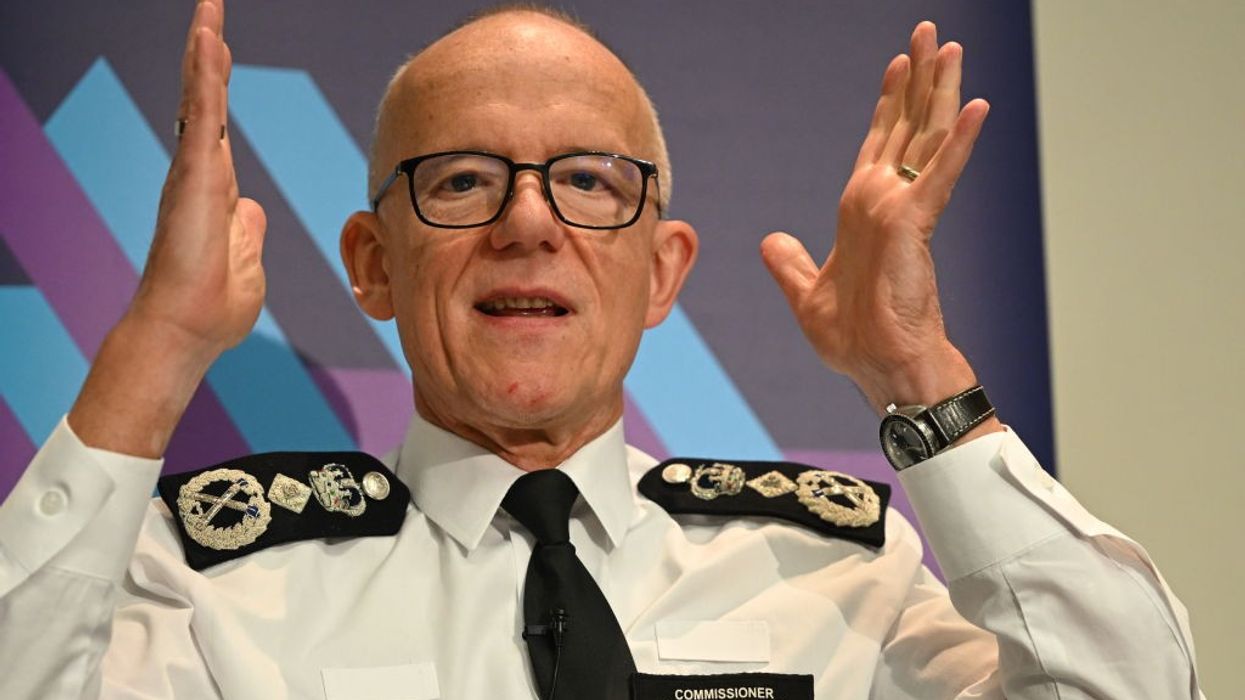

BRITAIN's top police officer has urged to close 'outrageous' gaps in hate crime laws, which he claims permit individuals to legally incite racial and religious hatred.
Metropolitan Police commissioner Sir Mark Rowley found it 'startling' that such incitement is possible as long as people avoid avoid being explicitly threatening or abusive.
His comments came in the wake of controversy surrounding the Met Police’s handling of hate crimes and protests related to the Israel-Hamas conflict. The police force has been criticised for its approach to policing these protests, with some demanding Sir Mark's resignation.
Senior Tory figures, including former home secretary Suella Braverman, and various campaign groups have pressured the police to ban large pro-Palestinian demonstrations. However, Sir Mark stated that the legal threshold for such a ban has not been met.
Sir Mark discussed the complexities of policing protests and hate crimes on the podcast A Muslim and a Jew Go There hosted by Baroness Sayeeda Warsi and comedian David Baddiel.
He pointed out that the Met has faced significant challenges in distinguishing between free speech and hate speech during these protests. He noted that while the police can impose certain conditions on protests, such as changing routes and timings, they do not have the power to ban protests outright.
"A march, so a moving gathering, there is a power in extremis to ban but we're nowhere near that threshold. If you listen to public rhetoric, you'd think we have the power to vanish this away, even if that was a good idea, which we don't," he was quoted as saying.
He added that the police are striving to minimise the negative impact of protests on communities, particularly Jewish communities in London, which have reported increased fear and anxiety due to the rise in antisemitic incidents.
Sir Mark disclosed that his team has been reviewing footage from the marches to spot any criminal offences, adding that the force has been actively monitoring protests to identify hate crimes and potential terrorist activities.
Furthermore, the police chief highlighted the potential role of hostile foreign states in exacerbating tensions surrounding the protests. He mentioned that countries such as Russia, Iran, and China, known for their espionage activities, could be trying to increase divisions within British society by influencing the debate around protest policing.
"I would be stunned if countries like Russia, Iran, and China weren't trying to add to the polarisation of debate about protest policing," he warned.
He also called for tighter laws to address inflammatory content online and urged politicians to consider plugging the gaps in current legislation to provide clear guidelines for social media platforms to remove harmful content.
"Having really tight laws is important, both for ourselves but also to be fair to social media platforms. It gives them a very clear duty to remove it," he said.
Despite the pressures and criticisms, Sir Mark told the podcast that he is committed to balancing the protection of free speech with the need to prevent hate crimes. He reiterated that the Met would continue to use its powers to impose conditions on protests to protect vulnerable communities and maintain public order.