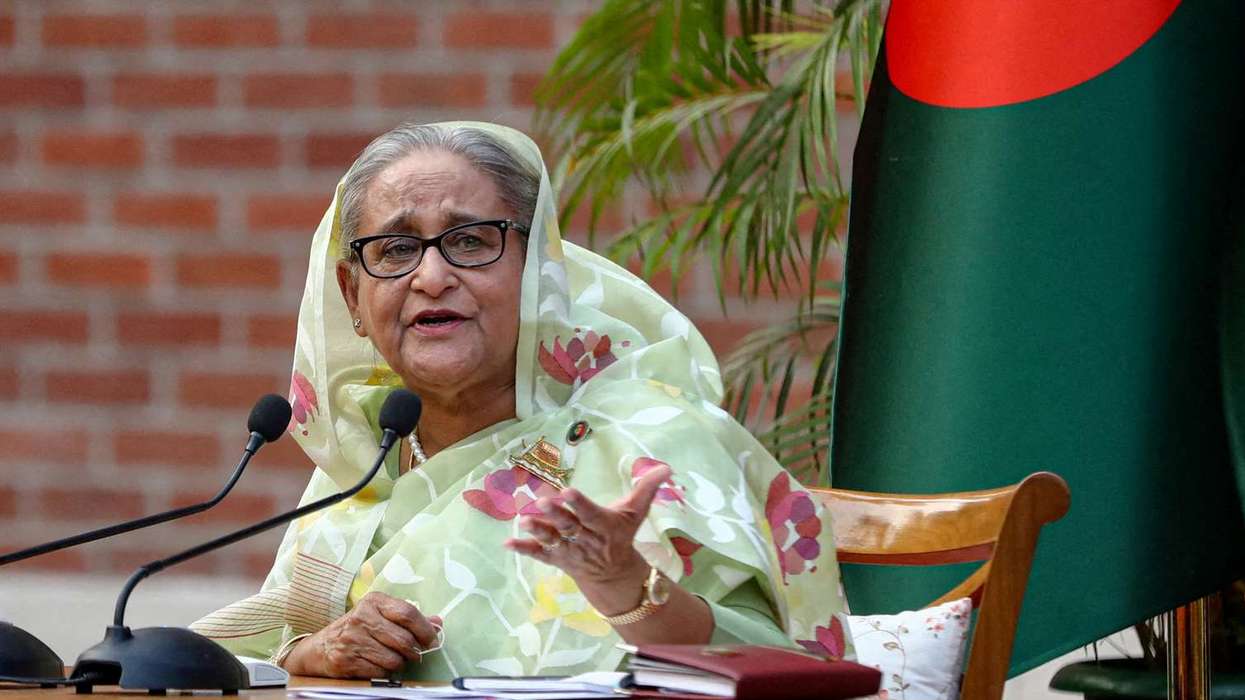

FORMER Bangladesh prime minister Sheikh Hasina on Wednesday said she would return to Bangladesh in December despite the possibility of imprisonment or even a death sentence, saying she was determined to stand with her people.
Speaking during an audio-only virtual press conference, her first public media interaction since fleeing to India on August 5, 2024 following mass protests, Hasina said she would not be stopped by fear. Those attending the event heard only her voice.
"I know, they may put me in jail or kill me," she said, adding "I will go back home to be with my people."
Hasina also described India as a "great friend" of Bangladesh, saying it had always stood by the country during difficult times.
The Awami League leader said her planned return was not about regaining power but about putting Bangladesh back on the path of development, secularism and prosperity.
"Whatever fate awaits me, I will return to Bangladesh to be with my people. I cannot stay away while my beloved countrymen are suffering," she said during the media interaction at the Foreign Correspondents' Club.
India Denies Role in Sheikh Hasina's Delhi Media Event
"I may be detained, I may be sent to prison, they may frame me in fabricated cases but fear cannot decide my duty to the people. My life is beyond the calculations of personal safety," she said.
Hasina also ruled out any back-channel negotiations with the Bangladesh Nationalist Party (BNP) government over her return.
"I am not worried about my own future. I am worried about the future of Bangladesh. I want to return because the people deserve security, development, prosperity and peace," she added.
The former prime minister said that although she had been "forced away" from Bangladesh, she had "never separated" from its people.
She said the people of Bangladesh deserved a state that protected them, an economy that gave them opportunities and a democracy that gave them rights.
"My return and the return of the Awami League to the democratic process is not about power, it is to put Bangladesh on the right track. It is about reviving the country's path of development, progress, secularism and stability," she said.
"I want to return to Bangladesh with one purpose: to stand with the people," she said.
Last November, Hasina was sentenced to death in absentia by a special tribunal in Dhaka for alleged "crimes against humanity" linked to her government's crackdown on student-led protests in 2024.
Since the verdict, Dhaka has been urging New Delhi to extradite her to face the law.
Hasina said the current situation in Bangladesh was disturbing.
"Fear has entered homes, workplaces, and educational campuses; this is not the Bangladesh we built."
"I call upon the international community and all the friends of Bangladesh to stand with the people of Bangladesh in their struggle for democracy, justice and peace," she said.
She also called for the ban on the Awami League to be lifted and demanded the release of political prisoners.
"The ban on Awami League must be lifted, political prisoners must be released, false cases must be dropped, freedom of speech must be restored, media freedom must be protected and judicial independence must be guaranteed," she said.
Hasina alleged that the protests in Bangladesh during July and August 2024, which led to the fall of her government, were not a peaceful student movement.
She alleged that "organised groups" turned the movement into a "violent political instrument".
"It was not simply a spontaneous students protest. There was no visible or responsible leadership. Instructions were given invisibly. It was organised and used to create a path to power outside the ballot box," Hasina alleged.
Asked whether she was in touch with the ruling dispensation in Dhaka, Hasina replied: "It is their matter what it will do. I have decided to go. I will go."
Although Hasina had given several e-mail interviews in recent months, this was her first media interaction since taking shelter in India.
Her son, Sajeeb Wazed Joy, claimed that political killings had been legalised in Bangladesh since August 2024.
"Bangladesh today is a failed state, there is no law and order in the country today," he said.
"What should concern New Delhi most is that Bangladesh has become another Pakistan on India's eastern border," he alleged.
Several senior Awami League leaders also addressed the news conference.
(With inputs from agencies)