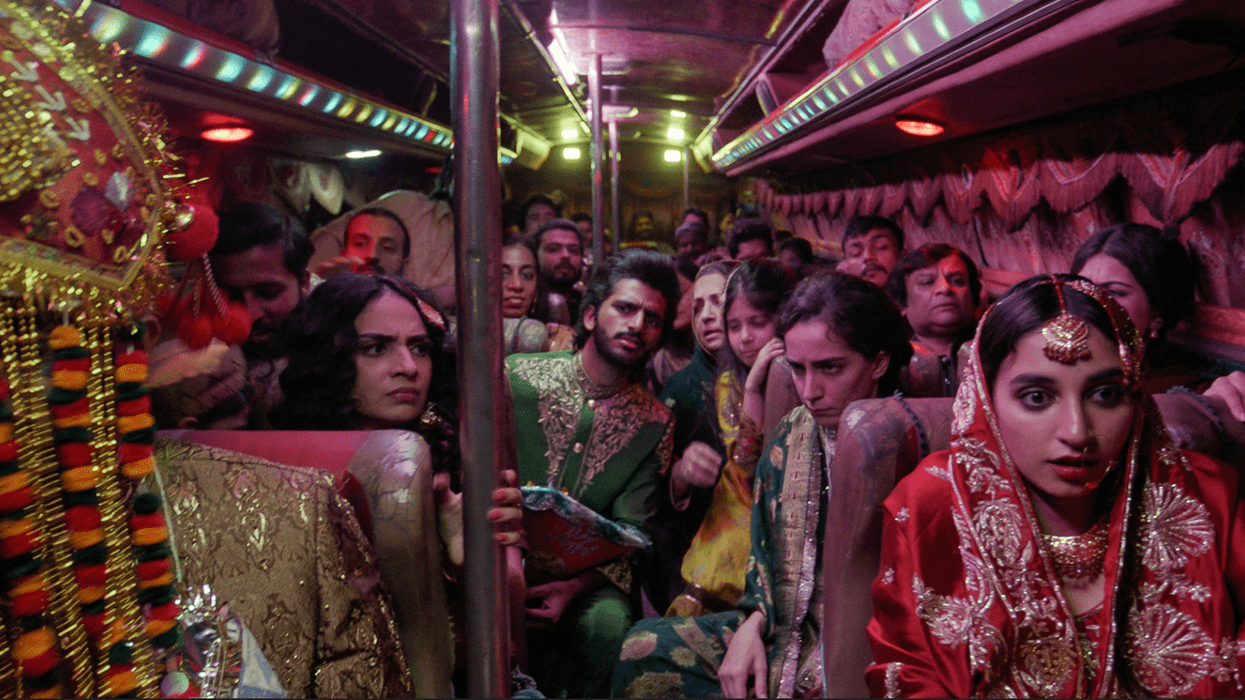

Highlights:
- Lali follows a woman whose past engagements ended in unexpected deaths.
- Mamya Shajaffar and Channan Hanif play newlyweds carrying secrets, fears and emotional scars.
- The film mixes pitch-black comedy with mystery, family drama and supernatural unease.
- Set in Sahiwal, Lali draws heavily on Punjabi culture, superstition and social expectations.
- After its Berlinale premiere, the film is now headed to the BFI London Film Festival.
What if the thing everyone fears about you becomes impossible to escape?
That question sits at the center of Lali, a darkly comic Pakistani film that begins with a young woman, a troubled marriage and a reputation that may be more powerful than reality itself.
Mamya Shajaffar plays Zeba, a young woman who has earned an unsettling reputation after the unexpected deaths of her previous fiancés. To the people around her, there is an obvious explanation: she is cursed.
Then comes Sajawal, played by Channan Hanif, a man who enters the marriage carrying plenty of baggage of his own. He has his fears, insecurities and a troubled past, making the couple less like a conventional romantic pairing and more like two damaged people trying to figure out whether they can trust each other.
And that is where Lali starts getting strange.
When marriage meets the supernatural
Zeba and Sajawal’s relationship gradually becomes a pressure cooker of desire, suspicion, grief and superstition. What initially looks like a story about an unconventional marriage begins to take on a more unsettling shape as the boundaries between the living and the dead start to blur.
The film does not appear interested in staying inside one genre for too long. It moves between pitch-black comedy, domestic drama, mystery and supernatural storytelling, using each to complicate the others.
The result is a story in which the question of whether Zeba is actually cursed becomes only part of the mystery. Just as important is the effect that belief has on the people around her.
Set in Sahiwal and steeped in Punjabi culture, Lali places its supernatural elements within a recognizable world of family relationships, marriage and community expectations. The film stars Shajaffar and Hanif alongside Rasti Farooq, Farazeh Syed, Mehar Bano and Juggan Kazim.
A strange reunion behind the camera
The film comes from director and co-writer Sarmad Sultan Khoosat, who has previously tackled complicated social and personal themes in films including Zindagi Tamasha.
Khoosat also produced Saim Sadiq’s Joyland, which became the first Pakistani film to compete in the Un Certain Regard section at the Cannes Film Festival.
There is another connection between Joyland and Lali: Sadiq returns to collaborate with Khoosat, this time as editor and casting director. The screenplay is written by Khoosat and Sundus Hashmi.
That creative partnership is particularly fitting for a film that seems to be interested in what happens when ordinary family life starts feeling increasingly surreal.
Rather than treating superstition simply as a horror device, Lali uses it as part of the world its characters inhabit — where fear, gossip and social expectations can become almost as powerful as anything supernatural.
From Berlin to London
Lali has already had an unusual start to its life. Earlier this year, it premiered in the Panorama section of the 76th Berlin International Film Festival, making history as the first fully Pakistani-produced feature film to premiere at the Berlinale.
Now, the film is making its way to the BFI London Film Festival, where it will screen as part of the festival’s 70th edition, running October 7–18, 2026, at venues across London and elsewhere in the UK.
For a film built around a woman everyone believes is cursed, Lali has already developed a story of its own beyond the screen.
But the real curiosity lies in what happens inside the film: whether Zeba is truly haunted, whether Sajawal can outrun his own demons, and whether the couple’s marriage is doomed by something supernatural, or by the fears and assumptions of the people around them.