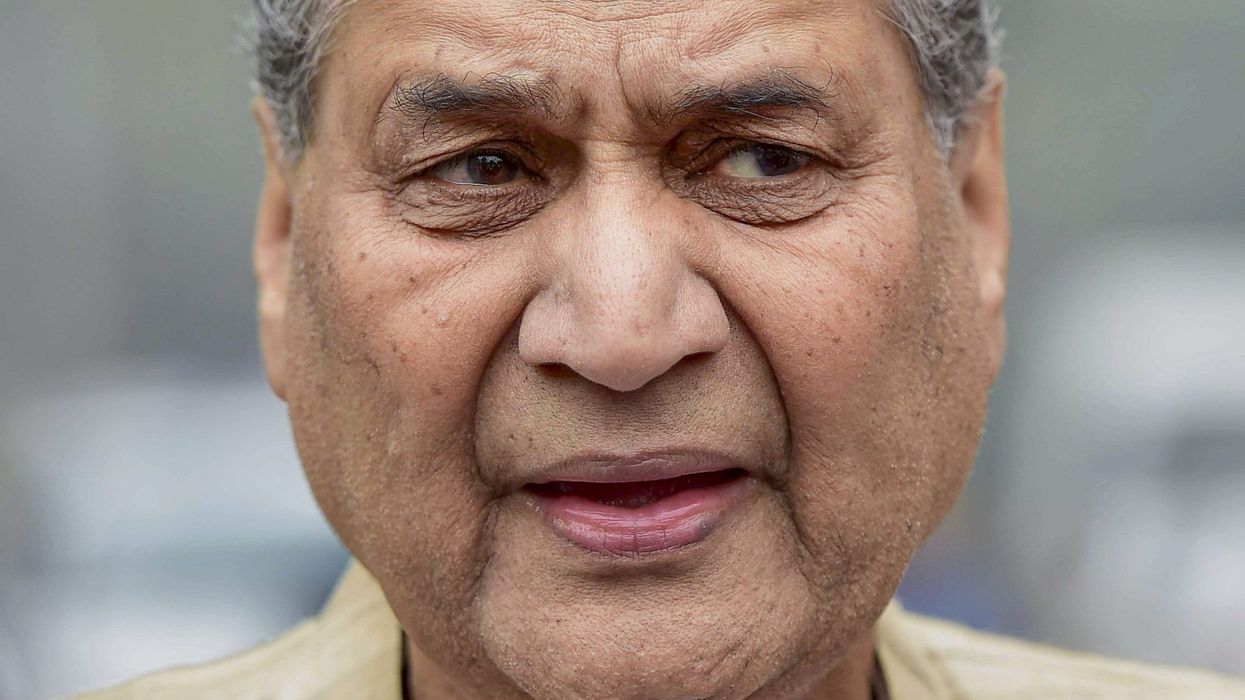
VETERAN industrialist Rahul Bajaj, whose name was synonymous with road transport in India, died Saturday (12) aged 83, his company said.
He "had not been keeping well", the Bajaj Group said in a statement, adding he would be cremated on Sunday in Pune, western India.
Bajaj was born into the Indian elite - his grandfather was one of Mahatma Gandhi's closest aides.
He led the eponymous family-owned conglomerate for more than 40 years and was best known for overseeing the stratospheric success of the Bajaj Chetak scooter in the 1970s and '80s.
The sturdy and affordable vehicle - based on a design by Italy's Vespa and named after the legendary horse ridden into battle by a Hindu Rajput king in the 1500s - became wildly popular with the Indian middle class following its 1972 launch.
But in the heavily regulated economy of the time, the firm was only allowed to make 6,000 units a year, leading at one point to a 10-year waiting list.
Bajaj was considered relatively clean in a country where corruption is widespread.
After stepping down as head of the firm in 2005, he served a term in the upper house of the Indian parliament, for the Congress party.
He was unusually outspoken for an Indian billionaire, many of whom seek to avoid conflict with the authorities.
After prime minister Narendra Modi's Bharatiya Janata Party came to power in 2014, Bajaj said industrialists feared criticising the government despite a plunging growth rate and a weak economy.
"If we criticise you there is no confidence that you will appreciate that," Bajaj had reportedly said at a private event in 2019 in the presence of home minister Amit Shah.
Last year, he expressed concerns over the impact of strict lockdowns imposed by the government to curb the spread of the coronavirus.
But Modi tweeted that he was "pained" by Bajaj's demise, adding that he would be remembered for his "noteworthy contributions to the world of commerce and industry" and was a "great conversationalist".
Fellow industrialists paid tribute, with Harsh Goenka, chairman of conglomerate RPG Group, tweeting: "The 'spine' of Indian business cracks."
Bajaj, he added, "was a visionary, straight-talking and very respected for his value systems. An era ends!"
Kiran Mazumdar-Shaw, the billionaire founder of Indian biotechnology company Biocon, said the country had "lost a great son & nation builder".
"I am devastated - he was a dear dear friend and will miss him dearly," she tweeted.
Bajaj was born on June 10, 1938, in the eastern Indian city of Kolkata.
After studying economics in New Delhi and law in Mumbai, he took an MBA from Harvard Business School in 1964 before joining the family business in Pune a year later.
The conglomerate was split into separate units in the 2000s following a family dispute.
But Bajaj Auto is now among the world's top 10 motorcycle-makers, and number one in three-wheelers, with a 72 per cent market share according to Autocarpro.
"Rahul Bajaj's passing is a big loss to India," tweeted Rahul Gandhi, the de facto head of Congress, now the main opposition party.
"We have lost a visionary whose courage made us proud."
(AFP)
Indian industrialist Rahul Bajaj dies at 83