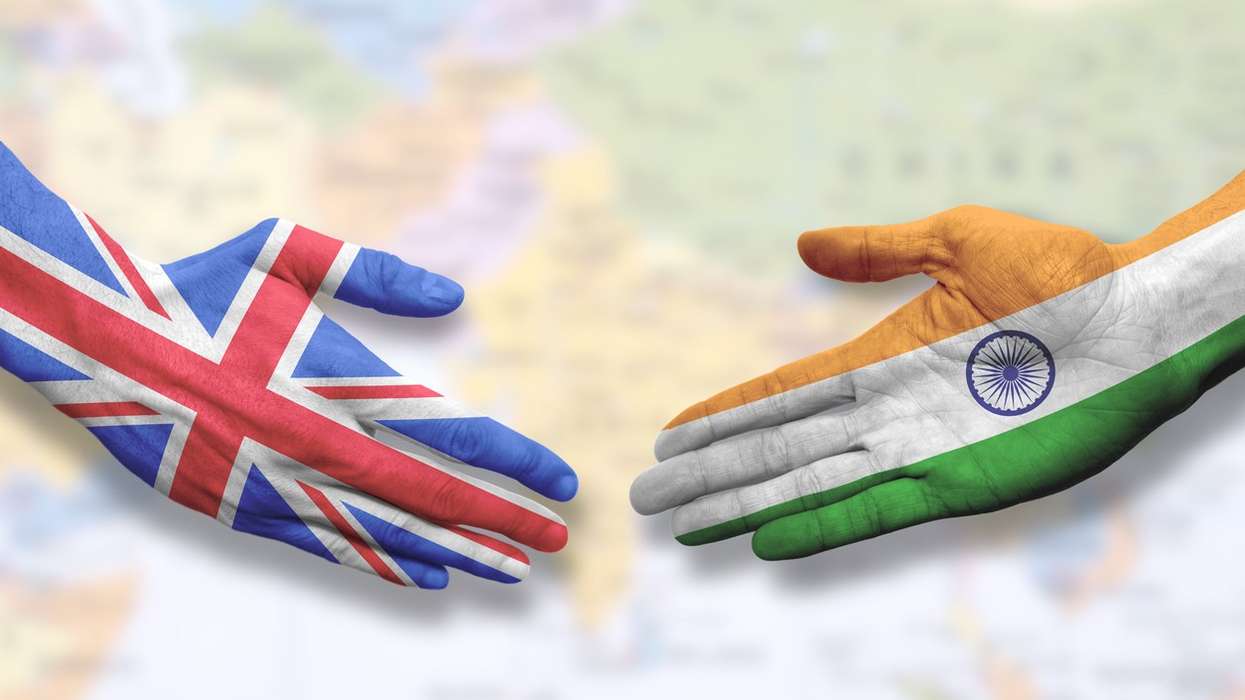

Data localisation and UK companies being allowed to bid for Indian government contracts are among the issues causing a possible deadlock in the final stages of the India-UK free trade agreement (FTA) negotiations towards a Diwali draft completion deadline, according to a UK media report on Sunday (9).
'The Daily Telegraph' quoted a source close to the talks to say that data localisation rules that prevent foreign companies taking data out of India and allowing UK firms to bid for public sector contracts are two key "sticking points" to a comprehensive deal. The likelihood of a so-called "thin" trade deal within the symbolic Diwali or October 24 deadline and further iterative deals at a later stage is now looking like a likely outcome.
"The stumbling blocks are absolutely to do with digital. How ambitious and comprehensive this deal is is in some way a function of time," the newspaper quoted an "insider" as saying. It follows UK Trade Secretary Kemi Badenoch indicating earlier this week that just because there may be an FTA struck with India, it did not mean "we can't do even more later". The Department for International Trade (DIT) also reiterated the government stance that any FTA would be agreed only if it meets the UK's interests.
"We remain clear that we won't sacrifice quality for speed and will only sign when we have a deal that meets the UK's interests, a UK government spokesperson said this week. It follows a week of controversial interventions that cast a shadow over the prospect of a wide-ranging bilateral trade agreement, with UK Home Secretary Suella Braverman expressing reservations over India being offered some sort of open borders visa concessions.
While India countered the minister's claims that a Migration and Mobility Partnership (MMP) between the two countries had not "worked very well" in tackling visa overstayers, strategic experts suggested that the wrangles may well end up in a diluted trade pact. The prospect of Prime Minister Narendra Modi's UK visit towards the end of the month to sign off on an FTA draft around Diwali is also seen as shaky at this stage.
"It now appears likely that the prospective UK-India FTA under the Liz Truss government will not be as substantive nor as comprehensive as envisaged by the previous Boris Johnson government, as negotiations on key issues of mobility/migration and tariffs can be expected to continue towards a non-time bound second-phase of the agreement, said Rahul Roy-Chaudhury, Senior Fellow for South Asia at the London-based International Institute for Strategic Studies (IISS) think tank.
"Negotiations on key issues of mobility/migration and tariffs can be expected to continue towards a non-time bound second-phase of the agreement. But, it will still enable both governments to claim political victory, even though its economic impact may be underwhelming for both, he said. The Diwali timeline for an FTA was announced enthusiastically by former prime minister Johnson during his visit to India in April.
The governing Conservative Party in the UK has since been thrown into turmoil and his embattled successor at Downing Street, Liz Truss, is believed to be very keen to score her big win by clinching a trade deal with one of the world's fastest growing economies a process she had initiated as former trade secretary.
The focus of the FTA negotiations is on reducing the barriers to trade, cutting tariffs, and supporting easier imports and exports into each other's markets. According to official UK government data, India-UK bilateral trade currently stands at around GBP 24.3 billion a year and the aim is for that to be at least doubled by 2030.
(PTI)