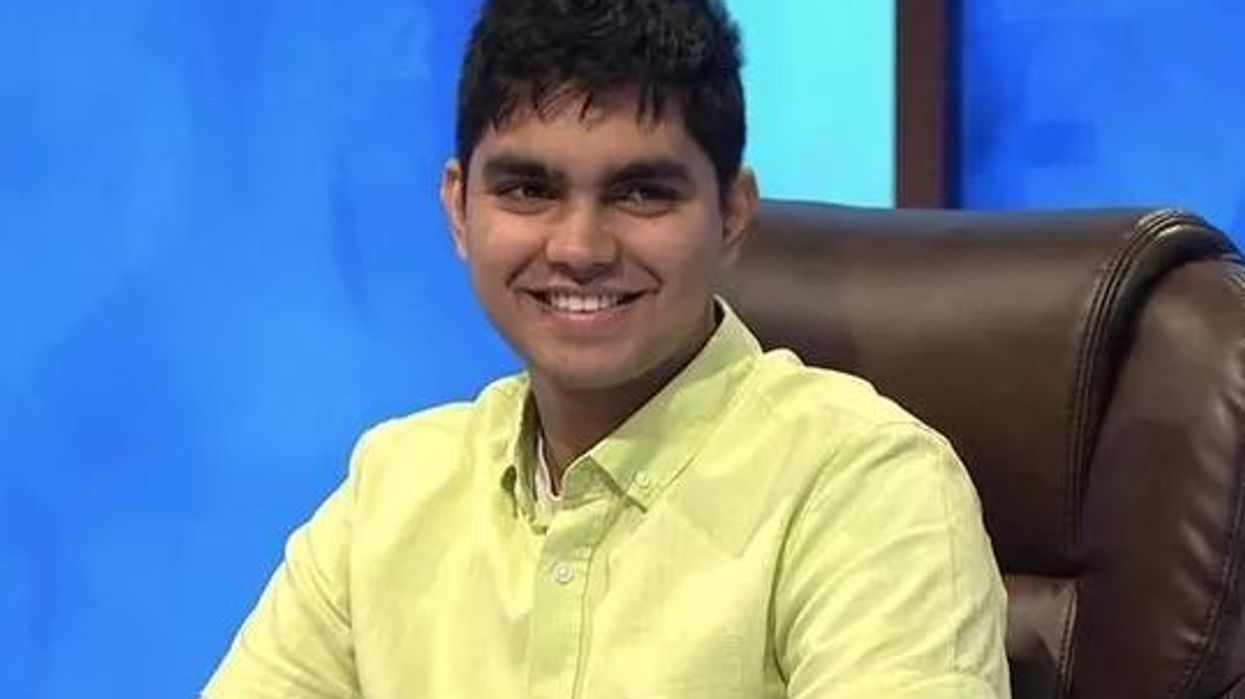

ETON scholar, who reached the knockout finals of Channel 4’s Countdown, now targets more TV success, reported The Guardian.
Jasamrit Rahala, 17, from Slough, identified as a maths prodigy aged nine, now targets University Challenge and Mastermind.
He was the youngest finalist on Child Genius aged 10 and competed in Britain’s Brightest Family.
Rahala is now studying double maths, physics and computer science A-levels at Eton College, after winning a king’s scholarship which covers his fees, the report added.
He applied to Countdown on his 16th birthday – the age limit for the show – but the pandemic meant he did not appear until he was 17. He was among the series’ top scorers, earning a place in the finals.
“I’ve always watched Countdown, since I was six or seven. And I noticed I would get the teatime teasers and decided as soon as I could I would apply,” Rahala told The Guardin.
“I like computer science and maths, and I guess it’s pattern recognition." His next game will air on 17 December.
Rahala was identified as a gifted pupil in year 3 and achieved a maximum 162 Mensa IQ score at 11, but his talent has occasionally proved challenging for his parents.
He lives with his father Santokh, mother Sardeep, a part-time NHS healthcare assistant, and sister Tania, 12, in a two-up, two-down in Slough. His father said he was embarrassed to admit he didn’t spot his son’s potential early on.
“I was working every hour to make ends meet, long hours, and travelling to and from work,” Santokh, 55, told the newspaper.
He is now a work coach for the Department for Work and Pensions after being made redundant from a 20-year job as a buyer for a food and drink company during the pandemic.
"Parents don’t know what to do when they have a clever child, and nor do schools. We encouraged our children to spend one hour a day on maths and another on English in addition to their school homework. We are just super proud of him," Santokh told The Guardian.
With money tight, Santokh scoured charity shops and car boot sales “finding old books wherever I could find them,” to encourage his son’s talent. “Our family motto is: poor books, rich words,” he said.
Rahala scored top marks in the 11-plus and passed entrance exams for five fee-paying private schools. However, owing to the family’s finances he went to Herschel grammar school, within walking distance of home.
At 13 he was accepted at Eton, and he now hopes to attend a top university studying computer science.
He plays the violin, rows, plays badminton and hockey, has volunteered at his local Sikh temple and tutors online.
“When I applied to Countdown, the only thing going through my mind was not to get knocked out in the first round. I do these things just for the fun of it. If it goes wrong, it goes wrong, and if it doesn’t it’s a nice experience,” the teenager told the newspaper.
Now he is trying to muster a team for the BBC Two show Only Connect.